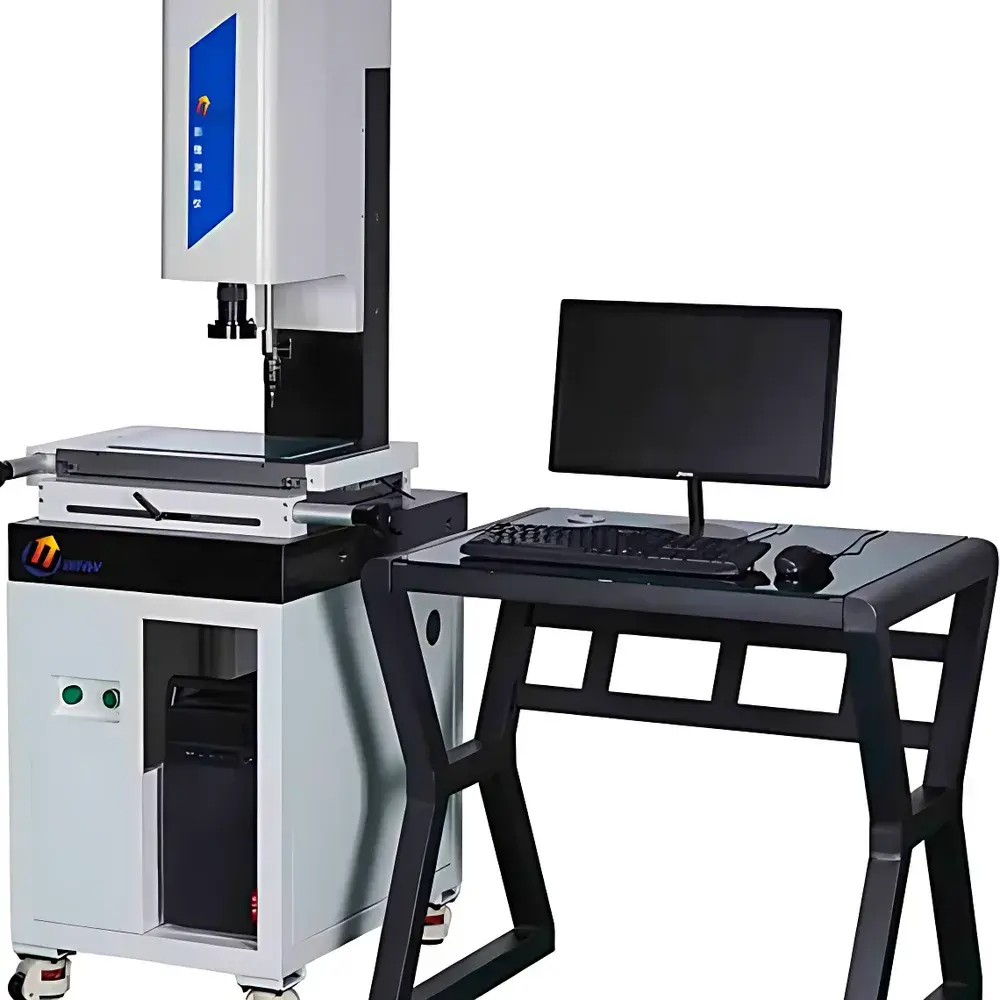
YANRUN YR3020CNC-T Probe-Integrated Fully Automated 3D Vision Measuring System
| Brand | YANRUN |
|---|---|
| Origin | Shanghai, China |
| Manufacturer Type | OEM Manufacturer |
| Country of Origin | China |
| Model | YR3020CNC-T |
| Operation Mode | Fully Automatic |
| XY-Axis Measurement Accuracy | (3 + L/200) µm |
| Z-Axis Measurement Accuracy | (5 + L/200) µm |
| Enclosed Linear Encoder Resolution | 1 µm |
| XY-Axis Travel Speed | 280 mm/s |
| Z-Axis Travel Speed | 100 mm/s |
| Optical Magnification | 0.7×–4.5× |
| System Magnification | 21×–200× |
| Camera | Hikvision GigE Color Industrial Digital Camera |
| Surface Illumination | 5-Ring 8-Zone LED Cold Light Source, 256-Level Brightness Adjustment |
| Edge Illumination | LED Cold Light Source, 256-Level Brightness Adjustment |
| Probe System | Renishaw MCP 3D Touch Probe |
| Probe Tips | Renishaw Ruby Spherical Tips (Φ1 mm & Φ2 mm) |
| Base & Column Material | Grade-0 Granite (Flatness ≤3 µm) |
| Motion Guidance | Precision Crossed-Roller Bearings |
| Drive System | DC Servo Motors |
| Focus Method | Auto-Focus |
| Max Load Capacity | 25 kg |
| Working Envelope | 300 × 200 × 180 mm |
| Dimensions (W×D×H) | 480 × 780 × 900 mm |
| Weight | 180 kg |
| Power Supply | 200–240 V AC, 50/60 Hz, Single Phase, 700 W |
| Operating Temperature | 20 °C ±2 °C |
| Relative Humidity | 30–80 % RH |
| Vibration Sensitivity | <0.002 g, <15 Hz |
Overview
The YANRUN YR3020CNC-T is a probe-integrated, fully automated 3D vision measuring system engineered for high-precision geometric metrology in regulated manufacturing and quality assurance environments. Combining non-contact optical imaging with tactile probing capabilities, it operates on the principle of coordinate metrology—where dimensional data are acquired via synchronized spatial referencing across X, Y, and Z axes using calibrated granite-based kinematic architecture. The system integrates a high-resolution GigE color industrial camera, a 6.5:1 zoom telecentric lens, and a Renishaw MCP 3D touch probe to support hybrid measurement strategies: optical edge detection for planar features (e.g., circles, slots, contours), and mechanical contact probing for recessed, occluded, or non-reflective surfaces (e.g., threaded holes, stepped shoulders, internal radii). Its closed-loop 1 µm resolution linear encoders, coupled with DC servo-driven motion control and auto-focus height mapping, ensure traceable repeatability under ISO 10360-2 and VDI/VDE 2617 compliance frameworks.
Key Features
- Fully CNC-controlled triaxial motion platform with grade-0 granite base and column (flatness ≤3 µm), ensuring thermal stability and long-term geometric integrity.
- Hybrid sensor architecture: simultaneous operation of optical imaging (0.7×–4.5× optical / 21×–200× system magnification) and tactile probing (Renishaw MCP probe with ruby-tipped Φ1 mm and Φ2 mm styli).
- Intelligent illumination management: independently controllable 5-ring 8-zone surface LED source and edge-optimized cold LED backlight, both adjustable in 256 brightness steps for optimal contrast across diverse material finishes.
- Auto-focus height mapping with sub-micron repeatability, enabling precise Z-axis dimensional analysis and surface topography profiling without manual intervention.
- Real-time temperature compensation algorithm that applies coefficient-of-thermal-expansion corrections based on ambient sensor input (20 °C ±2 °C reference), improving dimensional accuracy for aluminum, steel, and polymer components.
- Robust motion performance: XY-axis travel speed up to 280 mm/s and Z-axis at 100 mm/s—optimized for throughput in high-volume inspection routines while maintaining metrological integrity.
Sample Compatibility & Compliance
The YR3020CNC-T accommodates workpieces up to 300 × 200 × 180 mm and 25 kg, supporting machined metal parts, injection-molded plastics, PCB assemblies, precision stamped components, and micro-mechanical devices. Its dual-mode sensing enables reliable measurement of features ranging from 10 µm edges (via texture-enhanced contour extraction) to 50 mm deep cavities (via probe tip articulation). The system complies with foundational metrological standards including ISO 10360-2 (CMM performance verification), ISO 14253-1 (geometrical product specifications), and ASTM E1316 (terminology for non-destructive evaluation). Environmental operating conditions align with ISO 22057 for coordinate measuring machines—requiring controlled lab environments (20 °C ±2 °C, ≤0.002 g vibration, 30–80% RH) to maintain stated accuracy budgets.
Software & Data Management
The proprietary CNC4000 control suite and CNC Smart Metrology Software provide full GLP/GMP-aligned data governance. Key capabilities include: automated task sequencing with .rst file logging; audit-trail-enabled measurement history (per FDA 21 CFR Part 11 requirements); SPC-ready statistical analysis (Cp/Cpk, X̄-R charts, outlier detection); multi-format reporting (Excel, Word, PDF, DXF, AutoCAD DWG); CAD-to-part deviation mapping with GD&T overlay; and real-time classification of measurement primitives (in-spec, out-of-tolerance, unmeasured). The software supports multilingual UI (English, Simplified/Traditional Chinese, Japanese, Korean), automatic lens calibration (eliminating full recalibration cycles), and seamless integration with enterprise MES/QMS platforms via CSV export and RESTful API hooks.
Applications
This system serves Tier-1 automotive suppliers performing GD&T validation on engine manifolds and brake calipers; medical device manufacturers verifying ISO 13485-compliant orthopedic implant geometries; electronics contract manufacturers inspecting BGA pad alignment and solder mask registration; and precision optics fabricators certifying lens mount concentricity and flange flatness. It is routinely deployed for first-article inspection, in-process SPC monitoring, supplier qualification audits, and FAI documentation per AS9102. The probe-integrated design eliminates the need for separate CMM workflows when evaluating form errors (e.g., cylindricity, profile of a surface) or datums requiring physical contact.
FAQ
Does the YR3020CNC-T support calibration traceability to national standards?
Yes—system-level verification follows ISO 10360-2 protocols, and all encoder and probe calibration certificates are issued with NIST-traceable references.
Can the software generate compliant PPAP documentation?
Yes—customizable Excel and PDF templates include full GD&T callouts, measurement uncertainty statements, and operator/timestamp audit trails required for Level 3 PPAP submissions.
Is offline programming supported?
Yes—CAD-based feature recognition allows full measurement sequence development offline; programs can be validated via simulation prior to hardware execution.
What is the typical measurement uncertainty for a 10 mm diameter circle measured optically?
Under standard environmental conditions and using best-practice edge detection algorithms, expanded uncertainty (k=2) is ≤±1.8 µm for diameter, consistent with the (3 + L/200) µm specification.
How does the system handle reflective or translucent materials?
The 5-ring 8-zone surface illumination enables directional light modulation to suppress glare; combined with multi-threshold edge extraction and texture segmentation, it reliably detects features on anodized aluminum, polycarbonate lenses, and glass substrates.