
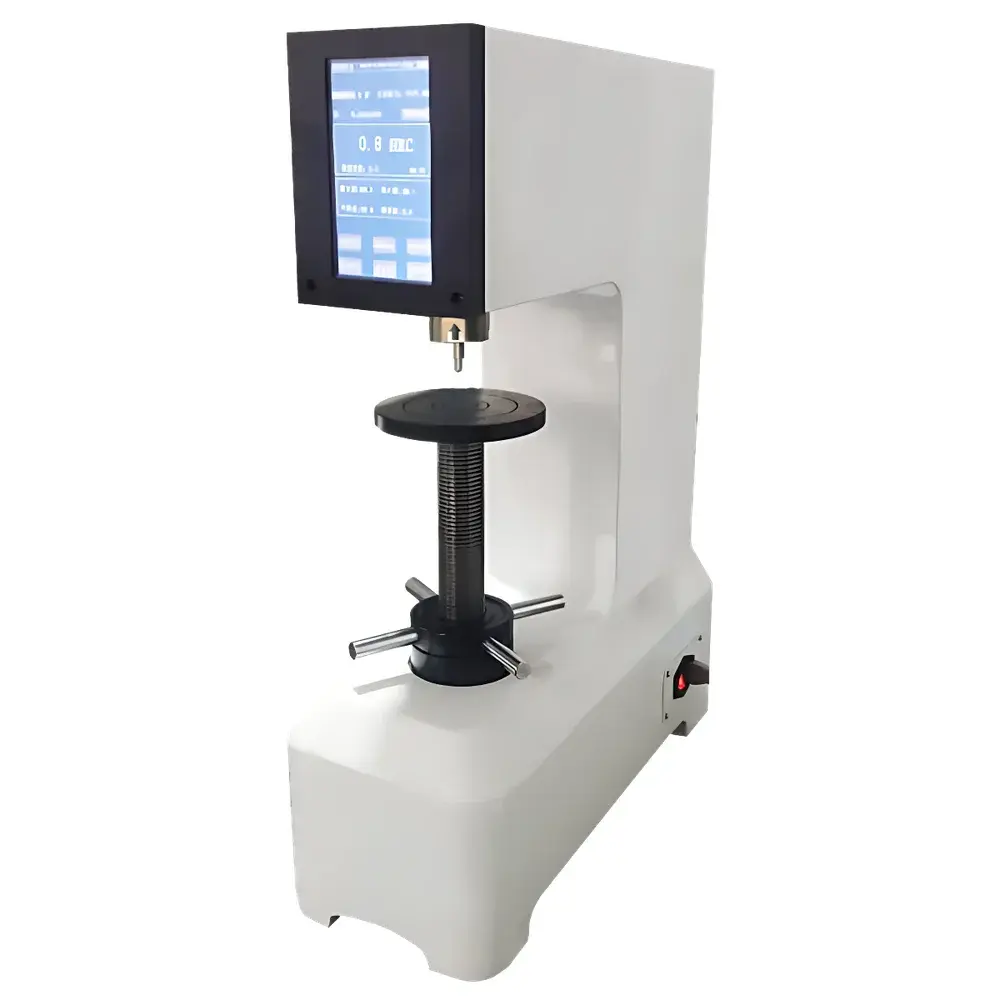
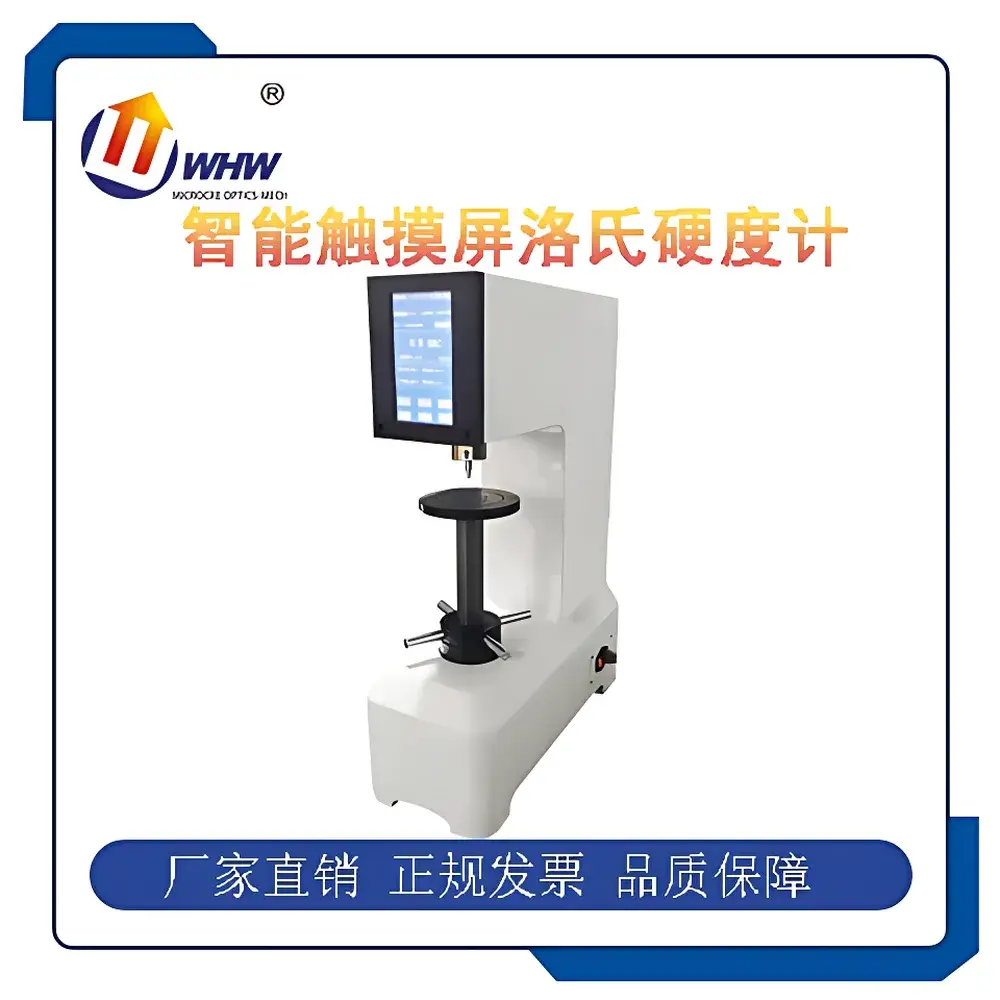
YANRUN YXHRI-150M Sensor-Actuated Touchscreen Plastic Rockwell Hardness Tester
| Brand | YANRUN |
|---|---|
| Origin | Shanghai, China |
| Manufacturer Type | Direct Manufacturer |
| Product Category | Domestic (China-made) |
| Model | YXHRI-150M |
| Instrument Type | Rockwell Hardness Tester |
| Hardness Scales | HRA: 20–95 |
| HRBW | 10–100 |
| HRC | 20–70 |
| HR15N | 70–91 |
| HR30N | 42–80 |
| HR45N | 20–70 |
| HR15T | 73–93 |
| HR30T | 43–82 |
| HR45T | 12–72 |
| Total Test Forces | 588 N (60 kgf), 980 N (100 kgf), 1471 N (150 kgf) |
| Preliminary Force | 98.07 N (10 kgf) |
| Hardness Resolution | 0.1 HR |
| Maximum Specimen Height | 180 mm |
| Indenter-to-Column Distance | 160 mm |
| Load Holding Time Range | 0–99 s (adjustable in 1-s increments for preliminary, total, and return phases) |
| Compliance Standard | GB/T 3398.2–2008 |
| Dimensions (W×D×H) | 530 × 210 × 780 mm |
| Weight | ~90 kg |
| Power Supply | 220 V AC |
Overview
The YANRUN YXHRI-150M is a fully automated, sensor-actuated Rockwell hardness tester engineered specifically for polymer-based and low-to-medium hardness materials. It operates on the standardized Rockwell principle—applying a preliminary minor load followed by a major load, then measuring the permanent depth deformation of an indenter (either diamond cone or hardened steel ball) to derive a dimensionless hardness number. Unlike traditional mechanical lever-based systems, the YXHRI-150M employs closed-loop force feedback control via high-precision load sensors, ensuring consistent and traceable application of test forces across all Rockwell scales—including conventional (A, B, C, R, L, M) and superficial (15N, 30N, 45N, 15T, 30T, 45T) scales. Its cast-iron frame provides exceptional rigidity and long-term dimensional stability, minimizing vibration-induced measurement drift during extended testing cycles. Designed for ISO/IEC 17025-aligned laboratories and industrial QC environments, the instrument meets the metrological requirements defined in GB/T 3398.2–2008—the Chinese national standard equivalent to ISO 2039-2 for plastics hardness testing—and supports routine calibration verification per ASTM E18 and ISO 6508.
Key Features
- Full-color capacitive touchscreen interface with intuitive menu-driven navigation—no external PC required for operation or configuration.
- Closed-loop sensor-controlled loading system ensures ±0.5% force accuracy across all three major test force levels (60, 100, and 150 kgf), eliminating mechanical hysteresis and reducing operator-induced variability.
- Integrated thermal-stable cast-iron base and column architecture minimizes deflection under load and maintains geometric integrity over decades of use—even in non-climate-controlled production floors.
- Digital hardness readout with 0.1 HR resolution; real-time display of load curve, dwell time, and scale selection during test execution.
- Onboard micro-printer enables immediate hard-copy documentation of test results, including date/time stamp, specimen ID, scale used, and measured value—critical for GLP/GMP audit trails.
- Automatic cylindrical surface correction algorithm compensates for curvature effects when testing rods, pipes, or other non-planar geometries—eliminating manual interpolation errors.
- Multi-scale conversion engine supports direct output in HRC, HV, HK, HBW, HRA, HRD, and all standard N- and T-series superficial scales—facilitating cross-material comparisons without external software.
Sample Compatibility & Compliance
The YXHRI-150M is optimized for non-metallic and soft metallic materials requiring precise, repeatable indentation characterization. It accommodates specimens up to 180 mm in height and supports flat, convex, and concave surfaces via interchangeable anvils (large flat, medium flat, and V-groove). Validated applications include rigid thermoplastics (e.g., PMMA, PC, ABS), thermoset composites, elastomeric friction linings, phenolic resins, laminated paperboard, aluminum and tin alloys, copper sheet, and low-carbon steels. All measurements comply with GB/T 3398.2–2008 (plastics), ASTM D785 (plastics and nonmetallic materials), and ISO 2039-2. The system’s force control architecture satisfies the repeatability and reproducibility criteria outlined in ISO/IEC 17025 Clause 7.7 for hardness testing equipment, and its data logging functionality supports FDA 21 CFR Part 11 compliance when paired with validated laboratory information management systems (LIMS).
Software & Data Management
While the YXHRI-150M operates autonomously via embedded firmware, it includes USB and RS-232 interfaces for bidirectional data exchange. Raw test records—including timestamp, scale, force profile, indentation depth, hardness value, and user-defined sample ID—are exportable as CSV or TXT files for statistical process control (SPC) analysis. Firmware supports configurable pass/fail thresholds, batch reporting, and multi-user access levels (operator, supervisor, administrator). Audit logs record all parameter changes, calibration events, and print actions with immutable timestamps—enabling full traceability for internal audits and regulatory inspections. No proprietary software installation is required; exported datasets integrate natively with Excel, Minitab, JMP, and enterprise QMS platforms.
Applications
- Quality assurance of injection-molded plastic components in automotive and medical device manufacturing.
- Verification of heat-treatment uniformity in aluminum alloy extrusions prior to anodizing.
- Batch release testing of rubber gaskets and sealing compounds against ASTM D2240 Shore A correlation curves.
- R&D evaluation of polymer nanocomposites where subtle filler dispersion effects influence surface hardness.
- Failure analysis of delaminated laminates or degraded thermoset matrices using localized superficial scale mapping (e.g., HR15N).
- Calibration lab verification of reference hardness blocks per ISO 6507-3 and ISO 6508-3 protocols.
FAQ
What Rockwell scales does the YXHRI-150M support?
It supports HRA, HRB, HRC, HRD, HRF, HRG, HRK, HRL, HRM, HRR, HRBW, HR30TW, HR15N, HR30N, HR45N, HR15T, HR30T, and HR45T—all compliant with ASTM E18 and GB/T 3398.2.
Is the instrument suitable for testing curved surfaces?
Yes—built-in cylindrical correction algorithms automatically adjust hardness values for specimens with radii ≥5 mm, provided appropriate V-anvils or custom fixtures are used.
Does the system meet international calibration traceability requirements?
Yes—the load cell is factory-calibrated against NIST-traceable deadweight standards, and the instrument supports periodic verification using certified reference blocks per ISO 6508-3.
Can test data be exported to LIMS or ERP systems?
Yes—via USB mass storage mode or serial ASCII protocol; no drivers or middleware required.
What maintenance is required for long-term accuracy?
Annual verification of force application and indenter geometry is recommended; routine cleaning of the indenter and anvil surfaces with isopropyl alcohol is sufficient for daily operation.
Related Products



