
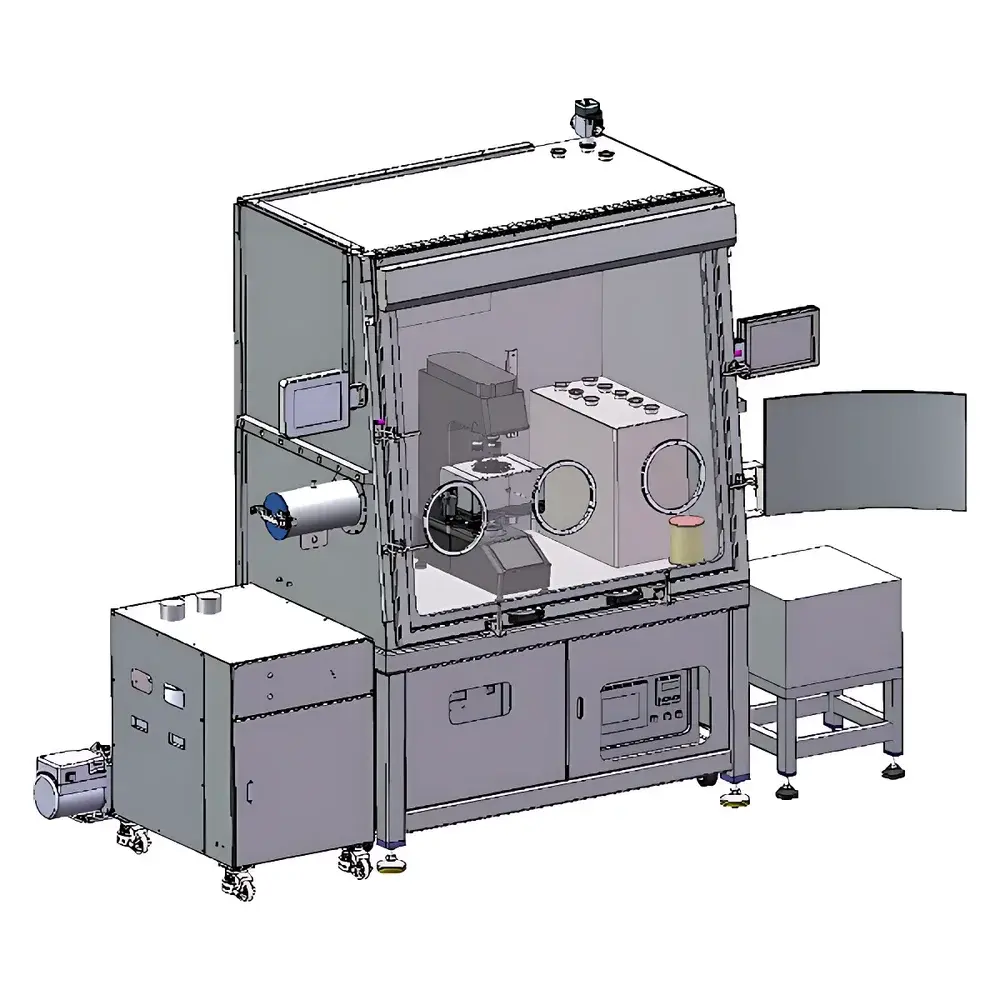
YANRUN HMAS-HT1200 Full-Temperature-Field High-Temperature Vickers Hardness Tester
| Brand | YANRUN |
|---|---|
| Origin | Shanghai, China |
| Manufacturer Type | Direct Manufacturer |
| Instrument Type | Vickers Hardness Tester |
| Operating Temperature Range | 200–1200 °C |
| Load Range | 1–30 kgf (standard), up to 150 kgf (optional) |
| Optical Magnification | 10× objective (20× optional), system magnification up to 2000× |
| Temperature Control Accuracy | ±1 °C |
| Temperature Field Uniformity | ≤±5 °C |
| Heating Element | Silicon Carbide Rods |
| Thermocouple Type | S-type |
| Maximum Sample Size | Ø20 mm × 20 mm |
| Load Application Method | Force-controlled, fixed-step loading (16/32/61/127 steps optional) |
| Load Resolution | 0.01% FS |
| Hold Time | Up to 30 min |
| Auto Sample Exchange Time | ≤20 s within isothermal field |
| Motion Control | 4-axis synchronized, positioning accuracy ≤±1.5 µm, resolution ≤0.1 µm |
| Objective Resolution | 1.44 µm (10×), 1.19 µm (20×) |
| Cooling Options | Recirculating water (13 L/min), inert gas quench (≤10 s), or forced-air (4-nozzle, 90° angle) |
Overview
The YANRUN HMAS-HT1200 is a full-temperature-field high-temperature Vickers hardness tester engineered for in-situ mechanical property characterization of advanced materials under controlled thermal conditions ranging from 200 °C to 1200 °C. Unlike conventional hot-stage microhardness systems that isolate heating and indentation, the HMAS-HT1200 integrates a precision furnace, high-temperature load train, and optically compatible imaging path into a single thermally homogeneous chamber—enabling true isothermal indentation with real-time observation. The instrument operates on the principle of diamond pyramid indentation under calibrated static load, followed by optical measurement of diagonal lengths in the residual impression; hardness values are calculated per ASTM E384 and ISO 6507-1, with direct traceability to SI units via force transducer calibration. Its design accommodates dynamic thermal protocols—including ramp-and-hold, stepwise temperature gradients, and cyclic thermal-mechanical loading—making it suitable for evaluating creep resistance, thermal softening behavior, phase-dependent hardness transitions, and interfacial stability in ceramics, refractory alloys, CMCs, and nuclear fuel cladding materials.
Key Features
- Full-temperature-field architecture ensures uniform thermal distribution (≤±5 °C gradient) across an 80 × 80 × 60 mm furnace cavity, eliminating thermal drift during indentation and imaging.
- High-temperature optical path supports real-time in-chamber observation at 10× or 20× magnification (system magnification up to 2000×), with diffraction-limited resolution down to 1.19 µm.
- Four-axis synchronized motion control (X/Y/Z/sample Z-A/indenter Z-B) enables precise positioning, multi-point mapping, and automated indentation arrays—all maintained within the 1200 °C environment.
- Fast sample exchange mechanism completes specimen replacement in ≤20 seconds without thermal interruption, supporting high-throughput comparative studies across alloy batches or thermal histories.
- Modular load train delivers calibrated forces from 1 to 30 kgf (extendable to 150 kgf), with force resolution of 0.01% full scale and accuracy of ±0.5% above 1 kgf—validated per ISO 14577-2 requirements.
- Integrated pre-heating module heats indenter and sample holder to target temperature prior to loading, minimizing thermal lag and ensuring mechanical equilibrium at the moment of contact.
- Optional glovebox integration (H₂O/O₂ ≤1 ppm) allows testing of oxidation-sensitive materials under inert or vacuum atmospheres, with dual-lock transition chambers for safe sample transfer.
Sample Compatibility & Compliance
The HMAS-HT1200 accepts cylindrical or disc-shaped specimens up to Ø20 mm × 20 mm, compatible with metallic superalloys (e.g., Inconel 718, Hastelloy X), oxide and non-oxide ceramics (Al₂O₃, SiC, ZrO₂), metal matrix composites, and coated systems. All critical subsystems—including furnace insulation, thermocouple placement, load train materials, and optical windows—are qualified for continuous operation at 1200 °C under inert gas purge. The system complies with essential safety and metrological standards including IEC 61000-6-2 (EMC immunity), EN 61000-6-4 (EMC emission), and ISO/IEC 17025 traceability frameworks for hardness calibration. When configured with audit-trail-enabled software and electronic signature modules, it meets documentation requirements for GLP and GMP environments per FDA 21 CFR Part 11.
Software & Data Management
The embedded control platform runs on a wall-mounted industrial PC with deterministic real-time scheduling, managing coordinated sequences of temperature ramping, load application, dwell timing, image capture, and stage movement. Image analysis algorithms automatically detect indentation diagonals using sub-pixel edge detection and apply ASTM E384-compliant area correction for non-ideal impressions. Raw data—including load-time-displacement curves, thermal profiles, pixel-calibrated images, and metadata (operator ID, timestamp, environmental conditions)—are stored in vendor-neutral HDF5 format. Export options include CSV, XML, and PDF reports compliant with ISO/IEC 17025 clause 7.8. Optional network connectivity enables remote monitoring, centralized database synchronization, and integration with LIMS platforms via OPC UA or RESTful API interfaces.
Applications
- High-temperature hardness mapping of turbine blade coatings during thermal cycling simulations.
- In-situ evaluation of fracture toughness (KIC) via Palmqvist or median crack length analysis at elevated temperatures.
- Creep-hardness correlation studies in Ni-based alloys subjected to sustained loads at 900–1100 °C.
- Thermal barrier coating (TBC) delamination onset detection through progressive indentation at graded temperatures.
- Development validation of ultra-high-temperature ceramics (UHTCs) for hypersonic vehicle leading edges.
- Quality assurance of sintered refractory components in nuclear and aerospace supply chains.
FAQ
What temperature uniformity can be achieved across the test volume?
The furnace maintains ≤±5 °C deviation across the central 60 × 60 × 40 mm zone at 1200 °C, verified by multi-point thermocouple mapping per ASTM E220.
Is the system capable of performing hardness tests during active heating or cooling?
Yes—the 4-axis motion controller and load train remain fully operational during programmed thermal ramps (1–40 °C/min), enabling true thermomechanical indentation profiling.
Can the system be upgraded to support higher maximum temperatures?
While the HMAS-HT1200 is rated to 1200 °C, YANRUN offers the HMAS-HT1700CM variant (up to 1600 °C) for specialized defense and fundamental research applications; retrofitting is not supported due to structural and material incompatibility.
Are hardness values traceable to national metrology institutes?
Force calibration is performed using NIST-traceable deadweight standards; temperature calibration follows ITS-90 via S-type thermocouples verified against reference SPRTs.
Does the system support automated hardness mapping across irregularly shaped samples?
The 4-axis coordinate system supports user-defined contour-following paths and height-compensated Z-axis tracking, provided sample topography is pre-scanned via optional profilometry integration.



