
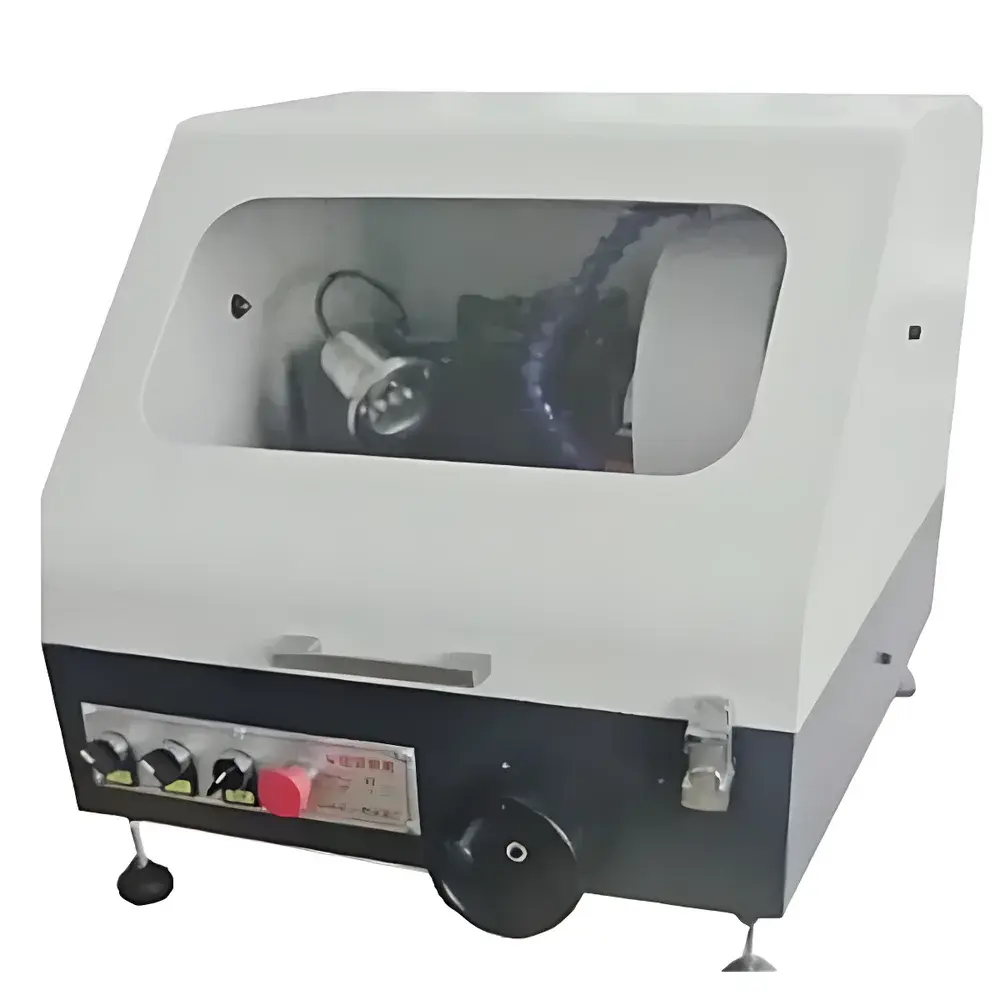
YANRUN Q-4T Manual Metallographic Cutting Machine
| Brand | YANRUN |
|---|---|
| Origin | Shanghai, China |
| Manufacturer Type | Direct Manufacturer |
| Country of Origin | China |
| Model | Q-4T |
| Instrument Type | Metallographic Cutting Machine |
| Maximum Cutting Diameter | 65 mm |
| Blade Specification | 250 × 2.0 × 32 mm |
| Cutting Method | Manual |
| Cooling System | Integrated Water Circulation System with 40 L Reservoir |
| Spindle Speed | 2800 rpm |
| Motor Power | 2.2 kW |
| Machine Configuration | Floor-Standing Integrated Unit |
| Power Supply | 380 V AC, 3-Phase |
| Net Weight | 100 kg |
| Standard Accessories | Main Unit (1), Precision Cutting Blades (2 pcs), Tool Kit (1 set) |
Overview
The YANRUN Q-4T Manual Metallographic Cutting Machine is a robust, floor-standing precision sample preparation instrument engineered for reproducible cross-sectional sectioning of metallic and hard-brittle materials prior to metallographic analysis. Operating on a manual feed principle with fixed spindle rotation, the Q-4T employs a high-torque 2.2 kW motor driving a 250 mm diameter abrasive wheel at a constant 2800 rpm—optimized to balance cutting efficiency, thermal control, and microstructural integrity. Unlike automated or semi-automated systems, its fully manual feed mechanism provides direct operator control over feed rate and pressure, enabling experienced technicians to adapt cutting parameters in real time for heterogeneous or heat-sensitive specimens. Designed for routine use in QC laboratories, R&D centers, and academic metallurgy departments, the Q-4T conforms to foundational principles outlined in ASTM E3-22 (“Standard Guide for Preparation of Metallographic Specimens”) and supports compliant specimen preparation workflows under GLP and ISO/IEC 17025 environments.
Key Features
- Floor-standing integrated architecture with rigid cast-iron base and vibration-dampening feet—ensuring mechanical stability during prolonged cutting cycles.
- Dual-blade configuration: Supplied with two precision-engineered 250 × 2.0 × 32 mm resin-bonded silicon carbide or aluminum oxide cutting wheels suitable for ferrous and non-ferrous alloys, sintered metals, and hardened tool steels.
- Integrated recirculating coolant system featuring a 40 L polyethylene reservoir, submersible pump, adjustable nozzle positioning, and overflow drainage—minimizing thermal distortion and preserving phase morphology.
- Ergonomic manual feed handle with calibrated scale and fine-adjustment lock—facilitating repeatable specimen positioning and controlled approach velocity.
- IP54-rated electrical enclosure with emergency stop button, blade guard interlock switch, and overload-protected motor circuitry—meeting IEC 60204-1 safety requirements for industrial laboratory equipment.
- Modular tool kit includes arbor wrenches, blade flanges, alignment gauges, and coolant filter elements—supporting in-house maintenance without third-party service dependency.
Sample Compatibility & Compliance
The Q-4T accommodates specimens up to 65 mm in maximum diameter or equivalent cross-sectional area—including cylindrical rods, rectangular billets, weld coupons, turbine blade segments, and powder metallurgy compacts. It is routinely deployed for sectioning structural steels (e.g., ASTM A36, AISI 4140), aluminum alloys (e.g., 6061-T6, 7075-T73), titanium grades (e.g., Ti-6Al-4V), and nickel-based superalloys (e.g., Inconel 718). The machine supports compliance with ASTM E3-22, ISO 14489:2020 (“Metallographic specimen preparation — Cutting”), and EN 10365:2017 (for steel product sampling). Its manual operation allows full traceability of cutting parameters—critical for audit readiness in ISO 9001-certified manufacturing labs and FDA-regulated medical device material characterization workflows.
Software & Data Management
As a manually operated mechanical system, the Q-4T does not incorporate embedded software, touchscreen interfaces, or digital data logging. This design choice eliminates firmware dependencies, cybersecurity vulnerabilities, and calibration drift associated with sensor-based automation—enhancing long-term operational reliability and reducing total cost of ownership. All process parameters (feed rate, dwell time, coolant flow rate) are recorded manually in laboratory notebooks or LIMS-integrated electronic batch records. The absence of proprietary software ensures full compatibility with enterprise-grade document management systems supporting 21 CFR Part 11-compliant electronic signatures and audit trails when paired with validated SOPs.
Applications
- Metallographic lab specimen preparation for optical microscopy (OM), scanning electron microscopy (SEM), and electron backscatter diffraction (EBSD) analysis.
- Quality assurance of welded joints in pressure vessels, pipelines, and aerospace structural assemblies per AWS D1.1 and ASME Section IX requirements.
- Failure analysis investigations involving fracture surface examination, inclusion rating (ASTM E45), and decarburization depth measurement (ASTM E1077).
- Academic instruction in materials science curricula—enabling students to master fundamental sectioning techniques, coolant management, and safety protocols before advancing to automated platforms.
- Preparation of reference samples for hardness testing (ASTM E10, E18), tensile bar machining, and corrosion coupon fabrication.
- Supporting ISO 17025 accreditation through documented operator qualification, equipment verification (spindle runout ≤ 0.02 mm), and periodic performance checks using certified reference blocks.
FAQ
Is the Q-4T suitable for cutting ceramic or composite materials?
Yes—when equipped with diamond-impregnated or cubic boron nitride (CBN) blades compatible with the 32 mm arbor size, the Q-4T can section technical ceramics (e.g., Al₂O₃, Si₃N₄), carbon-fiber-reinforced polymers (CFRPs), and metal-matrix composites. Coolant flow must be optimized to prevent delamination or thermal cracking.
Does the machine support variable speed control?
No—the Q-4T operates at a fixed 2800 rpm spindle speed, selected to ensure optimal abrasive wheel performance across common metallurgical applications. Speed variation is not required for manual sectioning where feed rate and pressure serve as primary process controls.
What maintenance intervals are recommended?
Daily: Clean coolant reservoir and inspect pump strainer. Weekly: Verify blade guard alignment and tighten arbor nut torque (45–50 N·m). Annually: Replace coolant hose assembly and verify electrical grounding resistance (< 1 Ω).
Can the Q-4T be integrated into an existing LIMS or MES environment?
While the unit itself has no digital interface, its operation is fully documentable via standardized work instructions, paper-based logbooks, or LIMS-integrated electronic forms—enabling full traceability of specimen ID, operator, date/time, blade lot number, and coolant batch.
Is CE marking available for export to EU markets?
The Q-4T complies with essential health and safety requirements of the Machinery Directive 2006/42/EC and EMC Directive 2014/30/EU. CE documentation—including risk assessment, EC Declaration of Conformity, and technical file—is provided upon request for customs clearance and end-user registration.



