
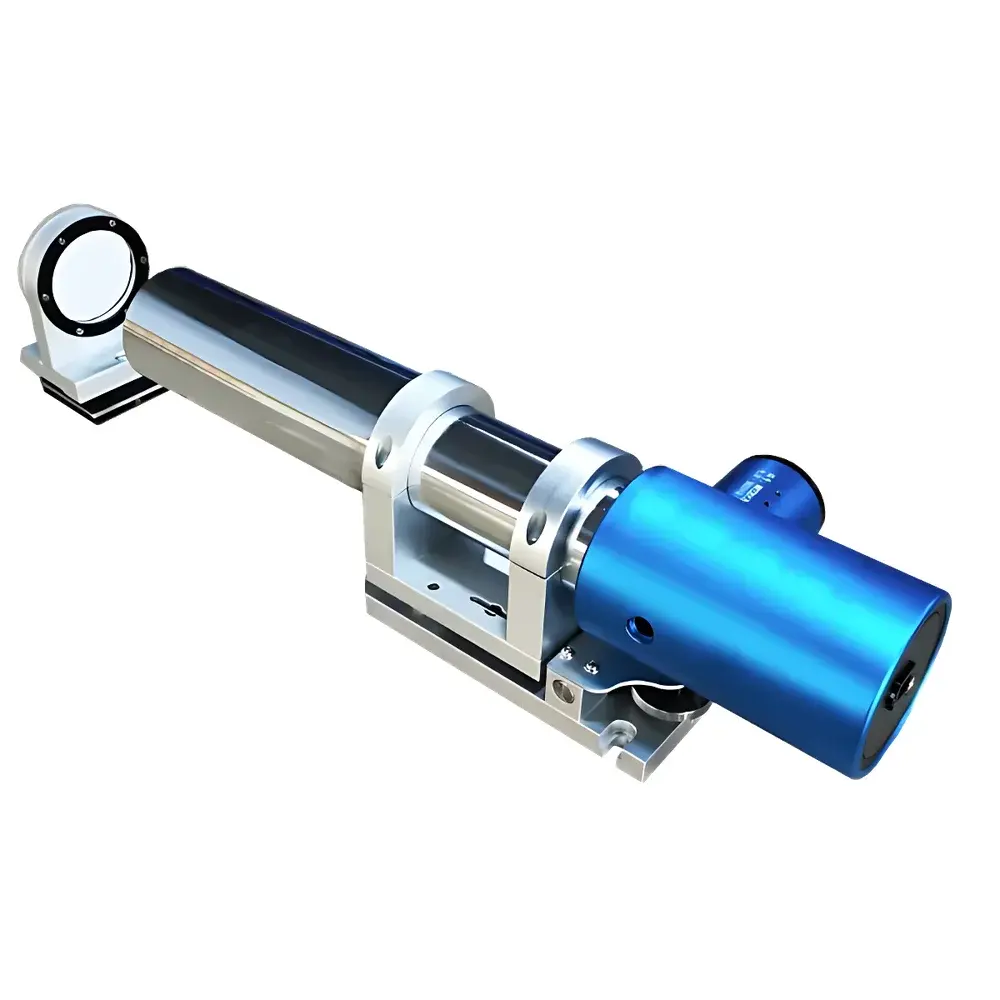
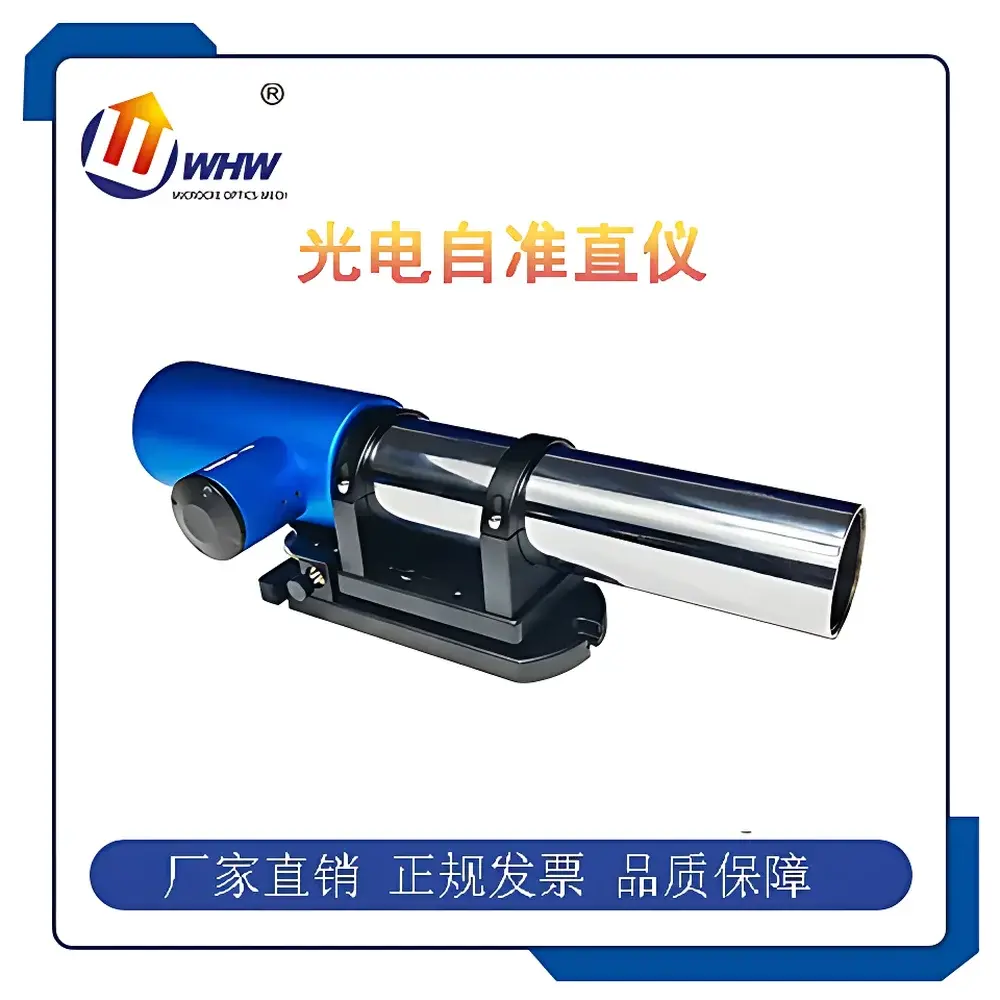
YANRUN MC030-YRMBT300/48/0.5 Dual-Axis Photoelectric Autocollimator
| Brand | YANRUN |
|---|---|
| Origin | Shanghai, China |
| Manufacturer Type | Manufacturer |
| Model | MC030-YRMBT300/48/0.5 |
| Focal Length | 300 mm |
| Aperture | 48 mm |
| Light Source | High-Stability Semiconductor LED |
| Measurement Range | 0–30 m |
| Angular Resolution | Adjustable down to 0.0001″ (arc second) |
| Field of View (X/Y) | 2200″ × 1800″ (arc sec) |
| Accuracy (Center) | ±0.5″ (0–±100″), ±1″ (0–±600″) |
| Frequency Response | ≤30 Hz |
| Interface | USB 2.0/3.0 |
| Operating System | Windows 7 or later (64-bit) |
| Dimensions | 388 × 135 × 125 mm |
| Weight | 5.0 kg |
Overview
The YANRUN MC030-YRMBT300/48/0.5 Dual-Axis Photoelectric Autocollimator is an advanced angular metrology instrument engineered for high-precision, non-contact measurement of angular deviations in two orthogonal axes (X and Y) simultaneously. It operates on the fundamental principle of optical autocollimation: a collimated beam—generated by projecting a reticle located at the focal plane of a 300 mm focal length objective lens—is reflected back from a flat mirror surface and re-imaged onto a high-resolution photoelectric sensor positioned at the same focal plane. When the mirror rotates by angle α, the returned image shifts by ΔS, corresponding to 2α in angular displacement. This linear-to-angular conversion enables traceable, sub-arcsecond angular quantification with robust repeatability. Designed for integration into precision engineering workflows—including machine tool calibration, optical alignment, and coordinate metrology—the instrument replaces traditional visual autocollimators with a digital, operator-independent measurement paradigm grounded in ISO 10110-5 and ASTM E2912 standards for angular measurement uncertainty.
Key Features
- Dual-axis real-time angular measurement (X and Y) with synchronized acquisition and independent resolution control
- High-stability semiconductor LED light source with >50,000-hour operational lifetime and minimal thermal drift
- Optical system featuring a 48 mm clear aperture objective lens and optimized f/6.25 design for high signal-to-noise ratio across 0–30 m working distances
- Adjustable angular resolution spanning 1″ to 0.0001″ (arc second), configurable per application requirement
- Electronic eyepiece interface with live centroid tracking, eliminating parallax and observer-dependent aiming errors
- USB 2.0/3.0 interface compliant with USB-IF specifications; supports plug-and-play operation under Windows 7+ (64-bit)
- Compact monolithic housing (388 × 135 × 125 mm, 5.0 kg) suitable for portable lab use, on-machine installation, and cleanroom deployment
- Patented mechanical and optical architecture validated under Chinese Utility Model Patent No. ZL2022XXXXXXX
Sample Compatibility & Compliance
The MC030-YRMBT300/48/0.5 is compatible with standard optical flats (e.g., Grade 0 and Grade 1 fused silica or BK7 mirrors ≥25 mm diameter), kinematic mirror mounts, and custom retroreflector arrays. Its measurement protocol conforms to ISO 230-1 (machine tool testing – geometric accuracy), ISO 10791-6 (test conditions for machining centers), and supports GLP/GMP-aligned data integrity when used with audit-trail-enabled software configurations. While the base unit does not include FDA 21 CFR Part 11 compliance out-of-the-box, its data export architecture (CSV, XLSX) facilitates integration into validated laboratory information management systems (LIMS) requiring electronic record retention and user authentication. Calibration traceability is maintained via NIM (National Institute of Metrology, China)-certified angular standards, with optional factory recalibration services available annually.
Software & Data Management
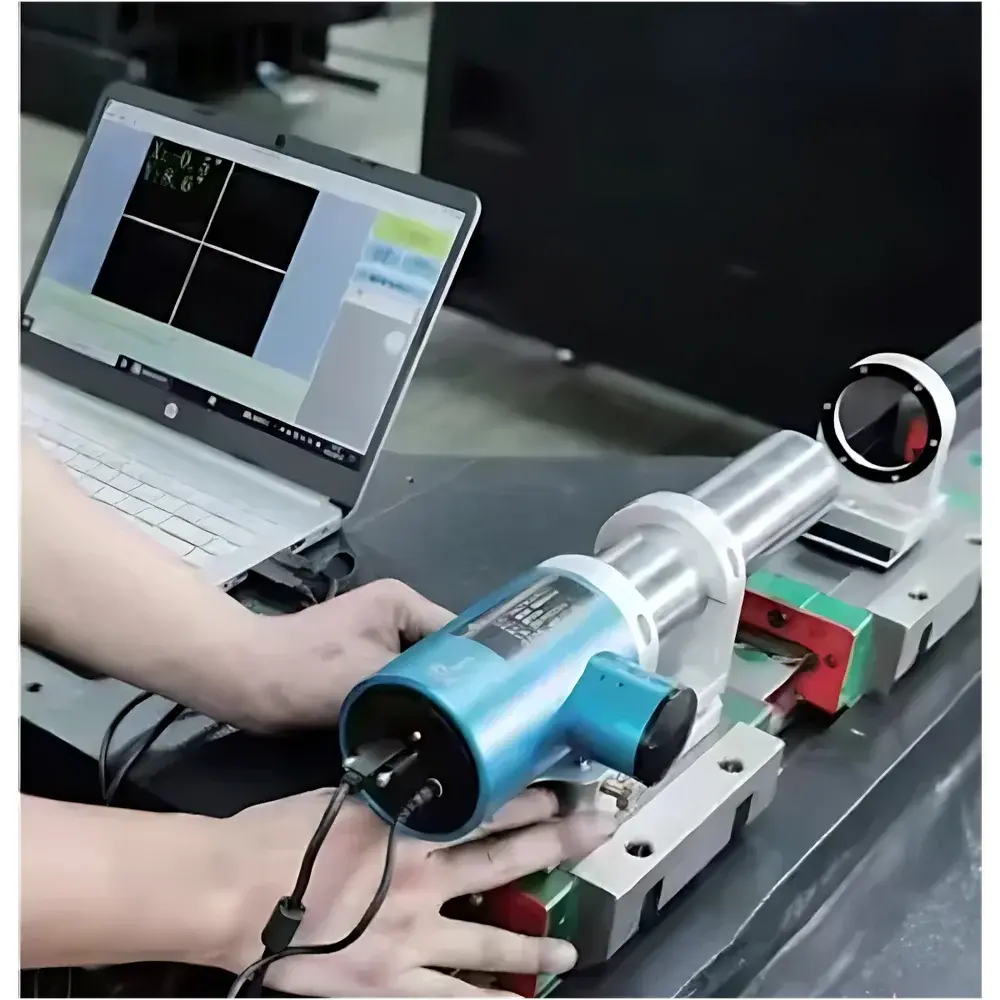
The included Windows-native measurement software provides real-time centroid visualization, dynamic error curve generation, and automated deviation calculation per ISO 230-2 Annex B. It supports multiple analysis modules: straightness (via multi-position scanning), perpendicularity (using orthogonal axis correlation), flatness (via grid-based sampling), and parallelism (differential tilt comparison). All raw pixel displacement data and derived angular values are timestamped and stored with metadata (operator ID, environmental temperature, mirror ID). Export options include standardized Excel reports (ASTM E29 format), CSV for statistical process control (SPC) tools, and XML for enterprise MES integration. Language support includes English, Chinese, Russian, and Korean—enabling multinational manufacturing site deployment without UI translation overhead.
Applications
- Precision alignment of CNC machine tool spindles, linear guides, and rotary tables
- Verification of optical component tilt and decenter in laser cavity assembly and interferometer setup
- Calibration of high-accuracy goniometers and rotation stages used in semiconductor lithography equipment
- Geometric error mapping of large-scale coordinate measuring machines (CMMs) and laser trackers
- Dynamic angular stability assessment of vibration-isolated optical platforms in metrology labs
- Quality assurance of aerospace structural components (e.g., wing spar angularity, satellite payload mounting interfaces)
- Teaching and research in university physics and precision engineering laboratories
FAQ
What is the minimum required warm-up time for high-accuracy measurements?
For measurements within ±0.5″ specification, a minimum 15-minute power-on stabilization period is recommended. For metrological validation (e.g., ISO 10012 audits), the instrument must be thermally equilibrated in a 20 ±0.5 °C environment for ≥24 hours prior to calibration.
Can this autocollimator measure angular motion dynamically?
Yes—its ≤30 Hz frequency response supports real-time monitoring of low-frequency angular oscillations, such as thermal drift in optical benches or slow-stage misalignment during long-duration tests.
Is third-party calibration documentation provided with shipment?
Each unit ships with a manufacturer’s calibration certificate referencing NIM-traceable angular standards. Full ISO/IEC 17025-accredited calibration reports are available upon request at additional cost.
Does the system support external triggering or synchronization with other instruments?
The current firmware does not include hardware trigger I/O; however, software-level synchronization via Windows Performance Counter timestamps enables post-hoc alignment with external DAQ systems recording vibration, temperature, or positional data.
What environmental conditions affect measurement repeatability?
Air turbulence, temperature gradients >0.3 °C/m, and mechanical vibration exceeding 10 µm/s RMS at 10–100 Hz can degrade sub-arcsecond performance. Use on granite tables with active damping is strongly advised for <0.1″ applications.




