
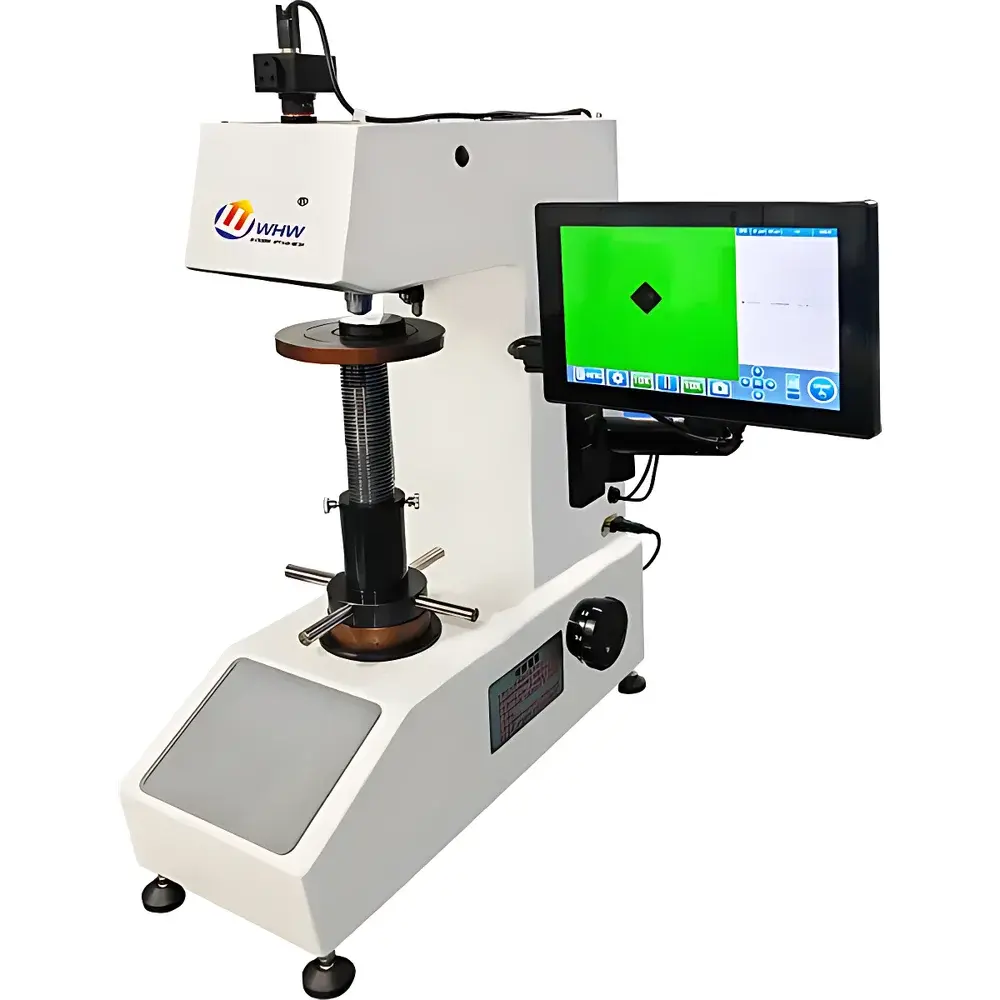
YANRUN MVS-5T Visual Vickers Hardness Tester
| Brand | YANRUN |
|---|---|
| Origin | Shanghai, China |
| Manufacturer Type | OEM Manufacturer |
| Country of Origin | China |
| Model | MVS-5T |
| Instrument Type | Vickers Hardness Tester |
| Hardness Range | 8–3000 HV |
| Total Test Force | 5 kgf |
| Maximum Specimen Height | 240 mm |
| Maximum Specimen Depth | 130 mm |
| Optical Magnification | 100× (observation), 200× (measurement) |
| Objective Lenses | 10× (observation), 20× (measurement) |
| Measurement Resolution | ≈0.14 µm (at 10× objective) |
| Load Application Speed | ≈0.05 mm/s |
| Dwell Time | 0–99 s (1 s increments) |
| Illumination Control | 20-level adjustable LED brightness |
| Touchscreen | 10.1-inch HD color capacitive touchscreen |
| Compliance Standards | GB/T 4340.2, ISO 6507-2, ASTM E384 |
| Data Storage | Unlimited test records with embedded image capture |
| Power Supply | AC 220 V / 50 Hz |
| Net Weight | ~60 kg |
| Dimensions (W×D×H) | 570 × 220 × 680 mm |
Overview
The YANRUN MVS-5T Visual Vickers Hardness Tester is an advanced, Android-based microhardness testing system engineered for precision, repeatability, and regulatory traceability in metallurgical laboratories, quality control departments, and academic research facilities. It operates on the fundamental principle of Vickers indentation hardness measurement: a diamond pyramid indenter (136° apex angle) is applied to a polished specimen surface under a defined load for a specified dwell time; the resulting diagonal lengths of the residual impression are optically measured and converted into hardness values (HV) using standardized geometric formulas per ISO 6507-1 and ASTM E384. Unlike conventional analog testers, the MVS-5T integrates real-time digital imaging, automated indentation analysis, and closed-loop motorized positioning—enabling fully automated testing sequences including auto-focusing, auto-measurement, and multi-point hardness mapping. Its design emphasizes mechanical stability, thermal inertia minimization, and optical fidelity, making it especially suitable for case depth profiling of heat-treated steels, thin-film hardness evaluation, and comparative hardness analysis across heterogeneous microstructures.
Key Features
- Monolithic cast-aluminum frame with automotive-grade baked enamel finish (cured at 60 °C), delivering exceptional rigidity, vibration damping, and long-term dimensional stability.
- High-resolution dual-objective optical path: 10× objective for wide-field observation (100× total magnification), 20× objective for high-precision measurement (200× total magnification); equipped with semi-silvered beam splitter for simultaneous viewing and imaging.
- Stepper-motor-driven turret with 1.8° step angle and microstepping control (8000 steps/revolution), enabling repeatable ±2 µm positioning accuracy during indenter/objective switching.
- Electromechanically actuated vertical loading mechanism with controlled descent velocity (~0.05 mm/s) and rapid unloading (~45 µm/s), ensuring consistent force application profiles and minimizing creep effects.
- 10.1-inch HD capacitive touchscreen with 180° ergonomic tilt adjustment, running a purpose-built Android OS interface optimized for laboratory workflows and multi-user access.
- Floating-point image processing algorithm for sub-pixel diagonal detection, achieving measurement resolution of ≈0.14 µm at 10× magnification and reducing operator-induced parallax error.
- Real-time indentation depth curve visualization and spatial distribution mapping, supporting quantitative case depth analysis (e.g., effective case depth per ISO 2639).
- Automated surface contour compensation for convex or concave specimens, applying geometric correction to diagonal measurements based on local curvature estimation.
- Configurable hardness range limits with audible/visual alarm triggers, supporting statistical process control (SPC) integration and out-of-specification event logging.
Sample Compatibility & Compliance
The MVS-5T accommodates specimens up to 240 mm in height and 130 mm in depth, compatible with standard metallographic mounts, bulk components, and cross-sectioned samples. Its robust stage design supports flat, cylindrical, and irregular geometries when paired with optional V-blocks or custom fixtures. All hardness measurements comply with the metrological requirements of GB/T 4340.2 (China), ISO 6507-2 (International), and ASTM E384 (USA) for verification and calibration procedures. The system supports full audit trail generation—including operator ID, timestamp, test parameters, raw images, and measurement logs—aligning with GLP and GMP documentation expectations. While not inherently 21 CFR Part 11 compliant, its data export architecture (CSV, PDF, JPEG) enables seamless integration with validated LIMS or ELN platforms requiring electronic record integrity.
Software & Data Management
The embedded Android application provides intuitive navigation through test setup, execution, and post-analysis modules. Users define test protocols—including force selection (0.2–5.0 kgf), dwell time (1–99 s), grid patterns, and pass/fail thresholds—via graphical configuration wizards. Each test generates a timestamped record containing calibrated pixel-to-micron scaling factors, raw indentation images, calculated HV values, and automatic conversions to HB, HRC, HRB, and HK scales per GB, ISO, and ASTM reference tables. Data is stored locally in encrypted SQLite databases with unlimited capacity; exports support batch PDF reporting (including annotated images and statistical summaries) and CSV for third-party statistical analysis (e.g., Minitab, JMP). Firmware updates are delivered over-the-air via secure HTTPS channels, ensuring continuous alignment with evolving calibration best practices.
Applications
- Case depth profiling of carburized, nitrided, or induction-hardened steel components in automotive and aerospace manufacturing.
- Microstructural hardness gradients in weld zones, heat-affected zones (HAZ), and dissimilar metal joints.
- Hardness uniformity assessment of sintered ceramics, tungsten carbide inserts, and PVD/CVD-coated tools.
- Educational demonstration of hardness–microstructure relationships in metallurgy and materials science curricula.
- Quality assurance of bearing races, gear teeth, and surgical instrument alloys where localized hardness deviations impact fatigue life.
- Research-grade indentation mapping for phase identification in duplex stainless steels or titanium alloys using HV contrast differentials.
FAQ
What standards does the MVS-5T comply with for calibration and verification?
It conforms to GB/T 4340.2–2012, ISO 6507-2:2018, and ASTM E384–22 for instrument verification, including indenter geometry checks, force accuracy validation, and optical measurement uncertainty assessment.
Can the system perform automatic hardness mapping across a predefined grid?
Yes—the software supports programmable X-Y coordinate grids with user-defined spacing, enabling automated multi-point hardness surveys for case depth or homogeneity analysis.
Is external PC connectivity required for data export or report generation?
No. All reporting, image annotation, and format conversion (PDF/CSV/JPEG) are performed onboard; USB-C and Wi-Fi interfaces enable optional network synchronization.
How is measurement traceability maintained for ISO/IEC 17025-accredited labs?
Raw image files retain embedded metadata (lens ID, magnification, calibration date); combined with NIST-traceable hardness reference blocks, they satisfy evidence requirements for accredited hardness testing.
Does the system support custom hardness scale definitions beyond GB/ISO/ASTM?
Not natively—but exported CSV files contain raw diagonal measurements and applied loads, allowing users to implement proprietary calculation models in external analysis environments.



