
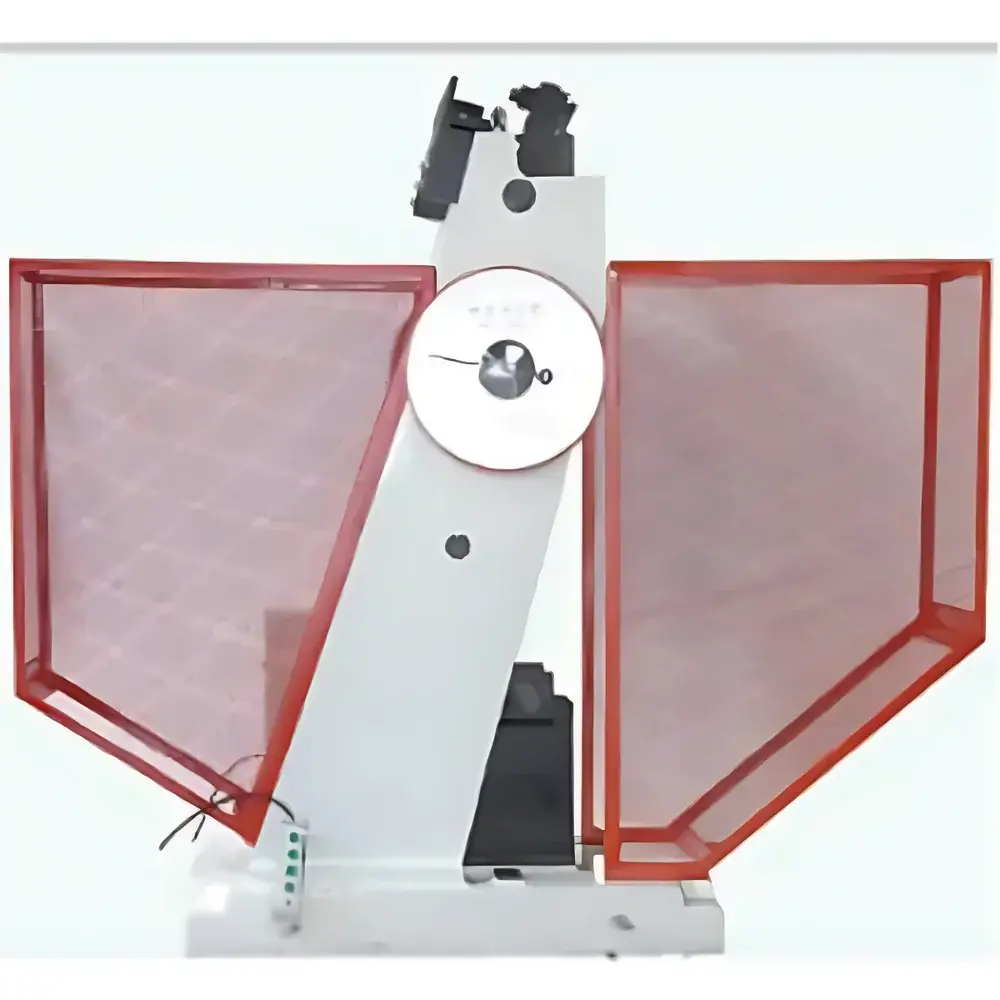
YANRUN JBS-300C Digital Semi-Automatic Charpy Impact Testing Machine
| Brand | YANRUN |
|---|---|
| Origin | Shanghai, China |
| Manufacturer Type | Direct Manufacturer |
| Product Category | Domestic |
| Model | JBS-300C |
| Instrument Type | Pendulum Impact Tester |
| Impact Energy | 300 J (large hammer), 150 J (small hammer) |
| Impact Velocity | 5.2 m/s |
| Pendulum Pre-Lift Angle | 150° |
| Specimen Support Span | 40 mm |
| Support Anvil Fillet Radius | R1.0–R1.5 mm |
| Striking Edge Fillet Radius | R2.0–R2.5 mm and R8 mm |
| Distance from Pendulum Pivot to Impact Point | 750 mm |
| Standard Specimen Dimensions | 10 × 10 × 55 mm |
| Power Supply | 3-phase, 4-wire, 50 Hz, 380 V, 180 W |
| Overall Dimensions | 2124 × 600 × 1340 mm |
| Angular Accuracy | ±0.1° |
| Axial Positioning Accuracy | ±0.05 mm |
| Net Weight | 450 kg |
Overview
The YANRUN JBS-300C Digital Semi-Automatic Charpy Impact Testing Machine is a precision-engineered pendulum impact tester designed for standardized Charpy V-notch and Charpy U-notch impact testing of metallic materials in accordance with ISO 148-1, ASTM E23, GB/T 229, and EN 10045-1. It operates on the principle of gravitational potential energy conversion: a calibrated pendulum is raised to a defined pre-lift angle (150°), released, and allowed to strike a notched specimen mounted on a rigid anvil support. The energy absorbed by fracture is calculated from the difference between initial and residual pendulum height—measured via high-resolution optical encoder and angular transduction—with digital readout resolution of 0.1° and axial positioning accuracy of ±0.05 mm. The system’s robust cast-iron frame and dynamically balanced pendulum assembly ensure minimal vibration transmission and high test-to-test reproducibility under controlled laboratory conditions.
Key Features
- Dual-range pendulum configuration: Interchangeable 150 J and 300 J hammers enable compliance with both standard and high-energy impact requirements without recalibration.
- Fully integrated semi-automatic operation: Equipped with motorized pendulum lifting, automatic hammer release, and fail-safe engagement/disengagement logic—reducing operator dependency and human error in repetitive testing sequences.
- Comprehensive safety architecture: Includes interlocked transparent polycarbonate guard enclosure, mechanical over-travel limit switches, and redundant electromagnetic braking to halt pendulum motion immediately upon specimen fracture or emergency stop activation.
- Precision specimen alignment system: Features a dedicated specimen centering gauge and support span adjustment tool (40 mm fixed span per ISO/ASTM), ensuring consistent notch positioning relative to the striking edge (R2.0–R2.5 mm and R8 mm options available).
- Digital acquisition and control: Embedded microcontroller unit (MCU) processes real-time angular displacement data from a high-stability photoelectric sensor, enabling direct energy calculation and display with traceable calibration records.
- Onboard thermal-printed reporting: Integrated mini-printer outputs test ID, energy absorption (J), fracture type (ductile/brittle), and timestamp—supporting basic GLP documentation workflows.
Sample Compatibility & Compliance
The JBS-300C accepts standard Charpy specimens measuring 10 mm × 10 mm × 55 mm, accommodating both V-notch (45°, 2 mm depth) and U-notch (5 mm radius, 2 mm depth) geometries. Optional anvil inserts and striker blades allow adaptation for sub-size specimens per ASTM E23 Annex A3. All mechanical components—including support anvils (R1.0–R1.5 mm fillet), striking edges, and pivot bearings—are manufactured to dimensional tolerances aligned with ISO 148-2 verification requirements. The instrument supports audit-ready calibration using certified reference pendulums traceable to national metrology institutes. Its electrical design complies with IEC 61000-6-2 (EMC immunity) and IEC 61000-6-4 (EMC emission) standards; CE marking is applicable when installed with appropriate local safety certification.
Software & Data Management
While the JBS-300C operates as a stand-alone instrument with embedded MCU firmware, its RS-232 serial interface enables bidirectional communication with external PCs running custom or third-party data acquisition software. Raw angular position data, trigger timestamps, and calculated energy values can be exported in ASCII CSV format for post-processing in MATLAB, Excel, or LIMS platforms. The onboard microcontroller maintains internal logging of up to 500 test records with date/time stamps, supporting retrospective review for internal quality audits. For regulated environments, optional PC-based software modules provide 21 CFR Part 11-compliant user authentication, electronic signatures, and audit trail generation—meeting minimum requirements for GMP/GLP laboratories performing mechanical property validation.
Applications
This impact tester is routinely deployed in metallurgical laboratories, foundry QA departments, and material certification bodies for evaluating low-temperature toughness transitions in structural steels (e.g., pipeline grades, pressure vessel plates), aluminum alloys, and weld metal deposits. It supports failure analysis investigations where brittle-to-ductile transition temperature (DBTT) determination is required per ASTM E208. In R&D settings, it facilitates comparative assessment of heat treatment effects, grain refinement strategies, and inclusion control on fracture resistance. The 300 J capacity ensures suitability for thick-section materials and high-strength alloys where standard 150 J configurations reach measurement saturation.
FAQ
What standards does the JBS-300C comply with?
It meets the mechanical and procedural requirements of ISO 148-1:2016, ASTM E23-22, GB/T 229-2020, and EN 10045-1.
Can the machine test sub-size specimens?
Yes—when equipped with optional support anvils and strikers, it accommodates 7.5 mm and 5 mm square cross-section specimens per ASTM E23 Annex A3.
Is calibration traceable to national standards?
Calibration is performed using NIST-traceable or CNAS-accredited reference pendulums; full calibration certificates include uncertainty budgets per ISO/IEC 17025.
What maintenance is required for long-term accuracy?
Annual verification of pendulum moment of inertia, bearing friction loss, and angular encoder linearity is recommended; consumables include striker blade replacements and anvil wear inserts.
Does the system support networked data export?
Native Ethernet or Wi-Fi connectivity is not included, but RS-232 output allows integration into existing lab networks via serial-to-Ethernet converters and middleware protocols (e.g., Modbus RTU).



