
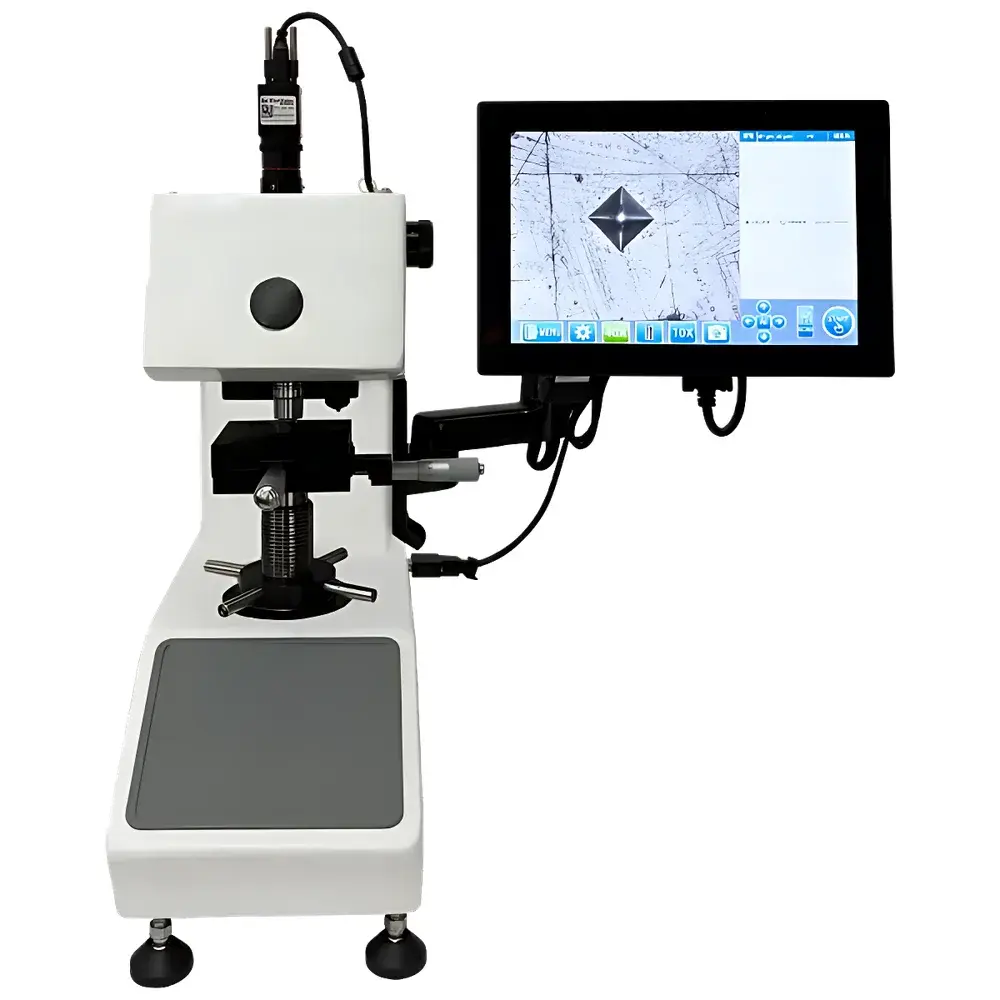
YANRUN HV-C5/10/30/50VE10 Automated Visual Vickers Hardness Tester
| Brand | YANRUN |
|---|---|
| Origin | Shanghai, China |
| Manufacturer Type | Direct Manufacturer |
| Product Category | Domestic |
| Model | HV-C5/10/30/50VE10 |
| Instrument Type | Vickers Hardness Tester |
| Hardness Measurement Range | 8–3000 HV |
| Test Force Options | 0.2–50 kgf (six selectable force levels per capacity tier) |
| Objective Lenses | 10× (observation), 20× (measurement for 5/10 kgf) |
| Total Magnification | 100× (observation), 200× (measurement, 5/10 kgf) |
| Minimum Detectable Indentation Resolution | 0.16 µm (10×), 0.08 µm (20×) |
| Indentation Dwell Time | 0–60 s (1 s increments) |
| Max Specimen Height | 230 mm |
| Distance from Indenter Center to Chamber Wall | 130 mm |
| Power Supply | AC 220 V / 50 Hz |
| Dimensions (L×W×H) | 580 × 375 × 800 mm |
| Net Weight | 47.0 kg |
| Compliance | GB/T 4340, ISO 6507 |
Overview
The YANRUN HV-C5/10/30/50VE10 is an automated visual Vickers hardness tester engineered for precision metrology in metallurgical laboratories, quality control departments, and R&D facilities requiring traceable, repeatable micro- and macro-hardness evaluation. It operates on the fundamental principle of Vickers indentation—applying a precisely controlled diamond pyramid indenter (136° apex angle) under defined load to produce a geometrically reproducible square impression on the test surface. The diagonal lengths of the residual indentation are measured optically using high-resolution objectives and digital image analysis, and hardness is calculated via the standardized formula: HV = 0.1891 × F/d², where F is applied load (kgf) and d is the arithmetic mean of two perpendicular diagonal measurements (mm). Designed to meet both GB/T 4340 and ISO 6507 international standards, the system supports full compliance with ISO/IEC 17025-accredited testing workflows and integrates seamlessly into GLP- and GMP-aligned environments where audit-ready documentation and measurement traceability are mandatory.
Key Features
- Triple-objective turret architecture enabling rapid, repeatable switching among 10× observation, 20× measurement (for 5/10 kgf models), and dedicated 10× imaging optics for higher-force applications—enhancing flexibility across heterogeneous sample surfaces.
- Fully automated test cycle: motorized loading, dwell, and unloading sequence executed without manual intervention; integrated stepper-motor-driven turret ensures consistent optical axis alignment before and after indentation.
- Optimized optical path design featuring a large-bore trinocular light path with >95% light transmission efficiency and minimal stray reflection—critical for high-contrast indentation edge detection and sub-micron measurement repeatability.
- Advanced floating-point calculation algorithm embedded in firmware, minimizing rounding errors during diagonal averaging and HV conversion—delivering improved consistency with theoretical hardness values across the full 8–3000 HV range.
- Modular automation expansion: optional motorized XY stage (custom-configurable), external PC integration, and proprietary hardness analysis software support progressive upgrades from semi-automated to fully networked, multi-instrument test management systems.
- Integrated LED illumination with thermal management circuitry extends lamp service life beyond 10,000 hours while maintaining stable color temperature and intensity throughout long-duration batch testing.
Sample Compatibility & Compliance
The HV-C5/10/30/50VE10 accommodates specimens up to 230 mm in height and 130 mm clearance from indenter center to internal chamber wall—suitable for forged components, heat-treated plates, weld cross-sections, and coated substrates. Its six-tier force selection (0.2–50 kgf) enables seamless transition between microhardness (e.g., case depth profiling per ASTM E384), small-part evaluation, and macro-scale structural material verification. All hardness calculations and reporting adhere strictly to GB/T 4340.1–2012 and ISO 6507-1:2018 requirements for instrument calibration, uncertainty estimation, and result presentation. Optional software modules provide built-in validation tools for ASTM E10, E92, and ISO 1463 conformity checks—including automatic indentation spacing verification, minimum specimen thickness alerts, and surface preparation advisories.
Software & Data Management
Control and analysis are performed via a dedicated industrial-grade tablet interface running real-time embedded OS. The software suite supports dual-mode operation: direct tablet-based measurement with touch-optimized UI or PC-hosted advanced analysis (via optional USB/Ethernet connectivity). Features include automated diagonal detection with adjustable edge sensitivity, statistical process control (SPC) charting, customizable report templates (PDF/CSV/XLSX export), and time-stamped audit logs compliant with FDA 21 CFR Part 11 requirements when paired with user authentication and electronic signature modules. Data integrity is reinforced through cyclic redundancy checksums, immutable test record archiving, and optional cloud synchronization with role-based access control for multi-user lab environments.
Applications
- Metallurgical QA/QC: Verification of heat treatment outcomes (annealing, quenching, tempering), carburizing/nitriding case depth assessment, and grain boundary hardness mapping.
- Aerospace component certification: Hardness profiling of turbine blades, landing gear alloys, and additive-manufactured Ti-6Al-4V structures per AMS 2430 and NADCAP requirements.
- Electronics packaging: Thin-film and solder joint microhardness evaluation for reliability prediction and intermetallic compound (IMC) growth monitoring.
- Academic materials research: Correlation studies between hardness, yield strength, and dislocation density in novel high-entropy alloys and nanocomposites.
- Tooling and die manufacturing: Surface and subsurface hardness uniformity assessment of H13, D2, and M2 steels subjected to PVD/CVD coatings.
FAQ
What standards does the HV-C5/10/30/50VE10 comply with for calibration and reporting?
It conforms to GB/T 4340.1–2012, ISO 6507-1:2018, and supports traceable calibration per ISO 6507-3 using certified reference blocks (e.g., NIST SRM 2820, 2821).
Can the system perform sequential multi-point hardness mapping on irregular surfaces?
Yes—when equipped with the optional motorized XY stage and PC software, it executes programmable grid-based indentation arrays with Z-axis auto-focus compensation.
Is remote diagnostics or firmware update capability supported?
Firmware updates are delivered via secure USB media; remote diagnostic mode is available through optional Ethernet-enabled service port with TLS-encrypted session handshaking.
How is measurement uncertainty estimated and documented?
Uncertainty budgets follow ISO/IEC Guide 98-3 (GUM), incorporating contributions from force accuracy (±0.5% FS), optical resolution (±0.08 µm), dwell time stability (±0.2 s), and environmental drift (temperature/humidity logging optional).
Does the system support integration into a centralized LIMS or MES platform?
Yes—via configurable RESTful API endpoints and HL7-compliant data export protocols, enabling bidirectional communication with laboratory information management systems and enterprise manufacturing execution platforms.



