
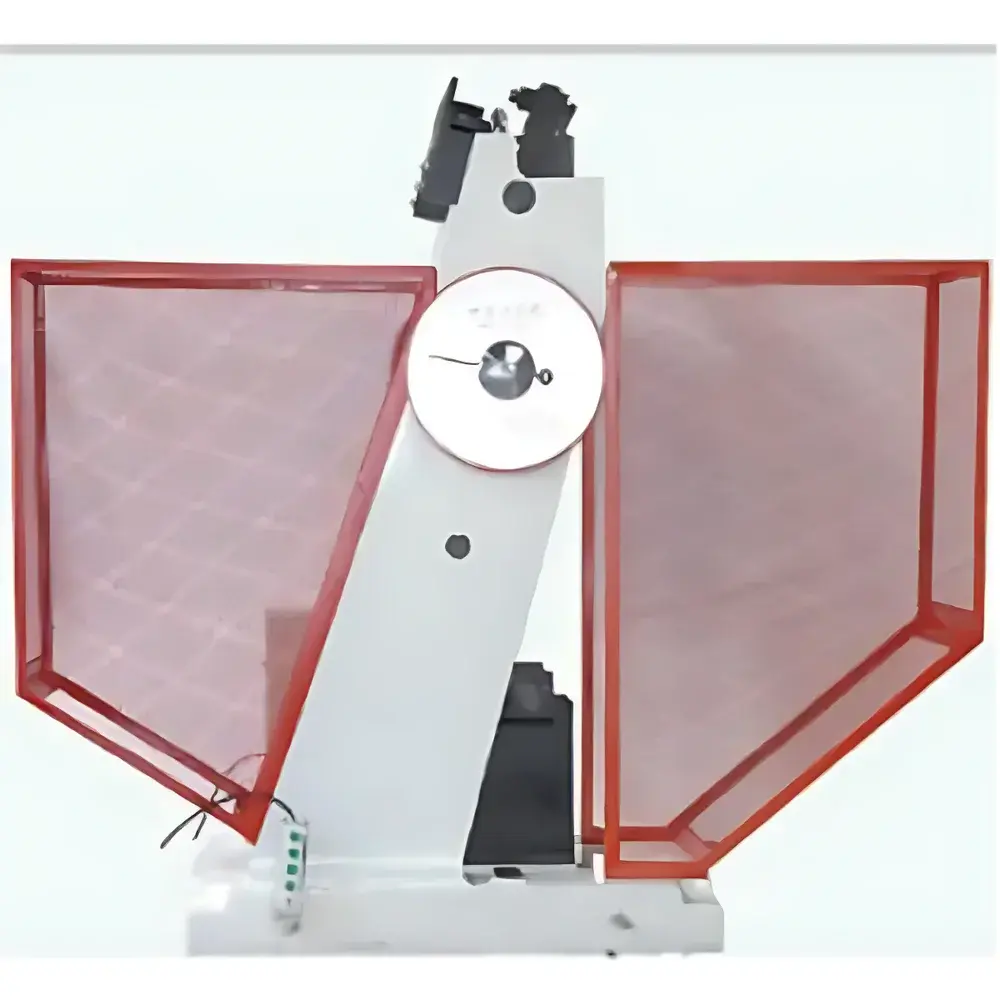
YANRUN JB-300C Semi-Automatic Charpy Impact Testing Machine
| Brand | YANRUN |
|---|---|
| Origin | Shanghai, China |
| Manufacturer Type | Direct Manufacturer |
| Product Category | Domestic |
| Model | JB-300C |
| Instrument Type | Pendulum Impact Tester |
| Nominal Impact Energy | 300 J / 150 J (achieved via adjustable counterweights) |
| Impact Velocity | 5.2 m/s |
| Pendulum Pre-Lift Angle | 150° |
| Specimen Support Span | 40 mm |
| Support Anvil Radius | R1.0–R1.5 mm |
| Striking Edge Radius | R2.0–R2.5 mm and R8 mm |
| Distance from Pendulum Pivot to Impact Point | 750 mm |
| Standard Specimen Dimensions | 10 × 10 × 55 mm |
| Power Supply | 3-phase, 4-wire, 50 Hz, 380 V, 180 W |
| Overall Dimensions | 2124 × 600 × 1340 mm |
| Angular Resolution | ±0.1° |
| Axial Positioning Accuracy | ±0.05 mm |
| Net Weight | 450 kg |
Overview
The YANRUN JB-300C Semi-Automatic Charpy Impact Testing Machine is a precision-engineered pendulum impact tester designed for standardized measurement of notched-bar impact energy in metallic materials according to ISO 148-1, ASTM E23, and GB/T 229. It operates on the principle of gravitational potential energy conversion: a calibrated pendulum is raised to a defined pre-lift angle (150°), released, and allowed to strike a notched specimen supported on a rigid anvil. The residual energy—calculated from the pendulum’s post-impact rebound height—is used to determine absorbed energy (in joules). This method provides quantitative assessment of material toughness, ductile-to-brittle transition behavior, and fracture resistance under dynamic loading conditions. The JB-300C supports dual nominal energy levels—300 J and 150 J—via interchangeable counterweight configurations, enabling flexible testing across a broad range of specimen thicknesses and material strengths without requiring hardware replacement.
Key Features
- Robust cast-iron frame with vibration-damped base structure ensures mechanical stability during high-energy impact events.
- Precision-machined pendulum assembly with hardened striking edge (dual-radius options: R2.0–R2.5 mm for Charpy V-notch; R8 mm for Izod configuration) meets ISO/ASTM geometric tolerances.
- High-resolution angular encoder (±0.1° accuracy) and axial positioning system (±0.05 mm repeatability) guarantee traceable energy calibration and consistent specimen alignment.
- Semi-automatic operation includes manual specimen placement and clamping, followed by motor-assisted pendulum lifting and release—reducing operator variability while maintaining full procedural control.
- Integrated safety enclosure with interlocked protective net conforms to EN ISO 13857 requirements for hazardous motion zones.
- Standardized 40 mm support span and 10 × 10 × 55 mm specimen fixture accommodate all common Charpy test geometries, including V-notch, U-notch, and keyhole configurations.
Sample Compatibility & Compliance
The JB-300C is validated for use with standard metallic specimens per ISO 148-1:2016 and ASTM E23-22, including carbon steels, alloy steels, aluminum alloys, and titanium grades. Specimens must be machined to dimensional tolerances specified in Clause 6 of ASTM E23 (e.g., ±0.075 mm width/thickness, ±0.1 mm length). The machine accommodates both unnotched and notched specimens with controlled notch root radii (0.25 mm ±0.025 mm for Charpy V). Calibration is performed using certified reference specimens traceable to NIM (National Institute of Metrology, China) or equivalent national metrology institutes. Full compliance documentation—including as-built drawings, calibration certificates, and verification reports—supports GLP/GMP audit readiness and regulatory submissions under FDA 21 CFR Part 11 where electronic records are implemented via optional software integration.
Software & Data Management
While the base JB-300C operates via analog dial readout and mechanical scale, optional digital data acquisition modules enable real-time energy calculation, automatic result logging, and CSV export. When paired with YANRUN’s IMPACT-Link software (v3.2+), the system supports user-defined test sequences, multi-specimen batch processing, statistical analysis (mean, SD, CV%), and PDF report generation compliant with ISO/IEC 17025 requirements. Audit trails record operator ID, timestamp, calibration status, and environmental parameters (optional ambient temperature/humidity sensor input). All digital outputs are structured for seamless import into LIMS environments and satisfy data integrity expectations under ALCOA+ principles.
Applications
- Quality control of structural steels in pressure vessel, pipeline, and offshore platform manufacturing.
- Evaluation of temper embrittlement and low-temperature toughness in quenched-and-tempered alloys.
- Validation of heat treatment process consistency across production lots.
- Research into fracture mechanics parameters, including crack initiation energy and plastic zone development.
- Third-party certification testing for CE marking, PED 2014/68/EU, and ASME Section VIII Div. 1 compliance.
- Academic metallurgy laboratories conducting comparative impact studies across alloy systems and microstructural conditions.
FAQ
What standards does the JB-300C comply with?
ISO 148-1:2016, ASTM E23-22, GB/T 229-2020, and EN 10045-1.
Can the machine test sub-size specimens?
Yes—when equipped with optional sub-size anvils and alignment fixtures, it supports 5 × 5 × 55 mm and 7.5 × 7.5 × 55 mm specimens per ASTM E23 Annex A3.
Is calibration verification required before each test series?
Per ISO 148-2, verification using certified reference specimens is mandatory at start-up, after maintenance, and at least every 24 hours of continuous operation.
What electrical infrastructure is needed for installation?
A dedicated 3-phase, 4-wire 380 V AC circuit (50 Hz) with minimum 20 A breaker capacity and proper grounding per IEC 60204-1.
Does the system support automated specimen handling?
No—the JB-300C is semi-automatic; fully automatic feeders and robotic arms are available as OEM-integrated upgrades (model JB-300C-Auto).



