
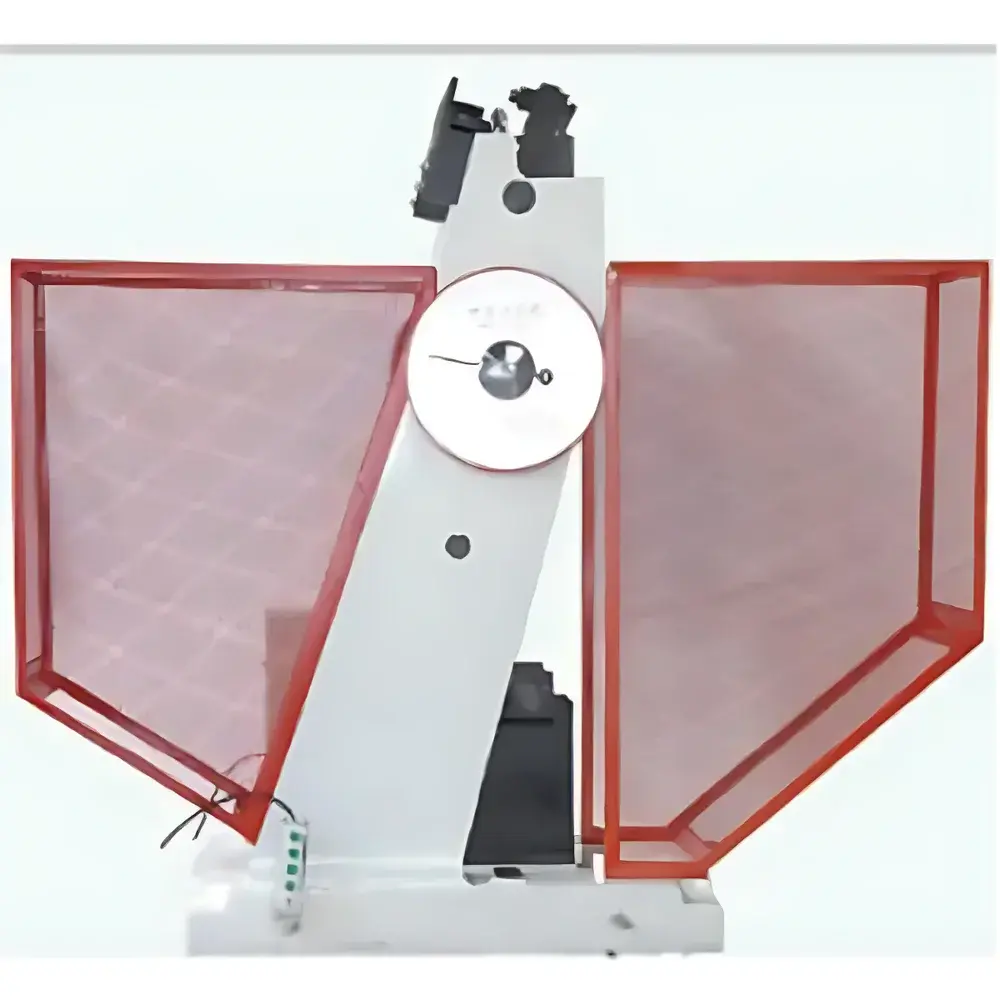
YANRUN JB-500C Semi-Automatic Charpy Impact Testing Machine
| Brand | YANRUN |
|---|---|
| Origin | Shanghai, China |
| Manufacturer Type | Direct Manufacturer |
| Country of Origin | China |
| Model | JB-500C |
| Instrument Type | Pendulum Impact Tester |
| Nominal Impact Energy | 250 J / 500 J (achieved via interchangeable pendulum weights) |
| Impact Velocity | 5.4 m/s |
| Pendulum Pre-lift Angle | 150° |
| Support Span | 40 mm |
| Anvil Radius (support) | R1.0–R1.5 mm |
| Striking Edge Radius | R2.0–R2.5 mm |
| Striking Blade Thickness | 16 mm |
| Distance from Pendulum Axis to Impact Point | 800 mm |
| Standard Specimen Dimensions | 10 × 10 × 55 mm |
| Power Supply | 3-phase, 4-wire, 50 Hz, 380 V, 180 W |
| Overall Dimensions (L×W×H) | 2124 × 600 × 1340 mm |
| Minimum Resolution | 2.5 J |
| Axial Positioning Accuracy | ±0.05 mm |
| Net Weight | 450 kg |
Overview
The YANRUN JB-500C Semi-Automatic Charpy Impact Testing Machine is a precision-engineered pendulum impact tester designed for standardized measurement of notched and unnotched metallic and polymer specimens under controlled impact loading conditions. It operates on the principle of gravitational potential energy conversion: a calibrated pendulum is raised to a fixed pre-lift angle (150°), released, and allowed to strike a standardized specimen mounted on a rigid anvil support. The energy absorbed during fracture—calculated from the difference between initial and residual pendulum height—is reported in joules (J), enabling direct comparison against ASTM E23, ISO 148-1, GB/T 229, and other international Charpy impact standards. With dual nominal energy capacities—250 J and 500 J—achieved through interchangeable pendulum assemblies with mass-adjusted counterweights—the JB-500C supports both routine quality control and high-energy structural material qualification across aerospace, automotive, heavy machinery, and metallurgical R&D laboratories.
Key Features
- High-stability pendulum system with 800 mm effective length and ±0.05 mm axial positioning accuracy ensures repeatable impact point alignment per ISO 148-2 requirements.
- Dual-energy configuration: includes dedicated 250 J and field-configurable 500 J pendulums—both compliant with ISO 148-1 Annex A geometric tolerances for striking edge radius (R2.0–R2.5 mm) and anvil radius (R1.0–R1.5 mm).
- Automated operational sequence: integrated motorized lifting, automatic pendulum release, and real-time optical sensing (photoelectric encoder) for precise energy calculation and reduced operator intervention.
- Robust cast-iron frame with vibration-damped base and adjustable leveling feet (four M24 anchor bolts + four tapered shims) guarantees mechanical stability during high-energy impacts.
- Comprehensive safety architecture: full-height protective enclosure with interlocked door switch, emergency stop circuit, and certified impact-resistant polycarbonate shielding conforming to EN ISO 13857 clearance requirements.
- Standardized specimen handling: includes alignment jig (specimen centering tool), anvil calibration gauge, hex key (S=12) for jaw torque control, and 40 mm span support geometry optimized for 10 × 10 × 55 mm Charpy V-notch or U-notch specimens.
Sample Compatibility & Compliance
The JB-500C accommodates standard Charpy specimens per ASTM E23 Type A (V-notch) and Type B (U-notch), as well as subsize geometries (e.g., 5 × 5 × 55 mm, 7.5 × 7.5 × 55 mm) when used with certified auxiliary supports. Specimen materials include carbon steels, alloy steels, aluminum alloys, titanium grades, and engineering thermoplastics—provided they meet minimum notch root radius (0.25 mm) and surface finish (Ra ≤ 1.6 µm) requirements per ISO 148-1. All mechanical components—including pendulum shaft, bearings, and anvil assembly—are manufactured to ISO 2768-mK general tolerances and undergo static load verification at 1.5× maximum rated energy. The system meets CE marking directives (2006/42/EC Machinery Directive, 2014/30/EU EMC Directive) and supports GLP-compliant audit trails when paired with validated software.
Software & Data Management
Controlled via a dedicated Windows-based application running on an integrated Lenovo industrial PC, the JB-500C software provides real-time energy readout, digital calibration logging, and automated report generation in PDF and Excel formats. Each test record stores timestamp, operator ID, specimen ID, energy value, and raw encoder pulse data—traceable to NIST-traceable reference pendulums. Audit trail functionality complies with FDA 21 CFR Part 11 requirements for electronic records and signatures when configured with user authentication, role-based access control, and immutable event logs. Raw data export supports third-party statistical analysis (e.g., Weibull modulus estimation, transition temperature curve fitting per ASTM E1921).
Applications
- Metallurgical QC labs performing routine Charpy impact testing on rolled plate, forged components, and weldment coupons per ASTM A370 or EN 10045-1.
- Research institutions evaluating ductile-to-brittle transition behavior in ferritic steels at sub-zero temperatures (when integrated with environmental chamber).
- Aerospace suppliers verifying impact resistance of Ti-6Al-4V fasteners and Al-Li alloy extrusions under AS9102 First Article Inspection protocols.
- Third-party certification bodies conducting ISO/IEC 17025-accredited impact testing for pressure vessel code compliance (ASME BPVC Section VIII, EN 13445).
- Academic materials science programs teaching fracture mechanics fundamentals using standardized energy-absorption metrics and crack propagation analysis.
FAQ
What standards does the JB-500C comply with for Charpy testing?
It conforms to ASTM E23, ISO 148-1/-2, GB/T 229, and DIN 50115 for pendulum impact testing methodology, specimen geometry, and energy calibration procedures.
Can the machine be used for Izod impact testing?
No—the JB-500C is configured exclusively for Charpy-type horizontal loading; Izod testing requires vertical specimen clamping and different pendulum kinematics.
Is remote diagnostics supported?
Yes, the embedded industrial PC enables secure RDP or TeamViewer access (with customer-configured firewall rules) for technical support and firmware updates.
What maintenance intervals are recommended?
Biannual verification of pendulum zero-energy offset, annual recalibration of encoder resolution and energy scale against certified reference bars, and quarterly inspection of safety interlocks and braking mechanism wear.
Does the system support LIMS integration?
Yes—via configurable CSV/XML output and optional OPC UA server module for direct connectivity to laboratory information management systems.



