
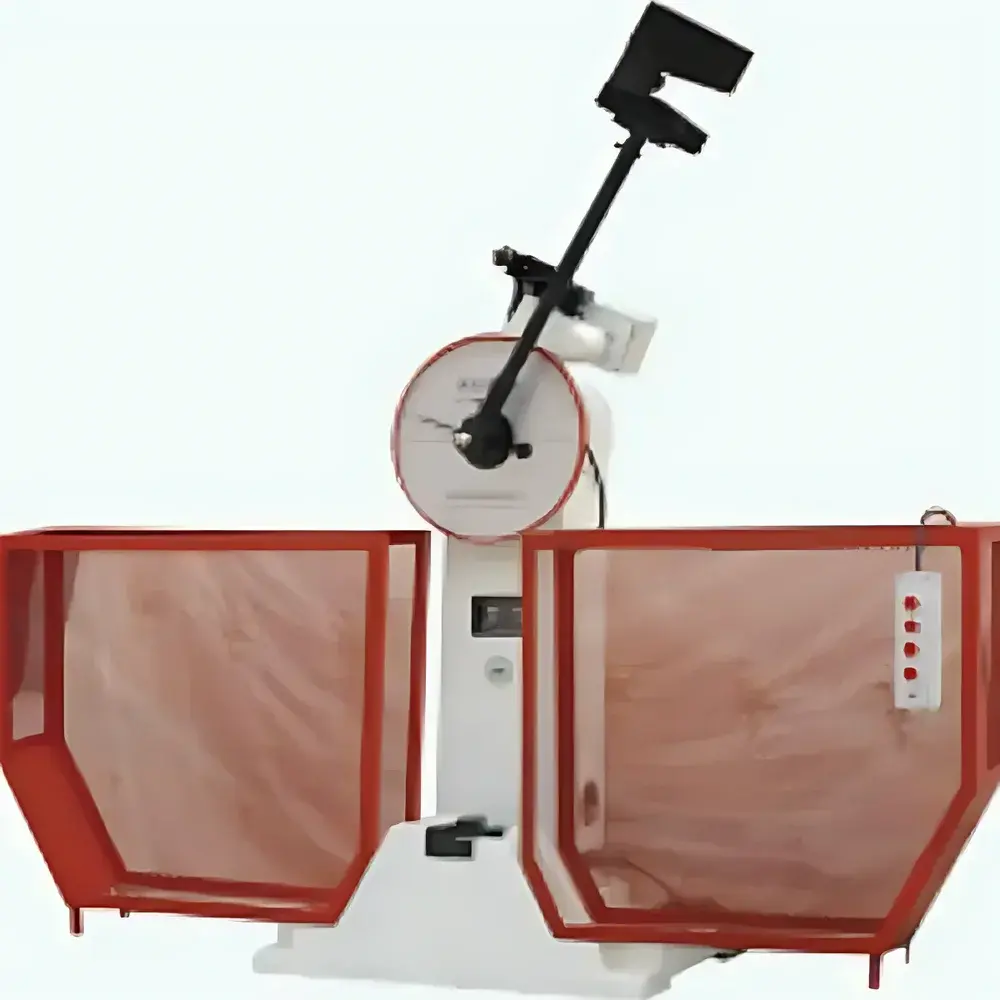
YANRUN JB-500B Semi-Automatic Pendulum Impact Testing Machine
| Brand | YANRUN |
|---|---|
| Origin | Shanghai, China |
| Manufacturer Type | Direct Manufacturer |
| Product Category | Domestic (China-Made) |
| Model | JB-500B |
| Instrument Type | Pendulum Impact Tester |
| Nominal Impact Energies | 250 J, 500 J |
| Impact Velocity | 5.4 m/s |
| Pendulum Arm Length (from pivot to impact point) | 800 mm |
| Specimen Support Span | 40 mm |
| Anvil Radius (support edge) | R1–R1.5 mm |
| Striking Edge Radius | R2–R2.5 mm |
| Striking Blade Thickness | 16 mm |
| Angular Accuracy | ±0.1° |
| Standard Specimen Dimensions | 10 mm × 10 mm × 55 mm |
| Overall Dimensions (L×W×H) | 2300 mm × 600 mm × 1400 mm |
| Net Weight | 550 kg |
| Power Supply | 3-phase AC 380 V ±10%, 50 Hz, 5 A |
| Ambient Requirements | Non-corrosive environment, free from mechanical vibration and strong electromagnetic fields |
Overview
The YANRUN JB-500B Semi-Automatic Pendulum Impact Testing Machine is a precision-engineered instrument designed for Charpy and Izod impact testing of metallic and polymeric materials in accordance with international standards including ASTM E23, ISO 148-1, ISO 180, and GB/T 229. It operates on the classical principle of gravitational potential energy conversion: a calibrated pendulum is raised to a defined initial angle (150°), released, and allowed to strike a notched or unnotched specimen supported at a fixed span (40 mm). The energy absorbed during fracture is calculated from the difference between the pendulum’s initial and residual potential energy—determined via high-resolution angular measurement (±0.1° accuracy) and validated arm geometry (800 mm pivot-to-impact distance). With dual nominal impact energies of 250 J and 500 J, the JB-500B accommodates both standard and high-toughness material evaluations, while maintaining strict compliance with metrological traceability requirements for laboratory accreditation (ISO/IEC 17025).
Key Features
- Robust cast-iron frame with reinforced base structure, engineered for minimal dynamic deflection during high-energy impact events (up to 500 J)
- Dual-pendulum configuration: interchangeable 250 J and 500 J hammers, each individually calibrated and certified per ISO 148-2
- Motor-driven automatic lifting and release mechanism ensures repeatable pre-lift angle (150°) and eliminates operator-induced variability
- Integrated safety interlock system with dual-mode physical barrier and optical curtain, compliant with EN ISO 13857 and EN 60204-1
- Precision-machined anvil and striker components: support radius R1–R1.5 mm, striking edge radius R2–R2.5 mm, blade thickness 16 mm — all manufactured to tolerances specified in ASTM E23 Annex A1
- Digital angular encoder with 0.01° resolution enables direct energy calculation without analog dial interpolation
- Standardized specimen alignment tools included: specimen centering gauge and support span calibrator, ensuring positional repeatability within ±0.2 mm
Sample Compatibility & Compliance
The JB-500B is optimized for standardized 10 mm × 10 mm × 55 mm specimens, supporting both Charpy V-notch (CVN) and Izod configurations. Optional fixtures enable testing of sub-sized specimens (e.g., 5 mm × 5 mm cross-sections) with appropriate energy scaling per ASTM E23 Section 8. All mechanical components—including pendulum shaft, bearings, and impact anvil—are manufactured from low-hysteresis alloy steel and undergo dimensional verification per ISO 2768-mK. The system meets essential requirements of the EU Machinery Directive 2006/42/EC and supports GLP-compliant operation when integrated with audit-trail-capable data acquisition software. Calibration certificates are provided traceable to NIM (National Institute of Metrology, China) and include uncertainty budgets per GUM (JCGM 100:2008).
Software & Data Management
While the JB-500B operates as a semi-automatic standalone tester, it features RS-232 and optional USB interfaces for integration with third-party laboratory information management systems (LIMS) or custom data acquisition platforms. Raw angular displacement and time-stamped event logs can be exported in CSV format for post-processing. When paired with YANRUN’s optional IMPACT-Link software (v3.2+), users gain automated test sequencing, real-time energy calculation, statistical analysis (mean, SD, CV%), and report generation compliant with ISO/IEC 17025 clause 7.8. Audit trails record operator ID, timestamp, calibration status, and environmental metadata—meeting FDA 21 CFR Part 11 requirements for electronic records when deployed with appropriate system validation protocols.
Applications
This instrument serves quality control laboratories in metallurgy, automotive component manufacturing, aerospace forging facilities, and polymer compounders. Typical use cases include: comparative toughness assessment of heat-treated steels (e.g., quenched & tempered 4140), validation of weld joint integrity per AWS D1.1, low-temperature impact screening of cryogenic alloys (−40°C to +60°C range with environmental chamber integration), and specification conformance testing for ASTM A370, EN 10045-1, and GB/T 229-2020. Its 550 kg mass and rigid foundation mounting ensure stable performance under repetitive high-cycle testing environments typical of production floor QC labs.
FAQ
What standards does the JB-500B comply with for Charpy testing?
ASTM E23, ISO 148-1, ISO 148-2, ISO 180, GB/T 229, and EN 10045-1.
Is the pendulum energy verified independently for each hammer?
Yes—each 250 J and 500 J pendulum is supplied with a factory calibration certificate referencing NIM-traceable reference specimens and includes expanded uncertainty reporting.
Can the machine be installed without a dedicated concrete foundation?
No—per ISO 148-1 Section 6.2, the unit requires anchoring to a minimum 500 mm deep reinforced concrete mass (≥2000 kg) to suppress resonant vibration and maintain energy measurement fidelity.
Does the system support temperature-controlled impact testing?
The base JB-500B is ambient-only; however, it is mechanically compatible with commercially available environmental chambers (e.g., −60°C to +200°C) via standardized mounting interfaces and extended specimen handling tools.
What maintenance intervals are recommended for long-term accuracy?
Biannual verification of angular encoder linearity, annual recalibration of pendulum moment of inertia, and quarterly inspection of striker/anvil wear per ASTM E23 Section 10.3.



