
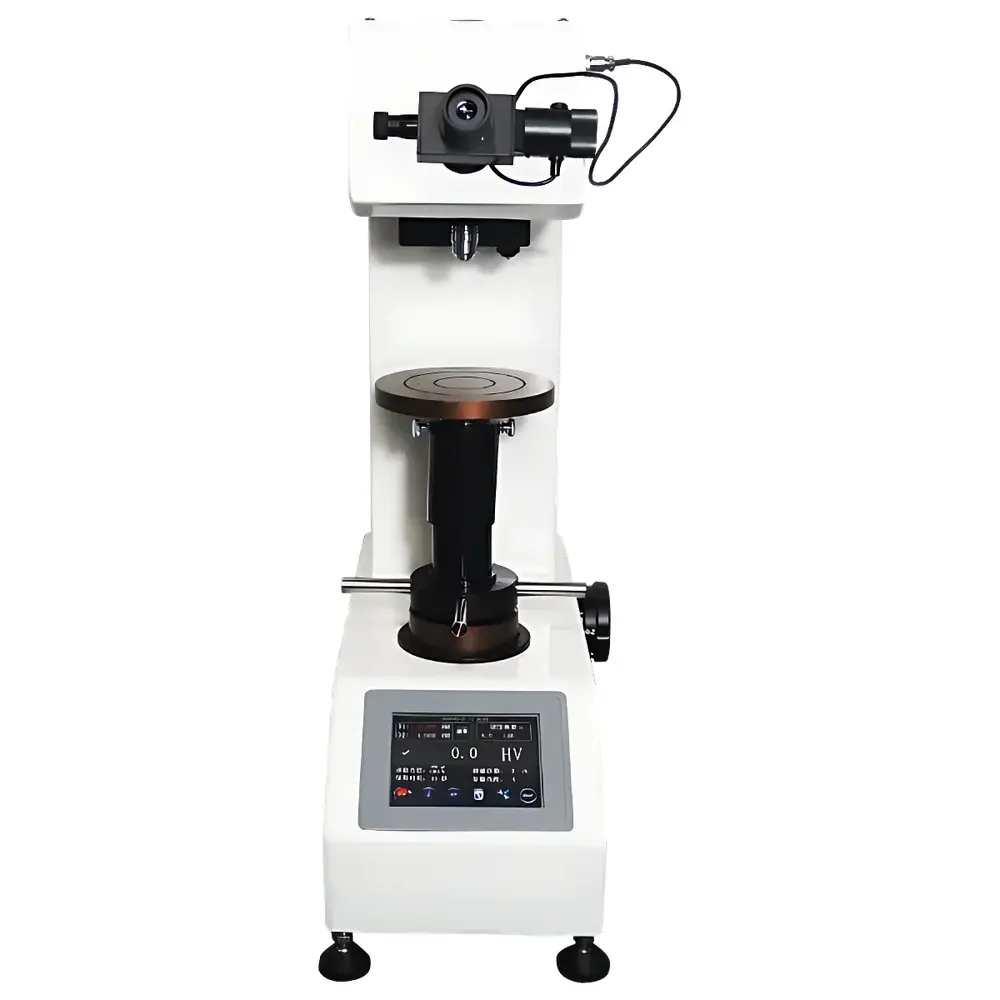
YANRUN HVS-5M/10M/30M/50M Touchscreen Digital Vickers Hardness Tester
| Brand | YANRUN |
|---|---|
| Origin | Shanghai, China |
| Manufacturer Type | Manufacturer |
| Product Origin | Domestic (China) |
| Model | HVS-5M / HVS-10M / HVS-30M / HVS-50M |
| Instrument Type | Vickers Hardness Tester |
| Measurement Range | 0.001–6000 HV |
| Test Force Loading Method | Fully Automatic (Load–Hold–Unload) |
| Standard Compliance | GB/T 4340.2, JJG 151 |
| Eyepiece Magnification | 10× (Digital Eyepiece) |
| Objective Lenses | 10× (Observation), 20× (Measurement) |
| Total Magnification | 100× (Observation), 200× (Measurement) |
| Hardness Display | Electronic LCD Screen (120 × 22 mm) |
| Hardness Scale Conversion | HV, HK, HBW, HRA, HRB, HRC, HRD, HRF, HR15N, HR30N, HR45N, HR15T, HR30T, HR45T |
| Built-in Thermal Printer | Yes |
| Data Acquisition | Manual (via touchscreen or digital eyepiece) |
| Data Calculation | Automatic |
| Optical System | Optimized Brightfield Illumination with Adjustable Intensity |
| Structural Design | Rigid Cast-Iron Frame for Vibration Damping and Long-Term Stability |
Overview
The YANRUN HVS-5M/10M/30M/50M Touchscreen Digital Vickers Hardness Tester is a fully automated micro/macro-hardness testing system engineered for precision metallurgical and materials science laboratories. Based on the Vickers indentation principle—where a diamond pyramid indenter (136° included angle) is applied under controlled static load to produce a geometrically similar impression—the instrument delivers quantitative hardness values in HV (Vickers Pyramid Number) units. The system supports test forces ranging from 0.098 N (10 gf, HVS-5M) up to 490.3 N (50 kgf, HVS-50M), enabling evaluation across soft metals, thin coatings, case-hardened layers, ceramics, and advanced composites. Its closed-loop force control architecture ensures traceable load application with ≤±0.5% deviation from setpoint, meeting metrological requirements outlined in ISO 6507-1 and ASTM E384. Designed for routine QC and R&D environments, the tester integrates mechanical robustness, optical fidelity, and intuitive digital workflow—all within a single benchtop platform compliant with GLP documentation practices.
Key Features
- Fully automatic turret rotation: Synchronized switching between indenter and objective lens eliminates manual alignment errors and enables repeatable positioning of test points.
- 5.6-inch true-color capacitive touchscreen interface: Menu-driven navigation allows direct selection of hardness scale (HV/HK), input of diagonal measurements, and real-time calculation and display of hardness values without external software.
- Digital eyepiece with 10× magnification and integrated linear encoder: Enables manual measurement of indentation diagonals with resolution down to 0.1 µm; values are auto-transmitted to the controller for instantaneous HV computation.
- Optimized optical path: Dual-objective configuration (10× for observation, 20× for measurement) provides 100× and 200× total magnification respectively, with adjustable LED illumination intensity to reduce observer fatigue during extended sessions.
- Built-in thermal printer and RS232 serial interface: Supports immediate hardcopy output of test reports (including date/time, load, dwell time, diagonal lengths, hardness value, and conversion equivalents) and bidirectional communication with third-party LIMS or statistical analysis platforms.
- Multi-scale hardness conversion engine: Compliant with ASTM E140 and ISO 18265, it performs real-time cross-referencing among 15 standardized scales—including HV, HK, HBW, Rockwell (A/B/C/D/F), and superficial Rockwell (15N/30N/45N, 15T/30T/45T)—based on material-specific correlation tables.
Sample Compatibility & Compliance
The HVS series accommodates specimens up to 160 mm in height and 200 mm in depth, with optional stage extensions available for larger parts. Flat, polished, or ground surfaces (Ra ≤ 0.8 µm recommended) yield optimal indentation geometry and measurement repeatability. The instrument conforms to national verification regulation JJG 151 and Chinese standard GB/T 4340.2 for Vickers hardness testing machines, and its force calibration protocol aligns with ISO 6507-2 traceability requirements. All hardness calculations adhere to the fundamental formula HV = 0.1891·F/d² (where F is test force in newtons and d is mean diagonal length in millimeters). For regulated environments—including ISO/IEC 17025-accredited labs and GMP-compliant manufacturing—the system supports audit-ready data logging (timestamped, operator ID-tagged, and immutable when paired with external database integration).
Software & Data Management
While standalone operation requires no PC, the embedded firmware stores up to 1,000 test records locally, each containing full metadata: test sequence ID, date/time stamp, applied load, dwell duration (5–60 s user-selectable), measured diagonals (d₁, d₂), calculated HV, scale conversion outputs, and operator notes. Export via RS232 enables CSV-formatted batch transfer for Excel-based SPC charting or import into laboratory information management systems (LIMS). No proprietary software installation is required; raw ASCII data streams are compatible with Python/Pandas, MATLAB, or JMP workflows. Optional PDF report generation (via connected Windows PC) satisfies FDA 21 CFR Part 11 requirements when deployed with electronic signature and audit trail modules.
Applications
This hardness tester serves critical roles in failure analysis, heat treatment validation, coating adhesion assessment, weld integrity verification, and incoming material inspection. Typical use cases include measuring case depth in carburized steel gears (using step-load profiling at 10 gf–1 kgf), evaluating Ti-6Al-4V additive manufacturing build layers, quantifying aluminum alloy temper condition (e.g., 6061-T6 vs. T4), and verifying ceramic substrate hardness in semiconductor packaging. Its low-force capability (down to 10 gf) makes it suitable for thin-film characterization—such as DLC coatings on medical implants—where traditional Rockwell methods lack resolution.
FAQ
What standards does the HVS series comply with?
It meets GB/T 4340.2 (Chinese national standard), JJG 151 (metrological verification regulation), and is designed in accordance with ISO 6507-1 for test method validity and ISO 6507-2 for instrument verification.
Can the instrument perform automatic diagonal measurement?
No—diagonal measurement is manual via the digital eyepiece; however, the system automates calculation, unit conversion, and result display upon entry of measured values.
Is calibration certification included with shipment?
Each unit ships with a factory calibration report traceable to NIM (National Institute of Metrology, China); third-party ISO/IEC 17025 calibration certificates are available upon request.
What maintenance is required for long-term accuracy?
Annual verification of indenter geometry (using certified reference blocks), periodic cleaning of optical components, and biannual load cell recalibration using deadweight standards are recommended per GB/T 4340.2 Annex C.
Does the thermal printer support label paper or only thermal roll media?
It uses standard 57 mm wide thermal paper rolls; custom label formats require external print drivers and are not natively supported.



