
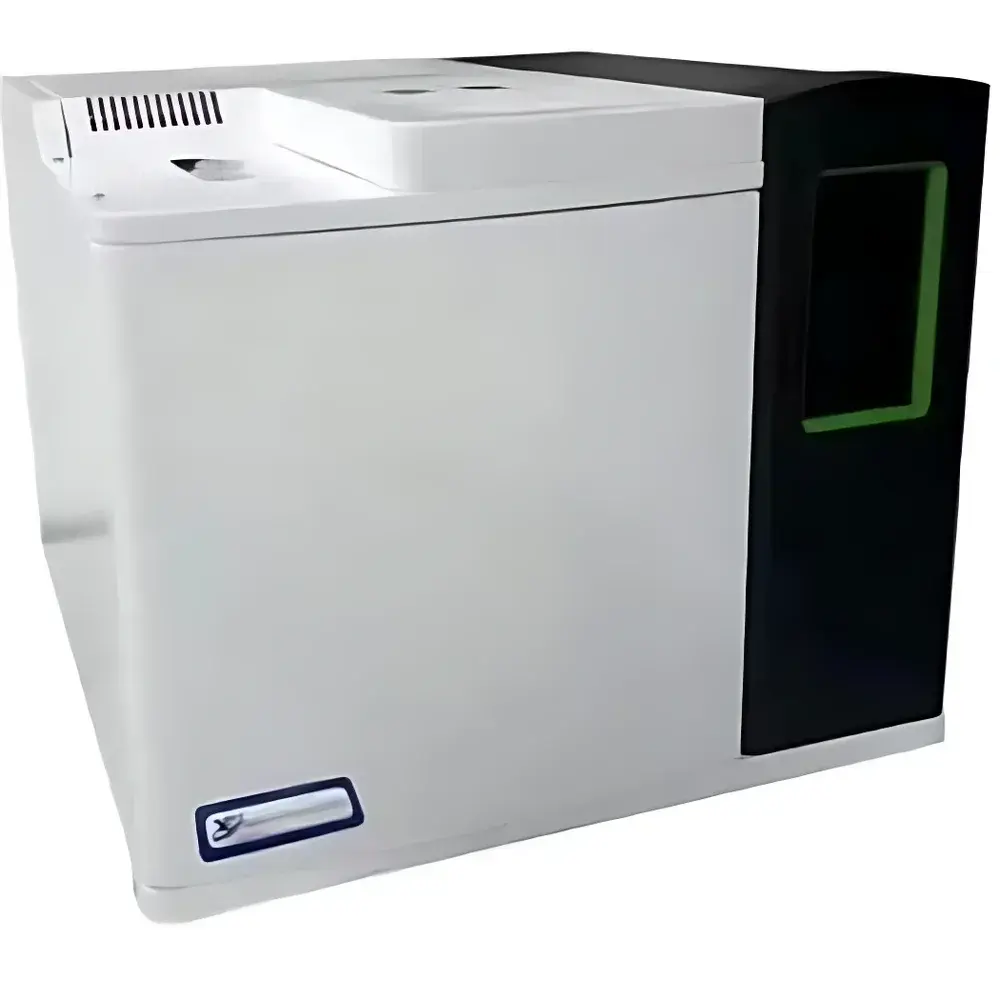
HSPX Plastic Flexible Packaging Solvent Residue Gas Chromatograph
| Brand | HSPX |
|---|---|
| Origin | Beijing, China |
| Manufacturer Type | Direct Manufacturer |
| Regional Classification | Domestic (China) |
| Model | Solvent Residue GC for Plastic Flexible Packaging |
| Instrument Type | Laboratory Gas Chromatograph |
| Application Field | Food Industry-Specific |
| Oven Temperature Range | Ambient + 5°C to 400°C |
| Ramp Rate | 0.1–40°C/min |
| Cool-down Rate | ~6 min (400°C → 50°C) |
| Carrier Gas Flow Range & Control | 0–1000 mL/min |
| Carrier Gas Pressure Range & Control | 0–970 kPa |
| Injector Max Operating Temperature | 400°C |
| Injector Pressure Setting Range | 0–970 kPa |
| Injector Total Flow Setting Range | 0–1000 mL/min |
Overview
The HSPX Plastic Flexible Packaging Solvent Residue Gas Chromatograph is a dedicated laboratory-scale gas chromatography (GC) system engineered for the precise quantification of residual organic solvents in multilayer flexible packaging films used across food, pharmaceutical, and nutraceutical supply chains. It operates on the principle of separation by volatility and differential partitioning between a mobile phase (inert carrier gas) and a stationary phase (capillary column), followed by selective detection—typically via flame ionization detection (FID)—to resolve and quantify trace-level solvent residues including toluene, xylene, ethyl acetate, methyl ethyl ketone (MEK), butyl acetate, ethanol, and isopropanol. Designed to meet stringent regulatory expectations for food-contact materials, this instrument supports compliance-driven workflows where reproducible, auditable, and method-validated data are essential for quality assurance and regulatory submissions.
Key Features
- Six independently controlled temperature zones—including oven, dual injectors, and up to three detector compartments—enable simultaneous optimization of separation efficiency, injection precision, and detector stability.
- Five-stage programmable temperature ramping (0.1–39.9°C/min) with per-stage hold time (0–655 min) accommodates wide-boiling-point solvent mixtures without compromising resolution or peak shape.
- Intelligent dual rear-door cooling system achieves rapid thermal equilibration: cooling from 300°C to 60°C in ≤7 minutes, with dynamic airflow modulation to maintain near-ambient baseline stability during low-temperature analysis.
- Modular dual-column, dual-gas-path architecture supports concurrent FID and TCD operation; optional expansion to ECD, FPD, or NPD detectors enables future adaptability for halogenated or sulfur-containing analytes.
- Capillary split/splitless injector with septum purge and make-up gas (tail-blown) functionality ensures robust introduction of headspace-derived volatile extracts while minimizing carryover and adsorption artifacts.
- Integrated power-failure recovery: retains all user-defined method parameters and resumes operation post-interruption; includes real-time drift compensation and electronic leak detection to safeguard TCD filaments and column integrity.
- Self-diagnostic firmware with alphanumeric LCD interface provides immediate fault localization (e.g., “Injector Temp Sensor Open”, “Column Flow Out of Spec”) accompanied by audible alert and on-screen guidance.
Sample Compatibility & Compliance
This GC system is validated for use with standardized headspace sampling protocols (e.g., ASTM D6866-22, ISO 11843-2) applied to solvent-extracted or thermally desorbed film specimens. It supports routine analysis per national and international food packaging safety guidelines, including GB/T 10004–2008 (China), FDA 21 CFR §177.1390, EU Commission Regulation (EC) No 1935/2004, and Swiss Ordinance SR 817.023.21. All thermal zones maintain ±0.1°C stability over extended runs, satisfying GLP/GMP requirements for instrument qualification (IQ/OQ/PQ). The system architecture allows full audit-trail configuration in accordance with FDA 21 CFR Part 11 when paired with compliant chromatography data systems (CDS).
Software & Data Management
The included GC workstation provides ISO/IEC 17025-aligned data acquisition, integration, calibration curve generation (linear, quadratic, or multi-point weighted), and report export in PDF, CSV, and XML formats. Raw data files are stored with immutable metadata timestamps, user logins, and version-controlled method templates. Optional CDS integration supports electronic signature workflows, role-based access control, and automated backup to network-attached storage or cloud repositories compliant with HIPAA and GDPR retention policies.
Applications
- Quantitative determination of residual solvents in laminated pouches, stand-up bags, and shrink sleeves prior to release for food packaging.
- Method development and validation for QC laboratories seeking accreditation under CNAS (China National Accreditation Service) or A2LA.
- Root-cause analysis of solvent retention anomalies linked to printing ink formulation, drying tunnel residence time, or lamination adhesive cure kinetics.
- Batch release testing for contract packaging organizations serving infant formula, dietary supplement, and ready-to-eat meal manufacturers.
- Supporting supplier qualification programs requiring documented evidence of solvent migration risk mitigation per EC 10/2011.
FAQ
What solvent residues can this GC detect and quantify?
It is optimized for common process solvents used in gravure and flexographic printing: toluene, xylenes (o-, m-, p-), ethyl acetate, methyl ethyl ketone (MEK), n-butyl acetate, ethanol, and isopropanol—with typical detection limits below 0.01 mg/m² when coupled with headspace autosampling.
Is the system compatible with regulatory-compliant data integrity standards?
Yes. When configured with audit-trail-enabled software and appropriate administrative controls, it meets the technical prerequisites for FDA 21 CFR Part 11, EU Annex 11, and ISO/IEC 17025 data governance requirements.
Can the instrument be upgraded to support additional detectors?
Yes. Its dual-gas-path design permits field installation of TCD, ECD, FPD, or NPD detectors without hardware replacement—only detector-specific electronics modules and gas line reconfiguration are required.
What maintenance intervals are recommended for routine operation?
Injector liner replacement every 200 injections; column trimming every 500 runs or as indicated by peak tailing; FID jet cleaning quarterly; carrier gas filter replacement every 6 months; annual preventive maintenance including valve calibration and leak verification.
Does the system include method validation documentation?
A basic IQ/OQ protocol template is provided. Full PQ documentation, including specificity, linearity, LOD/LOQ, precision, and robustness data, must be generated by the end-user lab in accordance with ICH Q2(R2) or equivalent local guidelines.




