
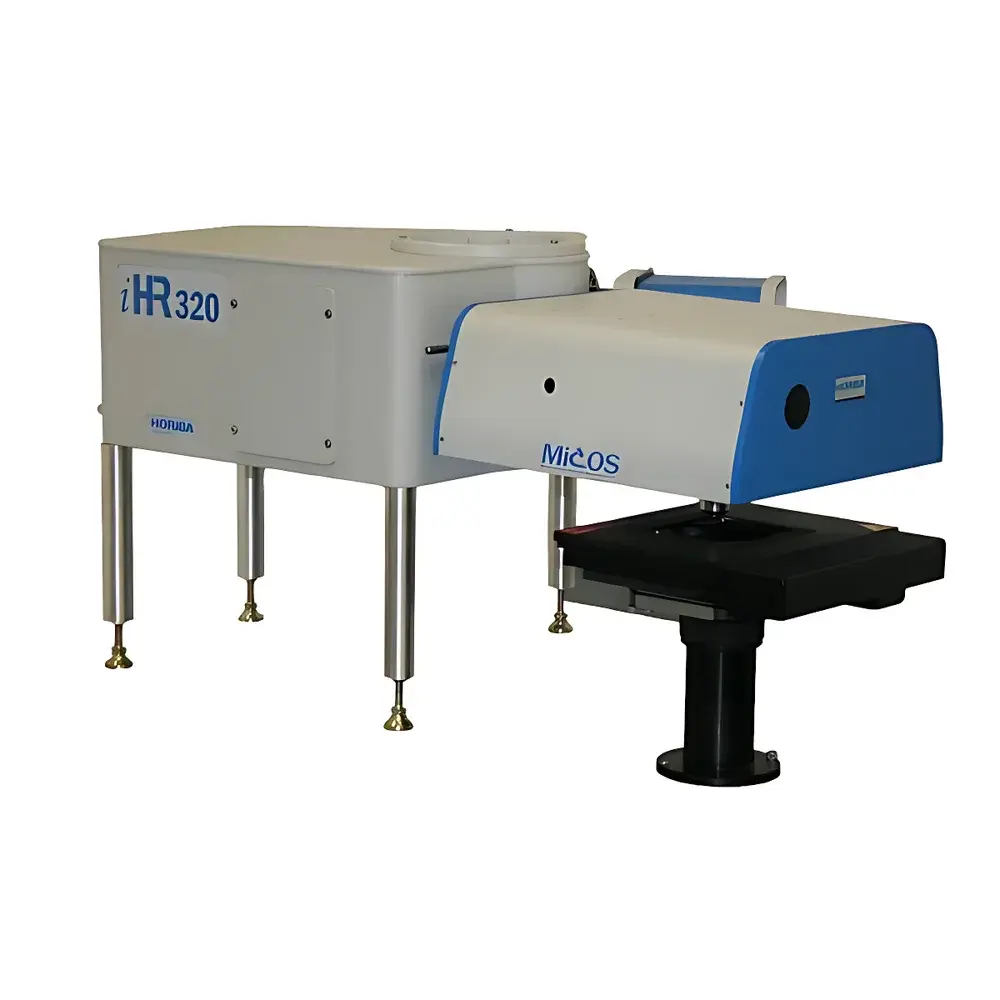
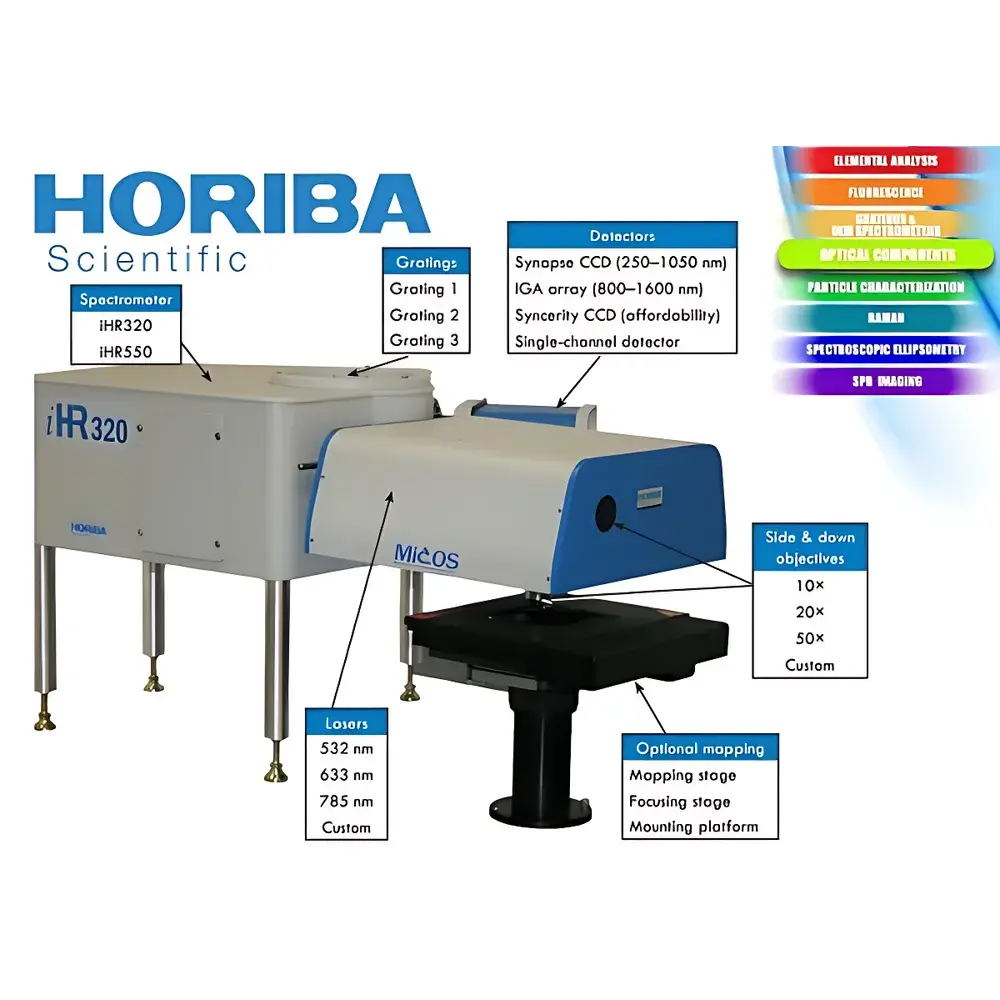
HORIBA MicOS Flexible Microscopic Optical Spectroscopy System
| Brand | HORIBA |
|---|---|
| Origin | USA |
| Manufacturer Type | Authorized Distributor |
| Product Origin | Imported |
| Model | MicOS |
| Pricing | Available Upon Request |
| Spectrometer Models | iHR320 / iHR550 |
| Spectral Range | 190–1600 nm (with multi-detector configuration) |
| Spectral Resolution | ≤0.1 nm (with 1200 g/mm grating & open-electrode CCD) |
| Detector Options | CCD (1024 × 256), InGaAs (512 × 256), Single-Channel PMT |
| Excitation Wavelengths | 325 nm, 405 nm, 488 nm, 532 nm, 633 nm, 785 nm |
| Objective Lenses | 10×, 50×, 100× (standard) |
| Microscope Configurations | Vertical (objective-down) or lateral (side-objective) |
| Sample Stage | Manual or motorized XYZ stage (optional mapping capability) |
| Integrated Imaging | Built-in digital camera for real-time sample visualization |
| Control Software | LabSpec 8 (FDA 21 CFR Part 11 compliant audit trail, GLP/GMP-ready) |
Overview
The HORIBA MicOS Flexible Microscopic Optical Spectroscopy System is an integrated platform engineered for high-precision, spatially resolved optical spectroscopy at the microscale. It combines a modular microscope probe—directly coupled to a high-throughput iHR320 or iHR550 triple-grating imaging spectrometer—with advanced excitation and detection flexibility. The system operates on core principles of confocal and epifluorescence optical spectroscopy, enabling quantitative measurement of photoluminescence (PL), electroluminescence (EL), and photomodulated reflectance (PMR) with diffraction-limited spatial resolution. Its architecture supports full spectral acquisition from deep ultraviolet (190 nm) to short-wave infrared (1600 nm), achieved via synchronized detector switching and grating selection—eliminating mechanical reconfiguration delays. Designed for research-grade reproducibility in semiconductor optoelectronics, 2D materials characterization, quantum dot analysis, and biological fluorescence mapping, MicOS delivers traceable, standards-aligned data under controlled environmental conditions.
Key Features
- Direct optical coupling between microscope probe and iHR triple-grating spectrometer ensures maximum light throughput and minimal alignment drift.
- Triple-detector capability: Simultaneous or sequential operation of back-illuminated UV-VIS CCD, InGaAs array, and single-channel PMT enables seamless spectral coverage across 190–1600 nm.
- Real-time visual feedback via integrated high-resolution digital camera, co-registered with spectroscopic acquisition coordinates.
- Dual microscope configurations: Vertical (objective-down) for standard wafer or slide-based samples; lateral (side-objective) for integration with upright cryostats or edge-emitting device testing.
- Motorized XYZ stage option supports automated spectral mapping with sub-micron positional repeatability and programmable raster scanning.
- Modular excitation interface compatible with CW and pulsed lasers (325–785 nm), LED sources, and broadband lamps—each selectable via automated filter wheels and shutter control.
Sample Compatibility & Compliance
MicOS accommodates a broad range of solid-state and biological specimens—including III–V and II–VI semiconductors, perovskite thin films, transition metal dichalcogenides (TMDs), organic LEDs, fluorescent proteins, and tissue sections—without requiring conductive coating or vacuum environments. Sample mounting is compatible with standard microscope slides, TEM grids, chip carriers, and cryogenic sample holders (e.g., Janis ST-500, BlueFrog systems). The system meets ISO/IEC 17025 calibration traceability requirements when operated with NIST-traceable reference standards (e.g., NIST SRM 2036, 2068). All hardware control and data acquisition comply with GLP and GMP documentation standards; LabSpec 8 implements full 21 CFR Part 11 compliance including electronic signatures, audit trails, and role-based access control.
Software & Data Management
Control, acquisition, and analysis are unified within HORIBA’s LabSpec 8 software suite—a Windows-based platform certified for regulated environments. LabSpec 8 provides synchronized hardware triggering, spectral deconvolution (including Voigt fitting and background subtraction), multivariate analysis (PCA, cluster mapping), and batch processing for large-area hyperspectral datasets. Raw spectra are stored in HDF5 format with embedded metadata (excitation wavelength, grating position, slit width, detector gain, temperature, stage coordinates). Export options include CSV, ASCII, and vendor-neutral JCAMP-DX for third-party analysis tools. Data integrity is enforced via checksum validation, automatic backup logging, and encrypted project archives.
Applications
- Quantitative PL quantum yield mapping of GaN-based micro-LED arrays and perovskite nanocrystal films.
- Strain and doping profiling in SiGe heterostructures via micro-Raman and micro-PL line-shape analysis.
- Time-resolved EL decay kinetics in OLED emissive layers using gated ICCD detection.
- Spatially resolved exciton binding energy extraction in monolayer MoS₂ using low-temperature (4 K) PMR spectroscopy.
- Label-free autofluorescence fingerprinting of formalin-fixed paraffin-embedded (FFPE) tissue sections for histopathological correlation.
- Defect-state identification in wide-bandgap oxides (e.g., ZnO, Ga₂O₃) through sub-bandgap luminescence mapping.
FAQ
What spectral resolution can be achieved with the MicOS system?
Resolution down to 0.1 nm (FWHM) is attainable using a 1200 g/mm grating and open-electrode CCD detector at 500 nm; actual resolution depends on slit width, grating choice, and detector pixel binning.
Is cryogenic operation supported?
Yes—lateral configuration enables direct coupling to upright liquid-helium cryostats; thermal drift compensation is implemented via active focus stabilization and stage temperature logging.
Can the system perform time-resolved measurements?
When equipped with optional gated detectors (ICCD or TCSPC modules), MicOS supports lifetime measurements from sub-nanosecond to millisecond scales.
How is calibration maintained across spectral ranges?
Automated wavelength calibration uses internal Hg/Ar/Ne lamp references before each acquisition sequence; intensity calibration employs NIST-traceable tungsten halogen and deuterium standards.
Is remote operation and multi-user access possible?
LabSpec 8 supports networked client-server deployment with concurrent user sessions, role-based permissions, and secure SSH/TLS data transfer.





