
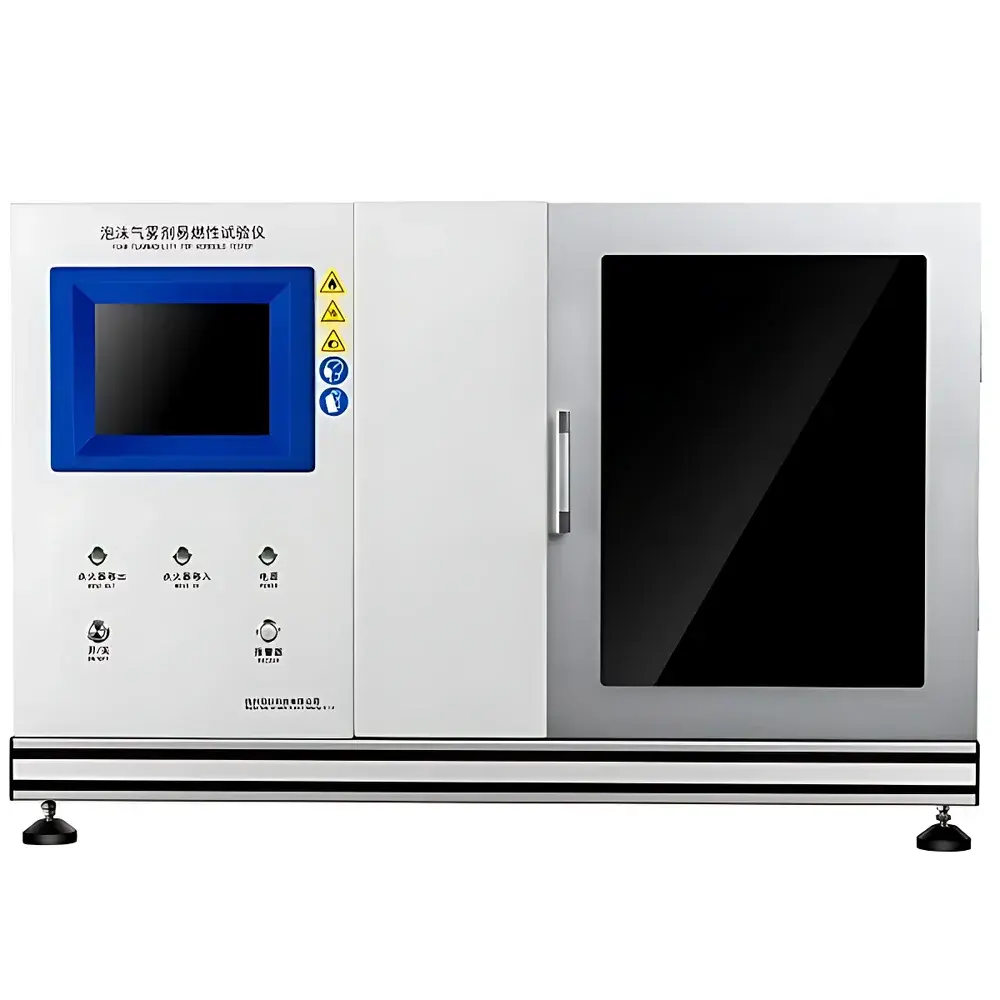
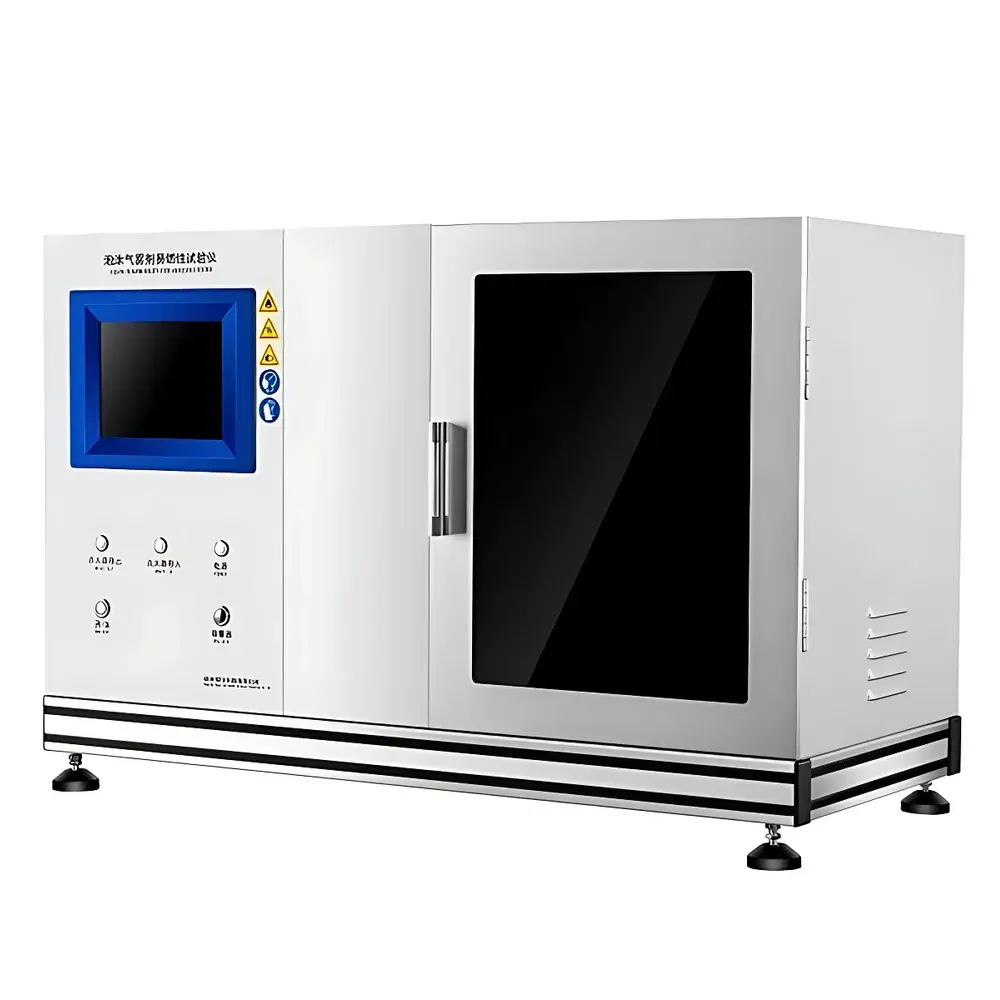
Young Instruments HWP11-10S Aerosol Foam Flammability Tester
| Brand | Young Instruments |
|---|---|
| Origin | Zhejiang, China |
| Manufacturer Type | Manufacturer |
| Country of Origin | Domestic (China) |
| Model | HWP11-10S |
| Price | Upon Request |
| Operating Temperature | (-5 to 45) °C |
| Relative Humidity Range | 5–95 %RH |
| Flame Height Detection Range | 0–235 mm |
| Flame Height Resolution | 5 mm |
| Flame Detection Response Time | ≤6 ms |
| Ambient Temperature Measurement Range | (-10 to +60) °C |
| Ambient Temperature Accuracy | ±0.5 °C |
| Ambient Humidity Accuracy | ±5.0 %RH |
| Ignition Method | Gas-powered igniter |
| Timing Accuracy | ±0.01 s |
| Sample Support Plate Diameter | Ø150 mm |
| Support Plate Material | High-Temperature Quartz |
Overview
The Young Instruments HWP11-10S Aerosol Foam Flammability Tester is a purpose-built instrument engineered for the standardized evaluation of flammability characteristics of aerosolized foam, gel, and paste formulations. It operates on the principle of controlled ignition and optical flame height quantification under precisely defined environmental conditions. The system complies with UN ST/SG/AC.10/Rev.6, Section 31.6 — “Test for Flammability of Aerosol Foams” — and its nationally adopted equivalents, including GB/T 21632–2008 (“Dangerous Goods – Test Method for Combustibility of Aerosol Foams”), GAT 536 (“Classification and Test Methods for Fire Hazard of Flammable and Explosive Dangerous Goods”), and NY/T 1860.27 (“Guidelines for Physicochemical Property Determination of Pesticides — Part 27: Flammability of Aerosols”). Designed for regulatory testing laboratories, quality control departments in chemical manufacturing, and safety assessment units, the HWP11-10S delivers repeatable, auditable, and standards-aligned test outcomes essential for UN classification, SDS authoring, and transport compliance documentation.
Key Features
- Embedded Windows CE operating system with real-time process control and intuitive 8-inch capacitive touchscreen interface;
- High-speed optical flame detection subsystem with ≤6 ms response time and 5 mm spatial resolution for accurate flame height tracking;
- Multi-layer optical shielding architecture minimizes ambient light interference, enabling robust flame edge recognition across irregular combustion profiles (e.g., flickering, asymmetric, or transient foam flames);
- Automated flame height thresholding algorithm eliminates subjective visual interpretation, ensuring inter-operator consistency and traceable pass/fail determinations;
- Integrated high-precision environmental monitoring module continuously records ambient temperature (±0.5 °C) and relative humidity (±5.0 %RH) during test execution;
- Gas-powered igniter provides stable, reproducible ignition timing synchronized with high-resolution digital chronometry (±0.01 s);
- Quartz glass support plate (Ø150 mm) withstands thermal shock and residue accumulation without degradation in optical clarity or dimensional stability;
- Fully automated test sequence—from sample placement and environmental stabilization to ignition, flame capture, data logging, and report generation—requires zero manual intervention post-setup.
Sample Compatibility & Compliance
The HWP11-10S accommodates a broad spectrum of semi-solid aerosol dispersions, including water-based foams, hydrocarbon-propelled gels, silicone-based pastes, and pesticide formulations meeting NY/T 1860.27 requirements. Its mechanical and optical design ensures compatibility with non-uniform discharge patterns typical of valve-triggered foam expansion. All hardware, firmware, and test logic are validated against the procedural rigor of UN Manual of Tests and Criteria, Part III, Subsection 31.6. The instrument supports full audit trails required under GLP-compliant environments and facilitates alignment with ISO/IEC 17025 documentation frameworks. While not inherently 21 CFR Part 11 compliant out-of-the-box, its data export structure (CSV, PDF reports with timestamps, operator ID, and environmental metadata) enables integration into validated LIMS or ELN platforms supporting electronic signature and change control.
Software & Data Management
The embedded Windows CE application provides localized configuration menus for test parameters (e.g., stabilization duration, ignition delay, flame persistence threshold), user access levels, and calibration log management. Real-time animated visualization displays flame propagation dynamics frame-by-frame, aiding method development and troubleshooting. All raw sensor outputs—including photodiode voltage traces, thermohygrometric logs, and timestamped flame height vectors—are stored internally and exportable via USB. Reports conform to GB/T 21632–2008 formatting conventions and include test identifier, environmental conditions, observed maximum flame height, burn duration, pass/fail status per UN criteria, and digital signatures where enabled by external authentication infrastructure.
Applications
- UN hazard classification of consumer and industrial aerosol products prior to transport (UN 2.1, 2.2, or non-hazardous determination);
- Formulation screening during R&D of low-flammability personal care foams and pharmaceutical sprays;
- Regulatory submission support for EPA, ECHA, and CNCA dossier packages requiring standardized flammability evidence;
- Internal QC verification for manufacturers of fire-retardant coatings, disinfectant gels, and insecticidal aerosols;
- Third-party certification testing in CNAS-accredited laboratories performing GAT 536-compliant hazard grading;
- Method validation studies comparing foam expansion kinetics under varying propellant blends and surfactant systems.
FAQ
What international standards does the HWP11-10S directly support?
It is configured and verified for UN ST/SG/AC.10/Rev.6 Section 31.6, GB/T 21632–2008, GAT 536, and NY/T 1860.27. Equivalent transpositions (e.g., ASTM D7407–22 Annex A1) may be implemented via parameter adjustment and lab-specific validation.
Can the instrument distinguish between flash fire and sustained flame propagation?
Yes—the system captures temporal flame height profiles at ≥100 Hz equivalent sampling rate, allowing differentiation between transient ignition events (2 s), as mandated by UN criteria.
Is quartz support plate cleaning and maintenance documented in the user manual?
Yes—cleaning protocols using anhydrous ethanol and lint-free wipes, along with periodic optical alignment verification using NIST-traceable reference targets, are included in the operational maintenance section.
Does the system support remote diagnostics or firmware updates?
Firmware updates are performed locally via USB drive; remote connectivity is not enabled by default but can be integrated through optional Ethernet-enabled industrial gateways compatible with Modbus TCP or OPC UA protocols.
How is measurement uncertainty addressed for flame height determination?
The 5 mm resolution is derived from calibrated pixel-to-mm mapping under standardized illumination geometry. Combined standard uncertainty (k=2) for flame height reporting is ≤±8 mm, incorporating optical parallax, substrate flatness, and edge-detection algorithm repeatability—fully documented in the factory calibration certificate.





