
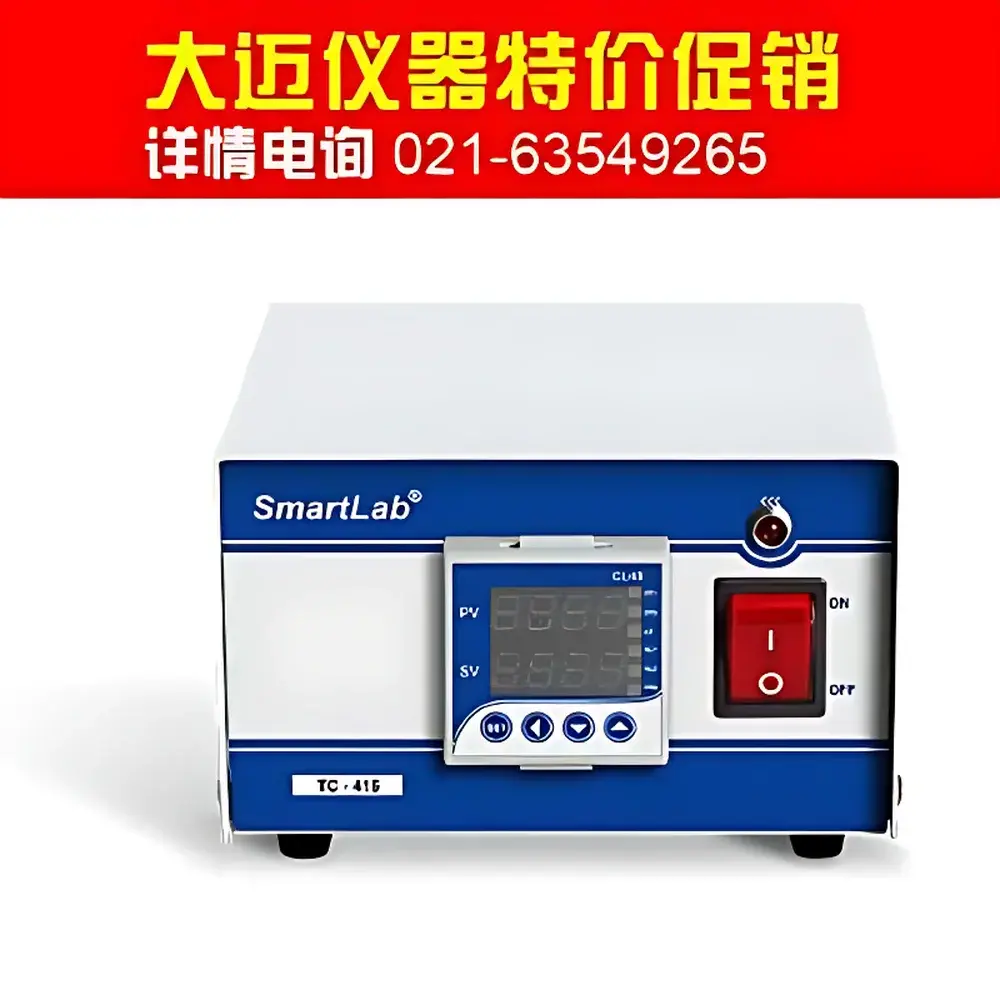
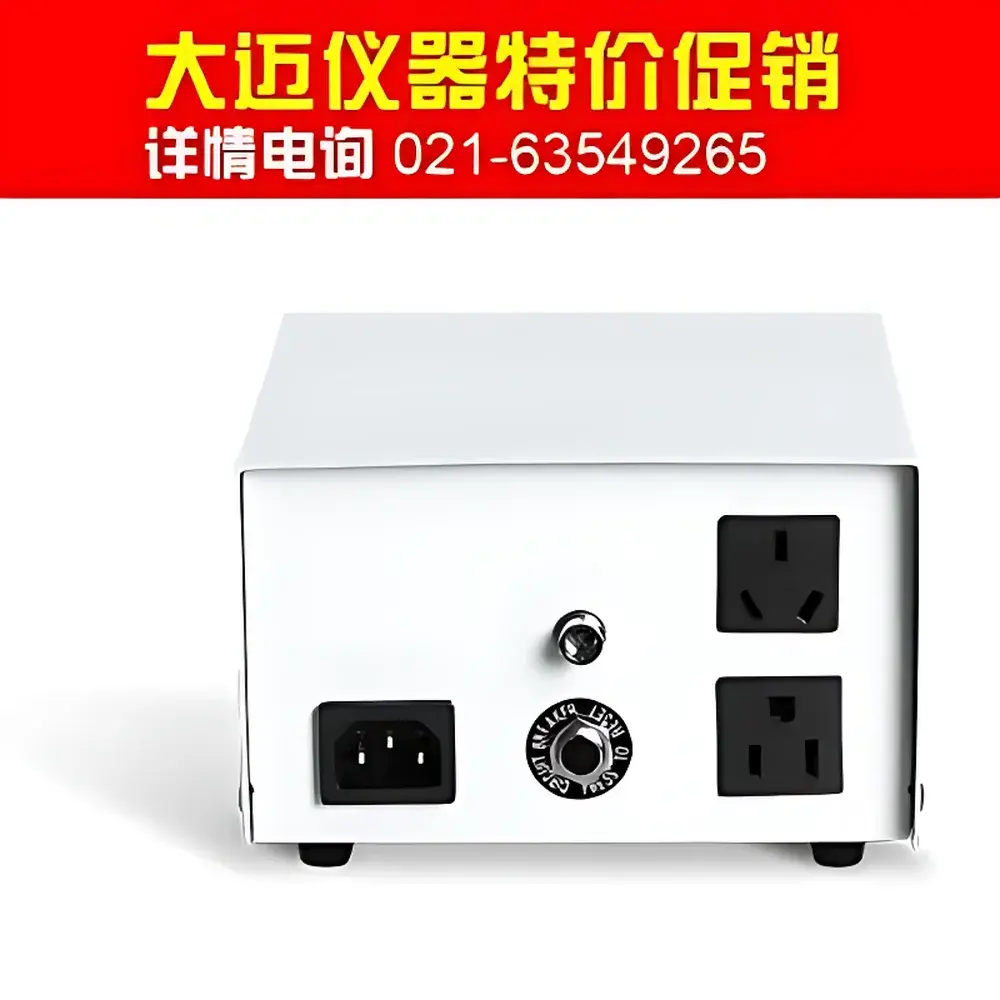
TC-415 Precision PID Temperature Controller
| Origin | Taiwan |
|---|---|
| Manufacturer Type | Distributor |
| Origin Category | Domestic (China-sourced) |
| Model | TC-415 |
| Quotation | Upon Request |
| Temperature Range | 0–400 °C |
| Resolution | 0.1 °C |
| Display | 4-digit LED |
| Control Method | Auto-tuning & Manual PID |
| Sensor Input | PT100 Ω and Type K Thermocouple |
| Control Accuracy | ±0.2% of Full Scale |
| Power Supply | 110/220 V AC, 15 A |
| Output Type | SSR + Plug-in Terminal Block |
| Housing | Stainless Steel with Powder-Coated Finish |
| Features | Power Failure Memory, Setpoint Lock, Ramp Rate Programming (°C/min), Deviation Compensation, Optional Multi-Step Program Control (up to 8 segments), Optional Timer (00:00–99:59 h:mm) |
Overview
The TC-415 Precision PID Temperature Controller is an industrial-grade, microprocessor-based thermal regulation instrument engineered for high-stability temperature management in laboratory ovens, environmental chambers, heating mantles, fluid baths, and custom thermal test fixtures. Utilizing dual-mode PID control architecture—supporting both auto-tuned and manually adjustable parameters—the TC-415 delivers consistent setpoint tracking across dynamic load conditions. Its core measurement system accepts two industry-standard sensor inputs: platinum resistance thermometers (PT100 Ω, Class B, 3-wire configuration) and Type K thermocouples, enabling seamless integration with existing calibration infrastructure. With a full-scale operating range of 0 to 400 °C and 0.1 °C digital resolution, the controller meets the repeatability and traceability requirements of ISO/IEC 17025-accredited laboratories performing thermal validation, material aging studies, or process qualification under ASTM E220, IEC 60584, or USP .
Key Features
- High-fidelity 4-digit LED display with ultra-bright segment lighting for clear visibility under ambient lab lighting or hood-mounted installations
- Dual-sensor compatibility: simultaneous support for PT100 Ω (RTD) and Type K thermocouple inputs with automatic sensor type recognition
- PID algorithm with adaptive auto-tuning and manual parameter adjustment (P, I, D, and output limit settings)
- Temperature deviation compensation function—enables offset correction at user-defined points to counteract systematic thermal lag or sensor drift
- Ramp-and-soak programming: programmable heating/cooling rate (°C/min) and hold duration per step; optional multi-segment profile control (8-step sequence)
- Setpoint lockout feature prevents accidental modification during unattended operation—critical for GLP/GMP-compliant workflows
- Non-volatile memory retains all configuration parameters—including setpoints, PID coefficients, and ramp profiles—during power interruption
- Robust stainless steel housing with electrostatic powder coating ensures corrosion resistance and mechanical durability in humid or chemically exposed environments
- SSR-compatible solid-state relay output (0–10 V DC or 4–20 mA optional) plus plug-in terminal block for rapid field wiring and maintenance
Sample Compatibility & Compliance
The TC-415 interfaces directly with resistive heating elements, cartridge heaters, band heaters, and Peltier modules rated up to 15 A at 220 V AC. It is compatible with standard laboratory thermal enclosures including forced-air ovens (e.g., Binder, Memmert), vacuum drying chambers, and jacketed reactors. The device complies with IEC 61000-6-2 (EMC immunity) and IEC 61000-6-4 (EMC emissions) standards. Its firmware architecture supports audit-ready operation: all setpoint changes, alarm events, and manual overrides are timestamped and stored in internal event logs—facilitating FDA 21 CFR Part 11 compliance when integrated into validated systems with external data logging.
Software & Data Management
While the TC-415 operates as a standalone front-panel controller, it supports analog output (0–10 V or 4–20 mA) for real-time process variable transmission to SCADA systems, PLCs, or PC-based DAQ platforms (e.g., LabVIEW, MATLAB Data Acquisition Toolbox). Optional RS-485 Modbus RTU communication enables remote monitoring and parameter configuration via host software—allowing centralized fleet management across multiple thermal units. All configuration changes are logged with UTC timestamps and operator ID fields (when paired with external authentication systems), satisfying traceability requirements for ISO 9001 and ISO 13485 quality management systems.
Applications
- Thermal stability testing of polymers, pharmaceutical excipients, and battery electrolytes per ICH Q1A(R2) guidelines
- Calibration of reference thermometers and thermocouple wire in metrology labs
- Control of heating zones in multi-zone sintering furnaces and annealing ovens
- Process validation of sterilization cycles in autoclave auxiliary heating circuits
- Environmental stress screening (ESS) for electronic components per MIL-STD-810
- Accelerated aging studies of adhesives, coatings, and composites under controlled thermal ramp profiles
FAQ
Does the TC-415 support NIST-traceable calibration?
Yes—the controller accepts calibrated PT100 and Type K sensors with documented uncertainty budgets. Internal offset compensation allows alignment to certified reference temperatures without hardware modification.
Can it be integrated into a GMP-regulated manufacturing environment?
When deployed with Modbus-enabled data logging, audit trail generation, and user access controls, the TC-415 satisfies key elements of FDA 21 CFR Part 11 and EU Annex 11 for computerized system validation.
What is the maximum load capacity for the SSR output?
The SSR driver supports loads up to 15 A at 220 V AC. For higher-power applications (e.g., >3.3 kW), external contactors or SCR power controllers must be used in series with the TC-415’s control signal.
Is firmware upgrade capability available?
Firmware updates are performed via RS-485 using vendor-provided configuration utilities. Version history and update logs are retained internally for regulatory review.
How is temperature uniformity ensured across large-volume chambers?
The TC-415 itself regulates only a single sensor zone. Uniformity optimization requires strategic sensor placement, auxiliary air circulation, and optionally, cascade control using secondary zone controllers synchronized via analog setpoint modulation.



