
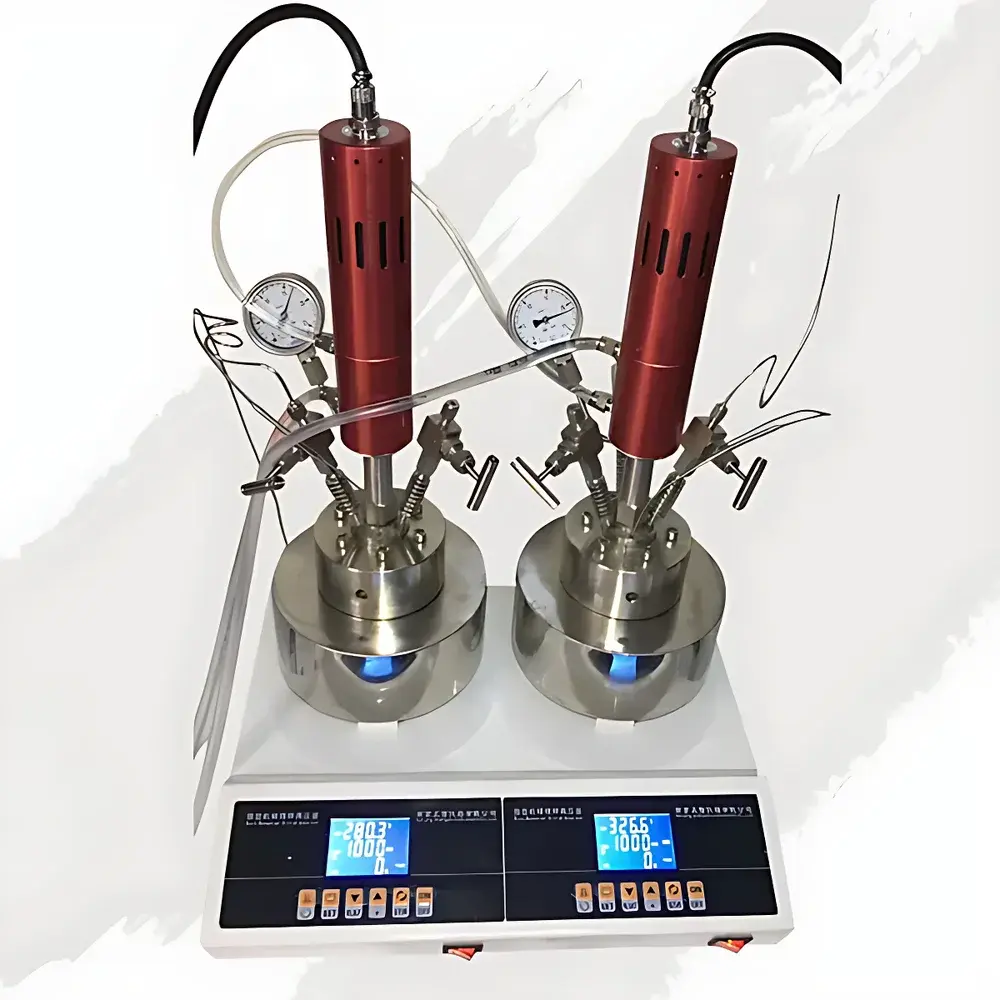
ZX-YIQI K-2-PS Parallel Mechanical Stirring Micro Reactor System
| Brand | ZX-YIQI |
|---|---|
| Origin | Jiangsu, China |
| Manufacturer Type | Authorized Distributor |
| Country of Origin | China |
| Model | K-2-PS |
| Price | USD 8,700 (FOB Jiangsu) |
| Usable Volume | 100 mL |
| Vessel Material | 316L Stainless Steel |
| Operating Pressure Range | –0.1 to 30 MPa |
| Vacuum Capability | ≤ –0.1 MPa (absolute) |
| Temperature Range | Ambient to 600 °C |
| Stirring Speed | 0–400 rpm |
| Motor Power | 100 W |
| Heating Power | 0–2500 W |
| Control Accuracy | ±1 °C |
| Safety Features | Dual-pressure relief (Hastelloy C-276 rupture disc), overtemperature/overpressure auto-alarm, dual-circuit interlocked PID temperature control |
| Sealing Options | Soft-seal (PTFE/gasket) or hard-seal (metal-to-metal) |
| Stirring Torque | Up to 40 N·m |
| Electrical Supply | 220 V AC / 50 Hz (110 V option available) |
Overview
The ZX-YIQI K-2-PS Parallel Mechanical Stirring Micro Reactor System is an engineered solution for high-fidelity small-scale reaction studies under demanding thermal, pressure, and rheological conditions. Designed in close collaboration with academic research groups across China, this system implements Couette-type mechanical stirring within a precisely machined, monolithic 316L stainless steel vessel—fabricated via CNC machining center to ensure dimensional integrity and surface finish critical for reproducible sealing and thermal uniformity. Its operational envelope spans from vacuum (≤ –0.1 MPa abs) to 30 MPa, and from ambient temperature up to 600 °C—enabling applications in catalytic screening, polymerization kinetics, supercritical fluid synthesis, hydrogenation under inert atmosphere, and high-temperature/low-volume quantitative reaction optimization. The reactor’s core architecture integrates process safety fundamentals—including ASME-compliant pressure containment, dual-stage overpressure protection, and fail-safe thermal interlocks—making it suitable for GLP-compliant laboratories conducting method development per ASTM E2913, ISO 17025, or USP guidelines.
Key Features
- Monolithic 316L stainless steel reactor body, precision-machined in one setup to eliminate weld-induced stress concentrations and ensure leak-tight integrity at elevated pressures.
- Clamp-and-latch quick-release closure mechanism with six symmetrically distributed Allen-head tensioning screws—reducing manual effort during repeated opening/closing cycles and minimizing gasket creep over extended use.
- Dual-path PID temperature control with independent heating and sensing circuits; prevents thermal overshoot and supports programmable ramp-hold profiles (optional upgrade).
- Brushless DC motor drive with rare-earth magnet rotor—provides continuous low-noise operation, bidirectional rotation, and torque stability up to 40 N·m for highly viscous media (e.g., polymer melts, slurries, or catalyst suspensions).
- Modular heating design: fully enclosed stainless steel heater cartridge enables rapid thermal response and allows physical separation of heating unit from reactor body for maintenance or sterilization protocols.
- Hastelloy C-276 rupture disc integrated into pressure relief path—certified for burst tolerance up to 30 MPa and compliant with ISO 4126-2 requirements for non-reclosing pressure relief devices.
Sample Compatibility & Compliance
The K-2-PS accommodates heterogeneous, viscous, and gas-evolving reaction mixtures—including but not limited to organometallic precursors, polycondensation intermediates, Fischer–Tropsch catalysts, and pharmaceutical API intermediates. Vessel liners (optional) include PTFE, quartz, and PPL for enhanced chemical resistance in aggressive halogenated or strongly acidic environments. All wetted components conform to ASTM A240 and ASME BPVC Section VIII Div. 1 material specifications. Pressure instrumentation meets EN 837-1 accuracy class 1.6; temperature sensors are calibrated traceable to NIST standards. The system supports audit-ready operation under FDA 21 CFR Part 11 when paired with optional electronic logbook software.
Software & Data Management
While the base configuration features an embedded LCD controller with real-time display of temperature, pressure, stirring speed, and elapsed time, optional PC-based acquisition software enables synchronized logging at 1 Hz resolution across all analog inputs. Data export is supported in CSV and Excel-compatible formats, with timestamped metadata including operator ID, batch number, and calibration status. Optional features include event-triggered data capture (e.g., upon alarm activation), configurable alarm escalation (visual + audible), and secure user-level access control aligned with GxP documentation workflows.
Applications
- Catalyst screening under controlled H₂ partial pressure (up to 10 MPa) and temperatures ≥ 300 °C.
- Kinetic modeling of step-growth polymerizations using precise stoichiometric dosing and real-time viscosity tracking via torque feedback.
- Supercritical CO₂-mediated extractions and reactions requiring simultaneous pressure stabilization and mechanical agitation.
- High-temperature hydrothermal synthesis of metal oxides and MOFs where oxygen exclusion and thermal homogeneity are critical.
- Process safety testing—including adiabatic calorimetry proxy experiments—using controlled exotherm induction within sub-100 mL volumes.
FAQ
What materials are available for reactor lining or internal components?
Standard options include PTFE, quartz, and PPL; custom linings in sapphire, alumina, or Hastelloy B-2 are available upon engineering review.
Is the system compatible with inert gas purging and blanketing protocols?
Yes—dual gas inlet ports (one for purge, one for reactant delivery) support sequential evacuation/refill cycles with mass flow controllers and residual O₂ monitoring down to 10 ppm.
Can the K-2-PS be integrated into automated reaction platforms?
It supports RS485 Modbus RTU and optional Ethernet/IP communication for integration with third-party LIMS or robotic liquid handlers.
What validation documentation is supplied with the system?
Each unit ships with Factory Acceptance Test (FAT) report, material certificates (EN 10204 3.1), pressure test record (hydrostatic at 1.5× MAWP), and calibration certificates for temperature and pressure transducers.
Does the system meet explosion-proof certification requirements for Class I, Division 1 environments?
The base unit is rated for general laboratory use; ATEX or IECEx-certified variants with intrinsically safe motor drives and sealed electronics are available as engineered options.



