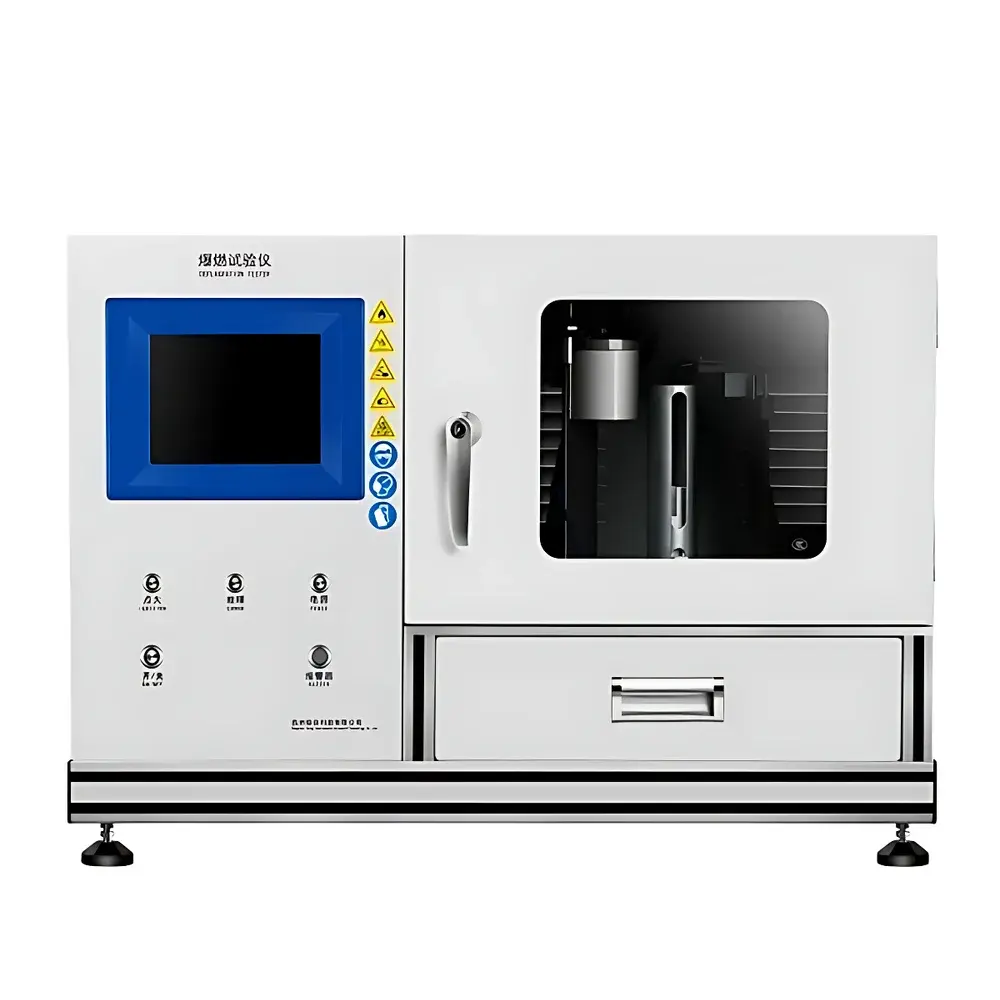
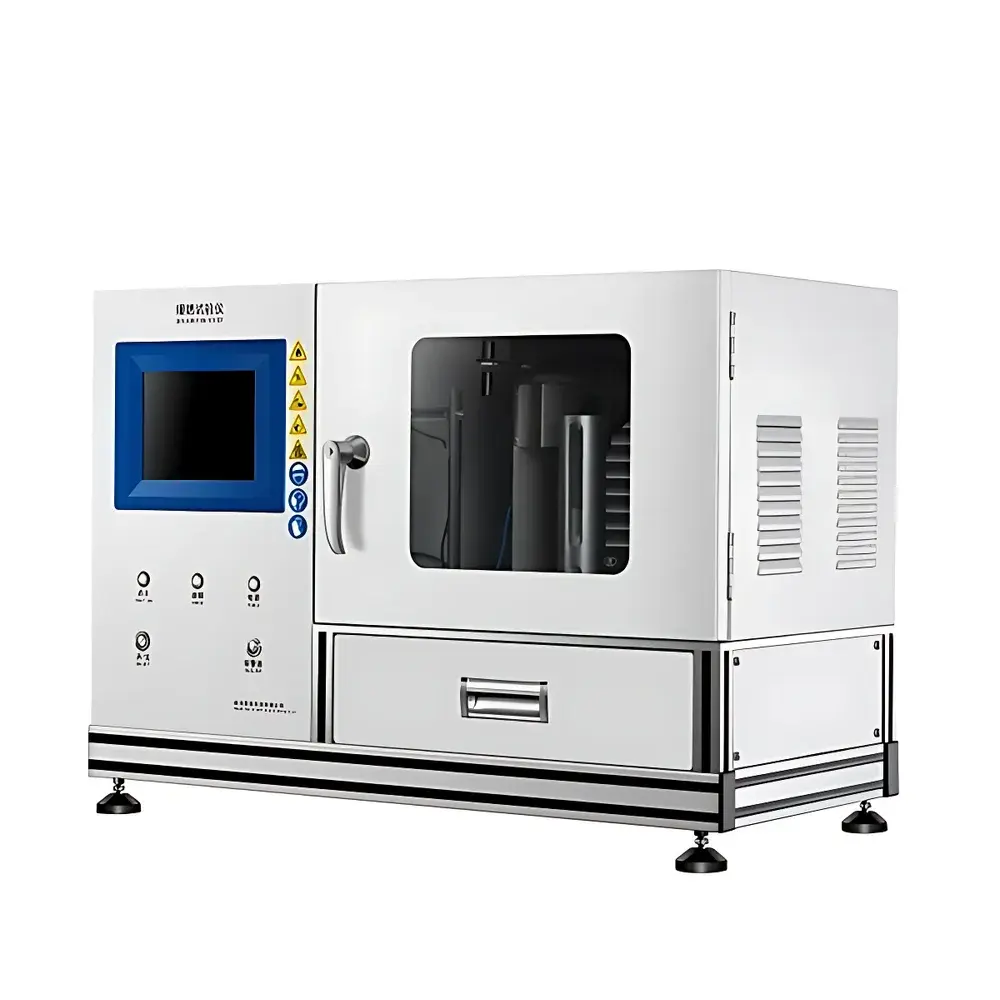
Young Instruments HWP14-10S Deflagration Test Apparatus
| Brand | Young Instruments |
|---|---|
| Origin | Zhejiang, China |
| Manufacturer Type | Manufacturer |
| Country of Origin | Domestic (China) |
| Model | HWP14-10S |
| Quotation | Upon Request |
| Operating Environment | (-5 to 45) °C, <95% RH |
| Temperature Measurement Range | (-40 to 1000) °C |
| Temperature Resolution | 0.1 °C |
| Temperature Accuracy | ±1.5 °C or ≤ ±0.004 |
| Temperature Sampling Rate | 1000 Hz |
| Deflagration Distance | 50 mm |
| Deflagration Velocity Range | ≤1500 mm/s |
| Velocity Measurement Accuracy | ±0.1 mm/s |
| Time Display Resolution | ±0.1 ms |
| Detection Method | Thermocouple-based temperature monitoring |
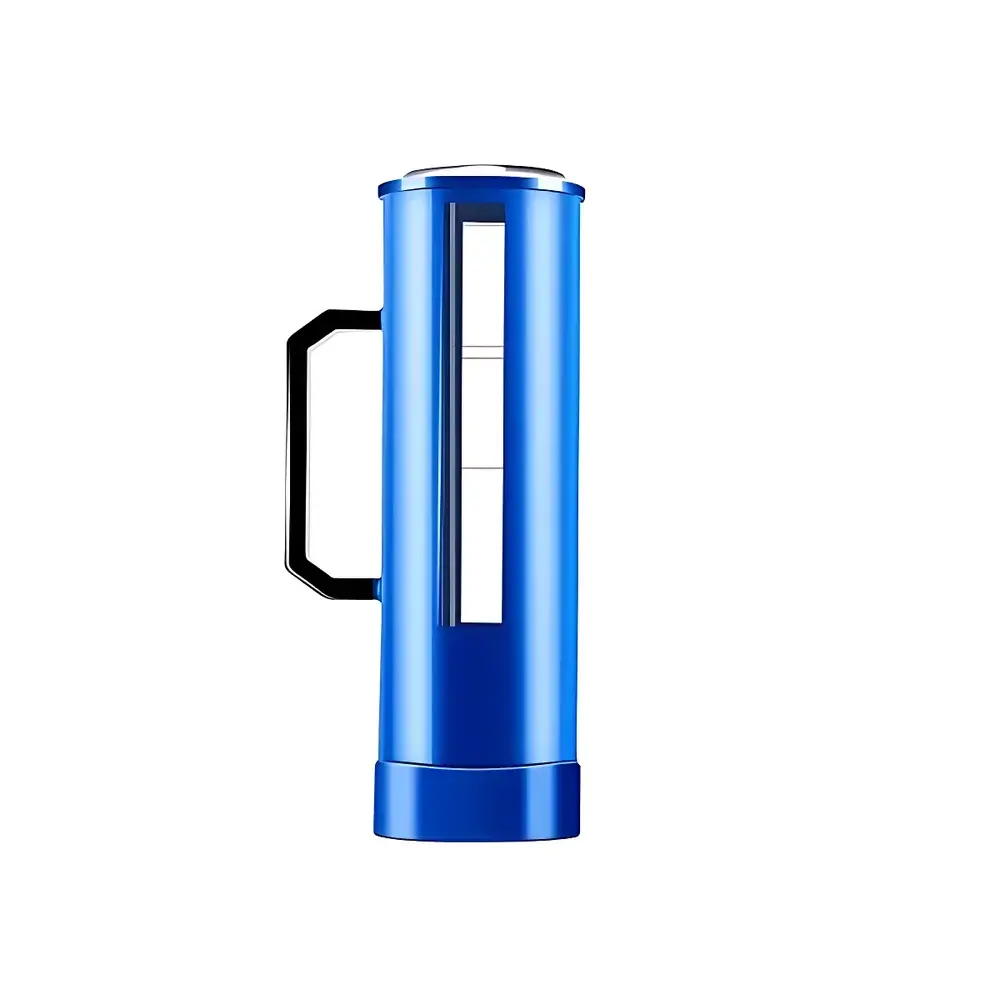
| Dewar Vessel Internal Volume | 300 cm³ |
| Dewar Inner Diameter | 48 mm |
| Dewar Outer Diameter | 60 mm |
| Dewar Length | 200 mm |
| Dewar Cooling Half-life | ≥5 h |
| Ignition Flame Length | ≥20 mm |
| Instrument Dimensions (L×W×H) | 830 mm × 400 mm × 600 mm |
Overview
The Young Instruments HWP14-10S Deflagration Test Apparatus is a purpose-built, CE-compliant laboratory instrument engineered for the quantitative assessment of deflagration propagation behavior in self-reactive substances and organic peroxides. It operates on the principle of controlled thermal ignition followed by high-speed thermal front tracking—measuring the velocity at which a combustion wave propagates axially through a confined sample column under standardized thermal boundary conditions. This apparatus implements the fundamental physics of unconfined or semi-confined deflagration dynamics, where flame speed and thermal rise rate serve as primary indicators of hazardous reactivity. Designed specifically to meet the stringent procedural requirements of UN Manual of Tests and Criteria, Part II, Section 23.4.2, Test C.2 (Deflagration Test), it also fulfills national regulatory test protocols including GB/T 21571–2008 “Test Method for Transition from Deflagration to Detonation of Dangerous Goods” and GB 5085.5 “Identification Standards for Hazardous Waste – Reactivity Identification.” Its architecture supports traceable, repeatable, and auditable test execution in compliance with GLP principles and quality assurance frameworks applicable to chemical safety evaluation laboratories.
Key Features
- Embedded Windows CE operating system with real-time control logic and deterministic response timing
- 8-inch industrial-grade capacitive touchscreen interface enabling intuitive parameter configuration, live thermal curve visualization, and status monitoring without external PC dependency
- High-fidelity thermocouple acquisition system sampling at 1000 Hz, supporting sub-millisecond temporal resolution for precise front velocity derivation
- Robust reaction chamber constructed from high-temperature alloy and sealed with tempered borosilicate viewing window—rated for repeated exposure to transient thermal loads up to 1000 °C and peak overpressures consistent with Class 1.3G deflagration events
- Motorized gas burner with programmable rotational positioning and calibrated jet-type ignition flame (≥20 mm length), ensuring reproducible energy input across test sequences
- Remote wireless ignition trigger with dual-stage safety interlock, eliminating operator proximity during initiation phase
- Automated test sequence execution: auto-zeroing, pre-conditioning, ignition, data capture, post-test cooldown verification, and report generation—all executed without manual intervention
- Dewar vessel with 300 cm³ internal volume, optimized geometry (48 mm ID, 200 mm length), and ≥5-hour thermal half-life to maintain stable baseline conditions between consecutive tests
Sample Compatibility & Compliance
The HWP14-10S accommodates solid, paste-like, and granular formulations typical of industrial organic peroxides (e.g., benzoyl peroxide, lauroyl peroxide), azo initiators, nitrocellulose derivatives, and other thermally unstable self-reactive compounds classified under UN Division 4.1 or 5.2. Sample loading follows strict volumetric protocols defined in Test C.2—50 mm column height within the standardized Dewar geometry ensures consistent heat transfer boundary conditions. The system complies with ISO/IEC 17025 documentation requirements for test method validation, and its measurement uncertainty budget has been characterized per GUM (JCGM 100:2008) for temperature and time domains. All firmware and calibration records support audit readiness for regulatory inspections aligned with CNAS, CMA, or OECD GLP standards.
Software & Data Management
Instrument firmware provides native data logging with timestamped thermal profiles (°C vs. ms), derived deflagration velocity curves (mm/s vs. position), and event markers for ignition, onset, and peak temperature. Raw datasets are stored in IEEE-compliant CSV format with embedded metadata (operator ID, test ID, ambient conditions, calibration certificate IDs). Export options include PDF summary reports compliant with GB/T 21571–2008 Annex B templates. Audit trail functionality logs all user actions—including parameter modifications, calibration events, and report exports—with immutable timestamps and operator authentication. While not FDA 21 CFR Part 11-certified out-of-the-box, the system architecture supports integration into validated LIMS environments via RS-232/USB CDC virtual COM port and Modbus TCP protocol extensions.
Applications
- Hazard classification of new chemical entities under UN TDG, ADR, IMDG, and IATA regulations
- Formulation screening for thermal stability optimization in polymer initiators and curing agents
- Batch release testing of commercial organic peroxides against specification limits for maximum allowable deflagration velocity
- Root cause analysis of field incidents involving unexpected energetic decomposition
- Supporting SDS Section 9 (Physical and Chemical Properties) and Section 10 (Stability and Reactivity) authoring
- Research into decomposition kinetics of nitrogen-rich heterocycles and metal-catalyzed peroxide systems
FAQ
What standards does the HWP14-10S directly implement?
It is configured and validated for UN Test C.2 (Manual of Tests and Criteria), GB/T 21571–2008, and GB 5085.5. Equivalent methods from ASTM E681 or EN 13423 may be adapted via user-defined test templates.
Is the Dewar vessel reusable after each test?
Yes—the stainless-steel Dewar is designed for ≥500 test cycles when operated within specified thermal and pressure limits; routine visual inspection and calibration verification are recommended every 50 runs.
Can the system measure both deflagration onset time and propagation velocity simultaneously?
Yes—onset is identified via first-derivative threshold detection on the thermocouple signal; velocity is calculated using finite-difference approximation across sequential 50-mm spatial intervals with synchronized time stamps.
Does the apparatus require external cooling water or liquid nitrogen?
No—it relies solely on passive thermal mass and insulated housing; the ≥5-hour Dewar cooling half-life eliminates need for active cryogenic support.
How is operator safety ensured during ignition?
Three independent safeguards: (1) physical separation via armored viewing window, (2) mandatory remote ignition with line-of-sight confirmation, and (3) hardware-enforced interlock preventing chamber access until thermal decay confirms safe residual temperature.
Related Products