
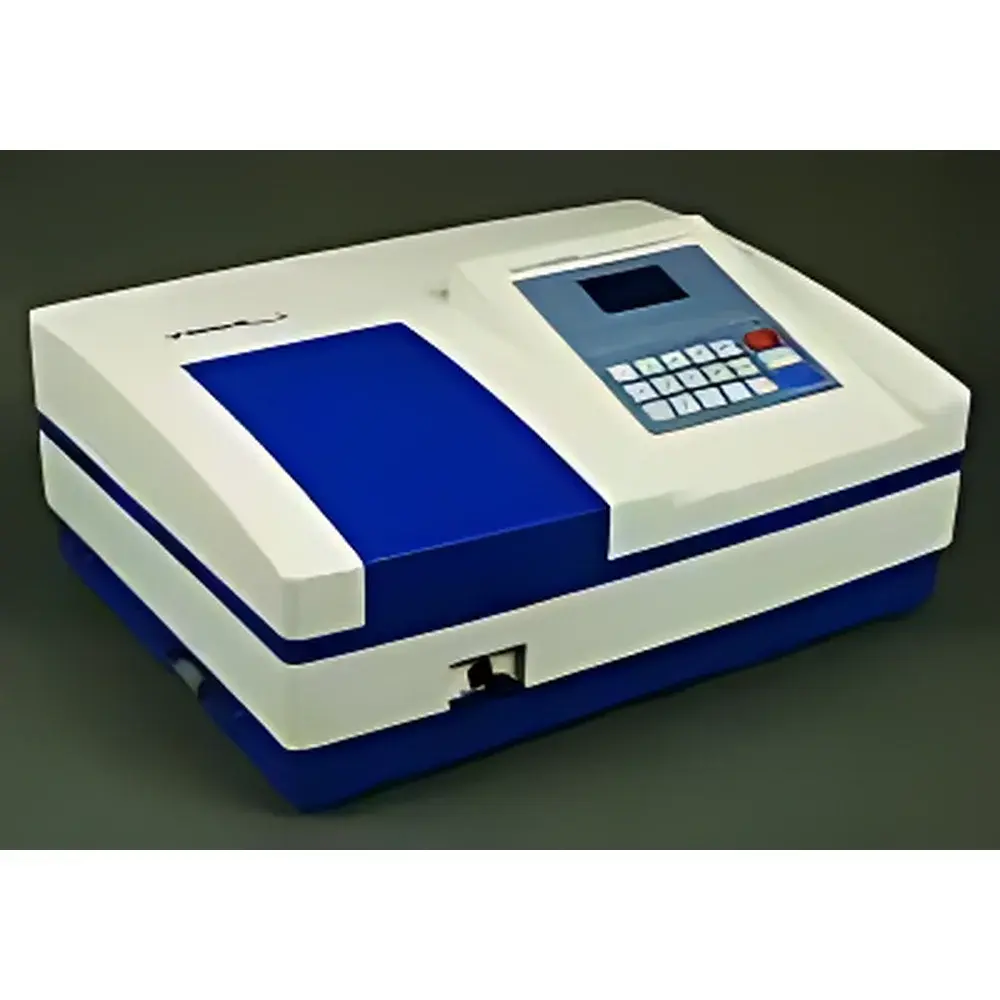
VWR 634-6001 UV-Vis Spectrophotometer
| Brand | VWR |
|---|---|
| Origin | USA |
| Model | 634-6001 |
| Optical System | Single-beam |
| Detector | Photodiode Array (PDA) |
| Wavelength Range | 190–1100 nm |
| Spectral Bandwidth | 4 nm |
| Wavelength Accuracy | ±2 nm |
| Stray Light | ≤0.05% T |
| Wavelength Repeatability | ≤0.3 nm |
| Photometric Accuracy | ±0.3% T |
| Photometric Range | 0–200% T, –0.3 to 3.0 A |
| Baseline Stability | ±0.002 A/h at 500 nm |
| Display | 128 × 64 dot-matrix LCD |
| Interface | USB |
Overview
The VWR 634-6001 UV-Vis Spectrophotometer is a single-beam, PC-controlled ultraviolet-visible absorption spectrometer engineered for routine quantitative and qualitative analysis in academic, pharmaceutical, environmental, and industrial quality control laboratories. It operates on the principle of Beer–Lambert law-based absorbance measurement, utilizing dual light sources — a deuterium lamp for the UV region (190–350 nm) and a tungsten-halogen lamp for the visible and near-IR range (350–1100 nm) — to ensure continuous spectral coverage across its full 190–1100 nm wavelength range. The optical path incorporates a 1200 lines/mm holographic grating and a sealed optical bench design, minimizing environmental interference and contributing to low stray light performance (≤0.05% T at 220 nm and 360 nm). Its photodiode array (PDA) detector enables rapid, simultaneous acquisition across the spectral range without mechanical scanning, supporting high-throughput applications such as kinetic assays and multi-wavelength quantitation.
Key Features
- Single-beam optical architecture with automatic source switching between deuterium and tungsten lamps, ensuring seamless transition across UV and visible regions
- Integrated 128 × 64 dot-matrix LCD display enabling standalone operation: direct execution of photometric, quantitative (standard curve and coefficient methods), and kinetic measurements without external PC
- Onboard storage capacity for up to 100 standard curves and 200 data sets, facilitating method portability and instrument-to-instrument consistency
- GLP-compliant self-diagnostic functionality: real-time wavelength and photometric accuracy verification per user-defined intervals, supporting audit-ready documentation
- Automated calibration routines including wavelength calibration, dark current correction, and auto-zeroing — reducing operator dependency and inter-user variability
- Spacious sample compartment accommodating cuvettes from 5 mm to 100 mm pathlength, with compatibility for optional accessories including an 8-position automated cell changer and micro-volume cuvette holders
- Robust optical housing with fully sealed grating and detector assembly, protecting critical components from dust, moisture, and ambient volatile organics commonly encountered in shared lab environments
Sample Compatibility & Compliance
The 634-6001 accommodates standard quartz, glass, and plastic cuvettes (10 mm nominal pathlength), as well as specialized formats including semi-micro (3.5 mL), micro (0.7 mL), and ultra-micro cells (down to 50 µL volume). Its broad wavelength range and low stray light specification make it suitable for demanding applications such as nucleic acid purity assessment (A260/A280, A260/A230), protein quantification via Bradford or BCA assays, and colorimetric enzyme kinetics (e.g., NADH/NADPH monitoring at 340 nm). The instrument supports compliance with widely referenced analytical standards including ASTM E275, ISO 6425, and USP for spectrophotometric system suitability testing. Its firmware includes configurable audit trail logging and electronic signature support aligned with FDA 21 CFR Part 11 requirements when used with validated software configurations.
Software & Data Management
Bundled PC software provides comprehensive control and data processing capabilities: wavelength scanning, fixed-wavelength time-course kinetics, multi-point quantitation, and dedicated modules for DNA/RNA and protein analysis (including extinction coefficient-based concentration calculation and molar absorptivity lookup tables). All acquired spectra and reports are exportable in CSV, TXT, and PDF formats. Raw data files retain metadata including date/time stamp, operator ID, instrument serial number, and calibration status flags — essential for GLP/GMP traceability. USB 2.0 interface ensures plug-and-play connectivity with Windows-based laboratory workstations; no additional drivers required. Software validation packages and IQ/OQ documentation templates are available upon request for regulated environments.
Applications
- Quantitative determination of analytes in pharmaceutical formulations (e.g., assay of active ingredients per USP monographs)
- Enzyme activity profiling and inhibitor screening via continuous absorbance monitoring at defined wavelengths
- Water quality analysis: nitrate, phosphate, and heavy metal speciation using colorimetric reagents
- Quality assurance of dyes, pigments, and polymers through spectral fingerprinting and batch-to-batch comparison
- Educational use in undergraduate chemistry and biochemistry labs for teaching spectroscopic fundamentals and calibration methodology
- Stability-indicating assays tracking degradation products via peak area or ratio changes over time
FAQ
What is the difference between single-beam and double-beam operation in UV-Vis spectrophotometry?
Single-beam instruments like the 634-6001 measure sample and reference sequentially using the same optical path, requiring manual or automated reference correction before sample measurement. This architecture offers higher optical throughput and lower cost while maintaining sufficient precision for most QC applications where environmental stability is controlled.
Can this instrument perform kinetic measurements over extended durations?
Yes — the built-in kinetic mode supports customizable time intervals (1 second to 999 minutes), total duration, and sampling frequency. Data are plotted in real time on the LCD and synchronized to the PC for post-acquisition slope analysis and rate constant derivation.
Is the 634-6001 compliant with regulatory data integrity requirements?
When operated with validated software and configured user access controls, the system meets core elements of ALCOA+ principles. Audit trail functionality records all critical events, and electronic signatures may be implemented per organizational SOPs aligned with 21 CFR Part 11 Annex 11 expectations.
How often should wavelength calibration be performed?
Initial calibration is factory-performed. Users are advised to verify wavelength accuracy prior to each analytical session or at least daily in regulated settings, using certified holmium oxide or didymium filters traceable to NIST standards.





