
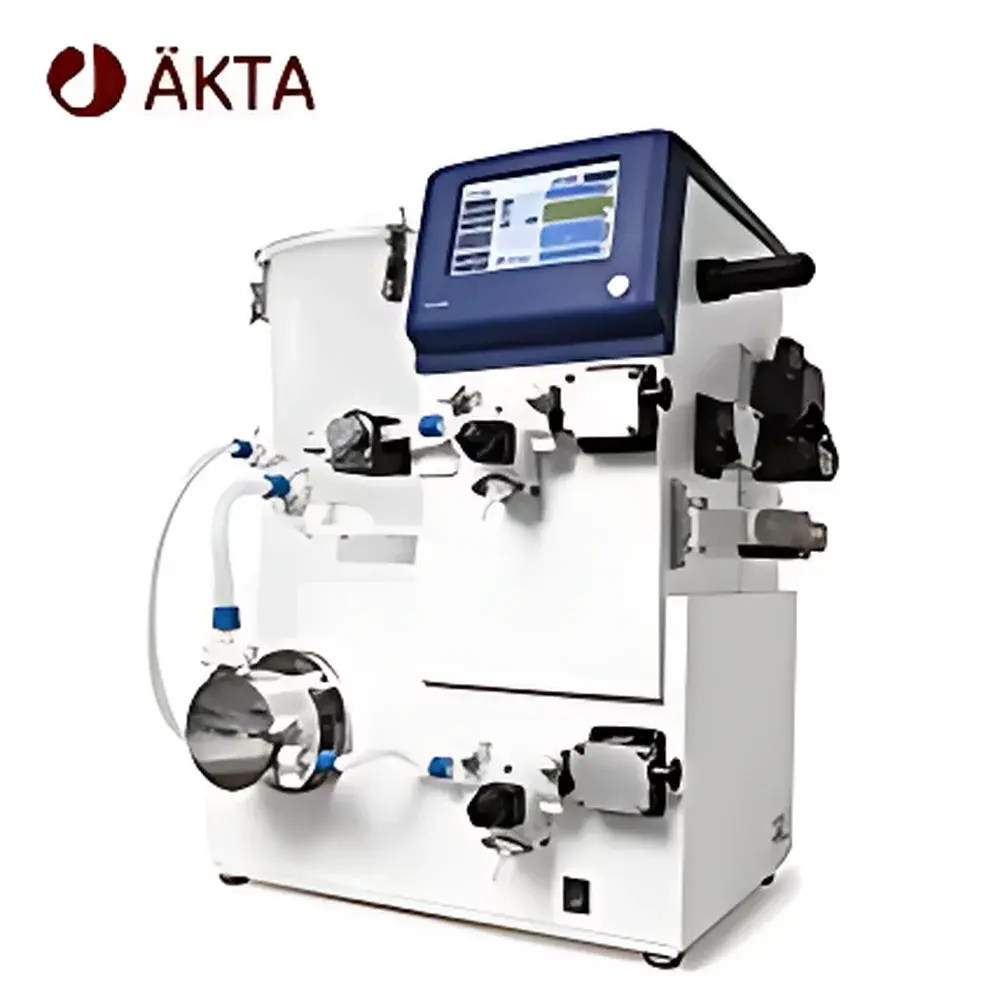
Cytiva AKTA flux Automated Tangential Flow Filtration (TFF) System
| Brand | Cytiva |
|---|---|
| Origin | USA |
| Model | AKTA flux |
| Application Scope | Research, Filter Screening, Process Development, and Small-Scale Production |
| Control Mode | Semi-Automated with Endpoint & Constant Retentate Volume (CRV) Control |
| User Interface | Touchscreen HMI with Real-Time Process Monitoring & Data Logging |
| Membrane Compatibility | Hollow-Fiber Modules and Cassettes |
| Regulatory Support | IQ/OQ Documentation Available via Fast Trak Validation™ Service |
| Compliance Context | Designed to support GLP/GMP environments |
Overview
The Cytiva AKTA flux Automated Tangential Flow Filtration (TFF) System is an engineered platform for precise, reproducible, and scalable tangential flow filtration operations in bioprocessing workflows. Based on the fundamental principle of cross-flow filtration—where fluid passes parallel to the membrane surface to minimize fouling and maintain consistent flux—the AKTA flux enables controlled concentration, diafiltration (buffer exchange), cell harvesting, and clarification of biological feedstocks including mammalian cell culture harvests, lysates, and purified protein solutions. Its modular architecture integrates seamlessly with Cytiva’s broader AKTA portfolio, particularly as a pre- or post-chromatography unit in integrated protein purification processes. The system operates across two configurations: the AKTA flux s, optimized for early-stage research and membrane screening at low working volumes (as low as 50 mL), and the AKTA flux 6, rated for process development and small-scale manufacturing applications requiring higher throughput and robust operational repeatability.
Key Features
- Semi-automated operation with programmable endpoint control and constant retentate volume (CRV) mode—enabling precise target concentration factors and consistent buffer exchange efficiency.
- Intuitive 7-inch touchscreen HMI with real-time display of transmembrane pressure (TMP), permeate flow rate, retentate volume, and system status—supporting immediate operator intervention and process visibility.
- Flexible membrane compatibility: supports both single-use hollow-fiber modules (e.g., Xampler, KrosFlo series) and flat-sheet cassettes (e.g., Pellicon, Viresolve Pro), allowing method transfer across scales and formats.
- Low minimum working volume capability (down to 50 mL for AKTA flux s) minimizes sample loss and reagent consumption during optimization studies.
- Integrated peristaltic pump with pulse-dampening design ensures stable flow delivery and reduces shear-sensitive product degradation.
- Onboard data logging compliant with ALCOA+ principles—time-stamped, user-identified events stored locally with export capability to CSV or secure network drives.
Sample Compatibility & Compliance
The AKTA flux accommodates a broad range of biologics—including monoclonal antibodies, viral vectors, plasmid DNA, extracellular vesicles, and clarified bacterial or yeast lysates—without compromising integrity or yield. It is validated for use with standard TFF membranes ranging from 10 kDa to 0.2 µm pore size, covering ultrafiltration (UF), diafiltration (DF), and microfiltration (MF) applications. From a regulatory perspective, the system is designed to operate within quality systems aligned with ICH Q5, Q8, and Q9 frameworks. While the instrument itself is not inherently “GMP-certified,” its configuration, documentation support (via Fast Trak IQ/OQ packages), and electronic record capabilities facilitate qualification under FDA 21 CFR Part 11, EU Annex 11, and ISO 13485 requirements. Installation Qualification (IQ) and Operational Qualification (OQ) templates are provided by Cytiva’s Fast Trak Validation™ service team upon request, supporting formal equipment commissioning in regulated environments.
Software & Data Management
The AKTA flux runs on UNICORN™ software version 7.0 or later—Cytiva’s unified control and data management platform for bioprocess instrumentation. UNICORN provides method creation, execution, and reporting functionalities with built-in audit trail functionality, electronic signatures, and role-based access control. All process parameters, alarms, and manual interventions are captured with timestamps and user IDs, satisfying traceability requirements for GLP and GMP audits. Data export options include native .uif files for further analysis in UNICORN Evaluation or third-party tools (e.g., MATLAB, Python pandas). No cloud connectivity or remote telemetry is enabled by default; all data resides on the local controller unless explicitly configured otherwise per site IT policies.
Applications
- Concentration and buffer exchange of purified proteins prior to formulation or analytical characterization.
- Harvest and clarification of CHO or HEK293 cell culture supernatants—reducing turbidity and particulate load before downstream chromatography.
- Downstream processing of lentiviral or AAV vectors—including removal of host cell proteins and empty capsids via size-based separation.
- Rapid screening of membrane chemistries, molecular weight cut-offs (MWCO), and operating conditions (flux, TMP, shear) during early process development.
- Scalable TFF method development bridging from lab-scale (AKTA flux s) to pilot-scale (AKTA flux 6), supporting Quality-by-Design (QbD) initiatives.
FAQ
What is the difference between AKTA flux s and AKTA flux 6?
The AKTA flux s is intended for research and filter screening with lower flow capacity and minimal working volume (≥50 mL); the AKTA flux 6 supports higher flow rates, larger membrane areas, and is qualified for process development and small-batch production.
Does the system support 21 CFR Part 11 compliance?
Yes—when operated with UNICORN software v7.0+, it provides audit trails, electronic signatures, and secure user authentication required for Part 11 adherence in regulated environments.
Can I use third-party membranes with the AKTA flux?
Yes—the system is compatible with commercially available hollow-fiber modules and cassettes from multiple vendors, provided mechanical and fluidic interfaces match standard mounting specifications.
Is validation documentation included with the system?
No—IQ/OQ documentation is delivered separately through Cytiva’s Fast Trak Validation™ service, which includes customizable templates and on-site or remote qualification support.
What maintenance is required for long-term reliability?
Routine cleaning-in-place (CIP) using sodium hydroxide or ethanol solutions, periodic calibration of pressure sensors and flow meters, and annual preventive maintenance by certified Cytiva field service engineers are recommended.



