
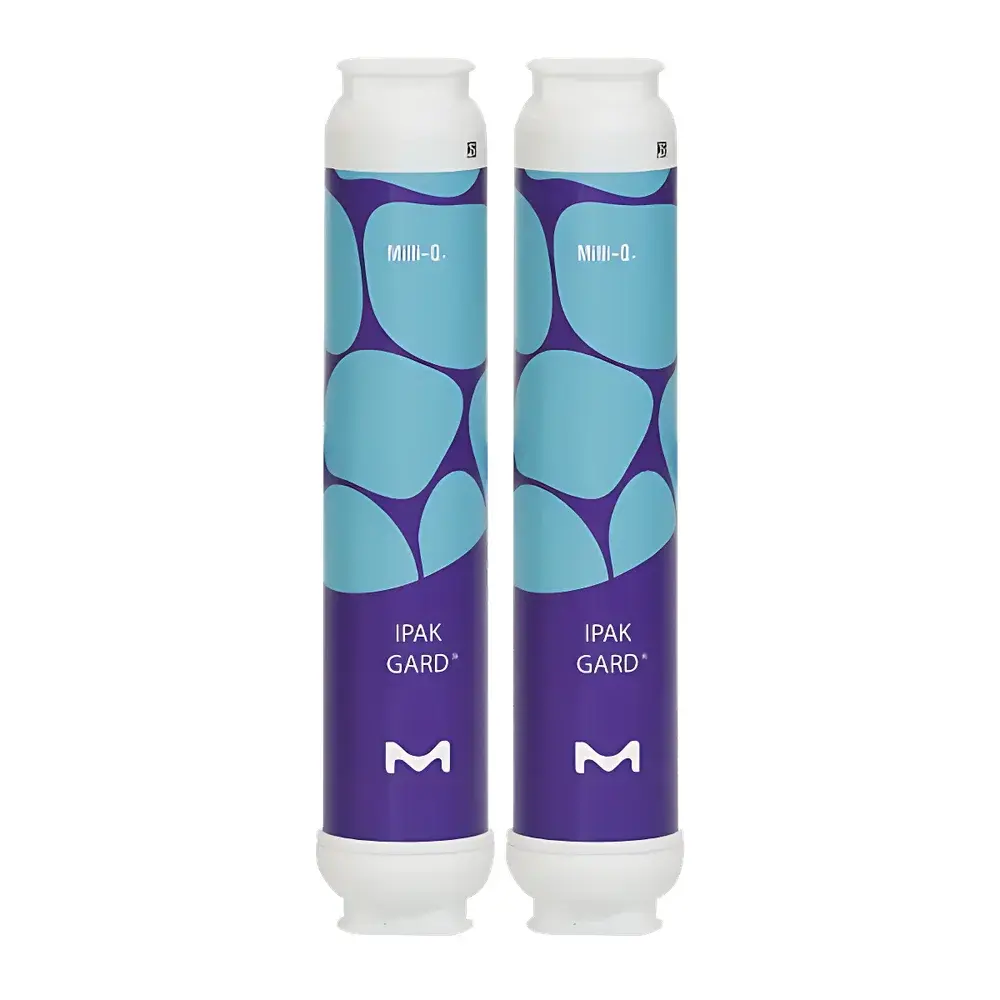
Milli-Q® IPAK Gard® Pre-Treatment Cartridge Kit for Elix® Water Systems
| Brand | Merck |
|---|---|
| Origin | Fujian, China |
| Manufacturer Type | Authorized Distributor |
| Product Category | Domestic |
| Model | IPAK Gard® Pre-Treatment Purification Cartridge |
| Price Range | USD 85 – 1,420 (FOB) |
| Feed Water Compatibility | Elix® System Output |
| Final Water Grade | ASTM Type I / ISO 3696 Grade 1 |
| Heavy Metals & Soluble Silica | < 0.1 ppb |
| Total Organic Carbon (TOC) | < 5 ppb |
| Microbial Count | < 0.001 EU/mL |
| Particles (> 0.1 µm) | < 1 particle/mL |
Overview
The Milli-Q® IPAK Gard® Pre-Treatment Cartridge Kit is a purpose-engineered consumable assembly designed exclusively for integration into Merck’s Elix® series water purification systems. It functions as the final polishing stage in a multi-stage ultra-pure water (UPW) generation train—receiving pre-purified water from the Elix® unit and delivering Type I ultrapure water compliant with ASTM D1193-20, ISO 3696:1987, and CLSI EP21-A guidelines. Unlike primary purification modules, the IPAK Gard® kit does not perform deionization or reverse osmosis; instead, it leverages high-capacity, low-leaching ion exchange media and catalytic-grade synthetic activated carbon to eliminate residual ionic species, trace organics, endotoxins, and sub-micron particulates that may persist after Elix® electro-deionization. Its dual-cartridge architecture—comprising the IPAK Meta® and IPAK Quanta® columns—is engineered for sequential contaminant removal: the Meta® cartridge targets cationic and anionic impurities via Jetpore® mixed-bed resin and IQo™ ion-selective media, while the Quanta® cartridge provides deep adsorption of hydrophobic organics, chlorine derivatives, and low-molecular-weight humic substances using thermally stabilized carbon granules.
Key Features
- Dual-column configuration optimized for synergistic contaminant removal: IPAK Meta® (ion exchange) + IPAK Quanta® (adsorption)
- Jetpore® mixed-bed resin with uniform bead morphology ensures consistent flow dynamics and minimizes channeling under variable load conditions
- IQo™ ion exchange media engineered for selective retention of monovalent ions (e.g., Na⁺, Cl⁻) and trace multivalent species (e.g., Fe³⁺, PO₄³⁻) without pH drift or resin exhaustion-induced breakthrough
- Synthetic activated carbon with controlled pore distribution (micro/mesopore ratio ≥ 3.2) validated for TOC reduction to 1,200 L throughput per cartridge pair
- Endotoxin-retentive membrane interface integrated within Quanta® housing reduces pyrogenic load to <0.001 EU/mL—critical for cell culture, molecular biology, and HPLC mobile phase preparation
- Non-leaching polypropylene housing and FDA-compliant wetted materials meet USP TOC validation requirements
Sample Compatibility & Compliance
This cartridge kit is validated solely for use with Merck Elix® Series (Elix 5, Elix 10, Elix 20) feed water outputs—never intended for direct connection to municipal or RO source water. It maintains full compliance with GLP and GMP water system qualification protocols when installed as part of a documented IQ/OQ/PQ sequence. The final water output meets ISO 14644-1 Class 5 cleanroom specifications for particle count (0.1 µm), satisfies USP purified water monograph limits for conductivity (<0.055 µS/cm at 25°C), and supports regulatory submissions requiring ASTM E2500-13 Annex A3 traceability for consumables used in analytical method development (e.g., LC-MS, ICP-MS, ELISA).
Software & Data Management
While the IPAK Gard® cartridges themselves are passive hardware components, their operational lifecycle is tracked via the Elix® system’s embedded controller firmware (v4.2+). Each cartridge pair carries a QR-coded label enabling NFC-assisted installation logging, automatic usage metering, and predictive replacement alerts based on cumulative volume, pressure differential, and real-time resistivity decay trends. Audit trails—including cartridge lot numbers, installation timestamps, and associated water quality logs—are exportable in CSV/Excel format and retain full 21 CFR Part 11 compliance when paired with Merck’s LabManager™ software suite (v3.8+), including electronic signatures, role-based access control, and immutable history archiving.
Applications
- HPLC and UHPLC mobile phase preparation where organic residue-induced baseline noise or column fouling must be eliminated
- Cell culture media formulation requiring endotoxin-free water to prevent TLR4-mediated apoptosis in primary neuronal or stem cell lines
- ICP-MS sample dilution and standard preparation, where sub-ppt metal contamination would compromise detection limits
- Next-generation sequencing library prep involving enzymatic reactions sensitive to residual RNase/DNase or oxidizing agents
- Calibration of trace-level environmental analyzers (e.g., GC-ECD for halogenated compounds) demanding certified blank integrity
FAQ
Can the IPAK Meta® and IPAK Quanta® cartridges be used independently?
No. They are functionally interdependent and must be installed as a matched pair to ensure complete contaminant removal and system pressure balance.
What is the recommended replacement interval under standard lab usage (10 L/h, 8 h/day)?
Based on resistivity decay monitoring, replacement is advised every 6–8 weeks or after 1,000–1,200 L total throughput—whichever occurs first.
Does this kit comply with ISO/IEC 17025:2017 for accredited testing laboratories?
Yes, when deployed within a fully qualified Elix® system and supported by Merck’s Certificate of Conformance (CoC) and batch-specific QC reports traceable to NIST SRM 1691.
Is sterilization or autoclaving permitted for reuse?
No. These are single-use, non-sterile cartridges. Autoclaving degrades ion exchange functionality and compromises carbon adsorption capacity.
How does the IQo™ media differ from conventional strong-acid cation resins?
IQo™ incorporates zwitterionic functional groups with tunable pKa profiles, enabling simultaneous capture of weakly ionized species (e.g., boric acid, silicic acid) at neutral pH—unachievable with standard sulfonate-based resins.



