
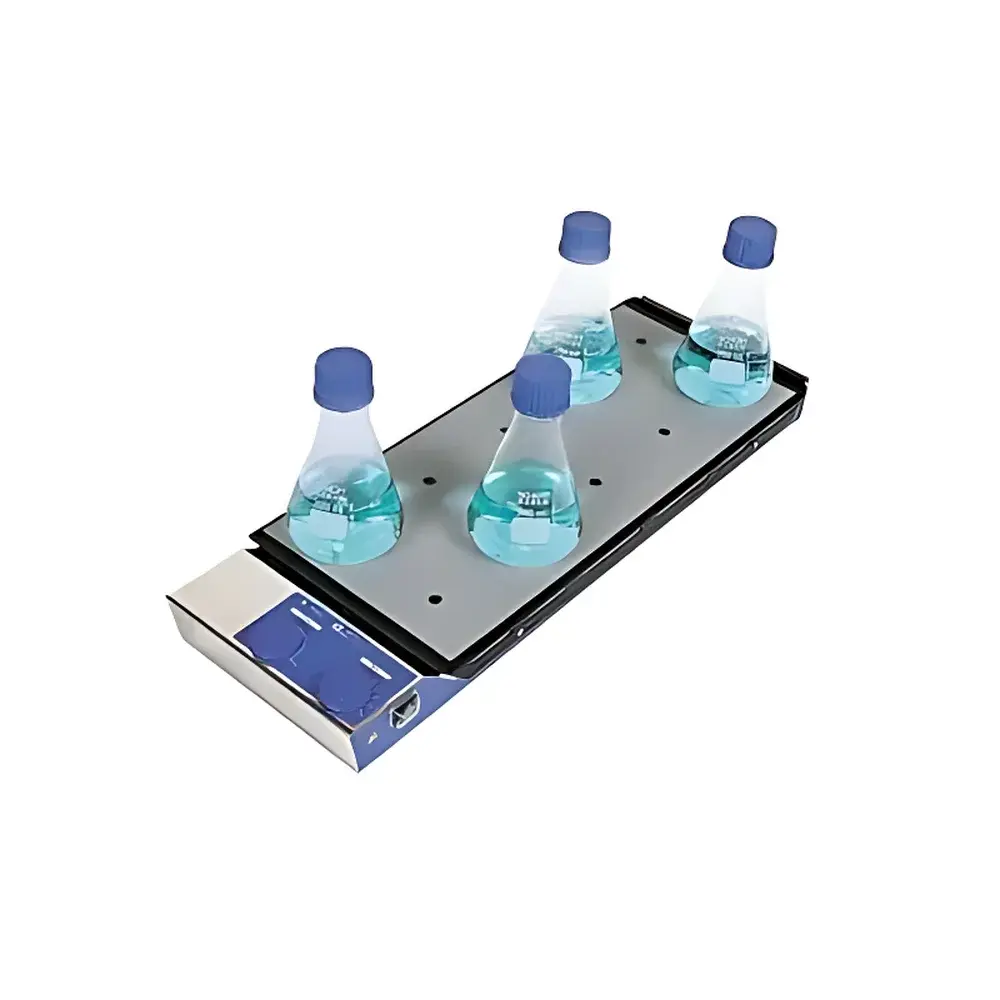
IKA RT5/RT10/RT15 Digital Multi-Point Magnetic Stirrer with Integrated Heating
| Brand | IKA |
|---|---|
| Origin | Germany |
| Model | RT5 / RT10 / RT15 |
| Stirring Points | 5 / 10 / 15 |
| Max. Volume per Position (H₂O) | 0.4 L |
| Total Max. Volume (H₂O) | 4 L |
| Stirring Speed Range | 0–1100 rpm |
| Speed Deviation per Position | 0% |
| Max. Stir Bar Length | 30 mm |
| Heating Power | 175 W / 375 W / 580 W |
| Heating Temp. Range | Ambient to 120 °C |
| Medium Temp. Stability | ±2 K |
| Heating Control | Analog Scale 1–10 |
| Plate Material | Silicone Film-Coated Aluminum |
| Plate Dimensions (W × L) | 110 × 495 mm / 180 × 495 mm / 270 × 495 mm |
| Overall Dimensions (W × L × H) | 120 × 610 × 60 mm / 190 × 610 × 60 mm / 280 × 610 × 60 mm |
| Weight | 4 kg / 7.5 kg / 10.5 kg |
| Ambient Operating Temperature | 5–40 °C |
| Motor Input Power | 14.4 W |
| Motor Output Power | 3.6 W |
| Stirring Point Spacing | 90 mm |
| Max. Medium Temperature (in Vessel) | 70 °C |
Overview
The IKA RT series digital multi-point magnetic stirrers are precision-engineered laboratory instruments designed for parallel sample processing under rigorously controlled thermal and mechanical conditions. Unlike conventional single-position stirrers, the RT platform integrates synchronized magnetic drive technology across multiple independent stirring positions—5, 10, or 15—each equipped with identical torque delivery and speed regulation. The system operates on the principle of rotating magnetic fields generated by individual coil assemblies beneath a thermally conductive, silicone-film-coated aluminum heating plate. This architecture ensures uniform heat distribution and zero inter-position speed deviation (<±0.1 rpm), enabling statistically robust comparative studies, reaction screening, and standardized protocol execution across replicates. The device is not a simple “hotplate stirrer” but a calibrated thermal-mechanical platform engineered for reproducibility in QC labs, pharmaceutical development, and academic research where inter-sample variance must be minimized.
Key Features
- Synchronized multi-point operation: All stirring positions rotate at identical, user-defined speeds (0–1100 rpm) with 0% relative deviation—critical for method validation and GLP-compliant workflows.
- Integrated analog temperature control (scale 1–10) delivering stable heating from ambient to 120 °C; medium temperature stability maintained within ±2 K under steady-state conditions.
- Three scalable configurations (RT5, RT10, RT15) share identical per-position performance specs—including max. 0.4 L aqueous volume per position and 30 mm max. stir bar length—ensuring method transferability across platforms.
- Optimized thermal architecture: Heating power scales with configuration (175 W / 375 W / 580 W), while the silicone-film-coated aluminum plate ensures rapid thermal response and minimal edge-to-center gradient (<1.5 K across full plate width).
- Low-profile, space-efficient design (height only 60 mm) with reinforced structural rigidity to minimize vibration transmission during high-speed operation—essential for sensitive optical or gravimetric measurements performed concurrently.
- Energy-efficient motor system: 14.4 W input / 3.6 W output delivers consistent torque without thermal overload, validated over >10,000 hr continuous duty cycles per unit in manufacturer reliability testing.
Sample Compatibility & Compliance
The RT series accommodates standard borosilicate glass vessels (e.g., 50–250 mL Erlenmeyer flasks, beakers, and reaction tubes) placed directly on the heated plate. With a maximum medium temperature limit of 70 °C inside the vessel (dictated by thermal conduction losses and container geometry), the system supports common aqueous, buffer, and low-viscosity organic solvent applications. It complies with IEC 61010-1:2010 for electrical safety in laboratory equipment and meets EN 61326-1:2013 electromagnetic compatibility requirements. While the analog temperature interface does not provide digital audit trails, its fixed-scale control aligns with ISO/IEC 17025:2017 clause 7.7.1 for documented equipment settings in non-automated analytical processes. For regulated environments requiring electronic records, integration with external PT100 probes and data loggers is supported via standard 4–20 mA output interfaces (optional accessory).
Software & Data Management
The RT series operates as a standalone hardware platform with no embedded microprocessor or firmware-based software. Temperature and speed are set manually via front-panel dials; no USB, Bluetooth, or Ethernet connectivity is provided. This design eliminates cybersecurity risks, reduces validation burden in GMP facilities, and ensures long-term operational consistency without dependency on proprietary drivers or OS updates. Users seeking traceable parameter logging may connect third-party calibrated temperature sensors (e.g., Class A PT100) to compliant data acquisition systems. All mechanical and thermal specifications are factory-verified per DIN EN ISO 9001:2015 procedures and accompanied by individual test certificates upon request—supporting equipment qualification (IQ/OQ) documentation packages.
Applications
- Parallel synthesis and optimization of catalytic reactions under identical kinetic conditions.
- Buffer equilibration and reagent preparation across multiple batches for clinical assay development.
- Standardized dissolution testing per USP using multi-vessel setups (with appropriate vessel holders).
- Cell culture media pre-warming and homogenization prior to sterile filtration.
- Calibration verification of viscometers or pH meters using matched reference solutions.
- Teaching laboratories requiring simultaneous demonstration of reaction kinetics with real-time comparability.
FAQ
Can the RT stirrer be used with corrosive solvents such as concentrated acids or halogenated organics?
Yes—provided the vessel material (e.g., PTFE-lined glass or quartz) is chemically compatible and the medium temperature remains ≤70 °C. The silicone film surface resists mild splashes but is not rated for prolonged exposure to strong oxidizers.
Is speed calibration traceable to national standards?
Each unit undergoes factory speed verification using NIST-traceable tachometry; calibration certificates (including uncertainty budgets) are available as optional documentation.
What is the recommended maintenance interval?
No scheduled maintenance is required. Clean the plate surface with isopropanol after each use; inspect stir bars for chipping before reuse. Motor lifetime exceeds 20,000 hours under typical lab usage.
Does the device support external temperature feedback control?
Not natively—but analog 0–10 V or 4–20 mA inputs can be added via IKA’s optional RT-EXT module for closed-loop PID regulation using external PT100 or thermocouple probes.
Are replacement heating plates available for different configurations?
Yes. IKA supplies certified OEM replacement plates (part numbers RT-PLATE-5, RT-PLATE-10, RT-PLATE-15) with identical thermal and dimensional specifications, ensuring continued compliance post-repair.



