
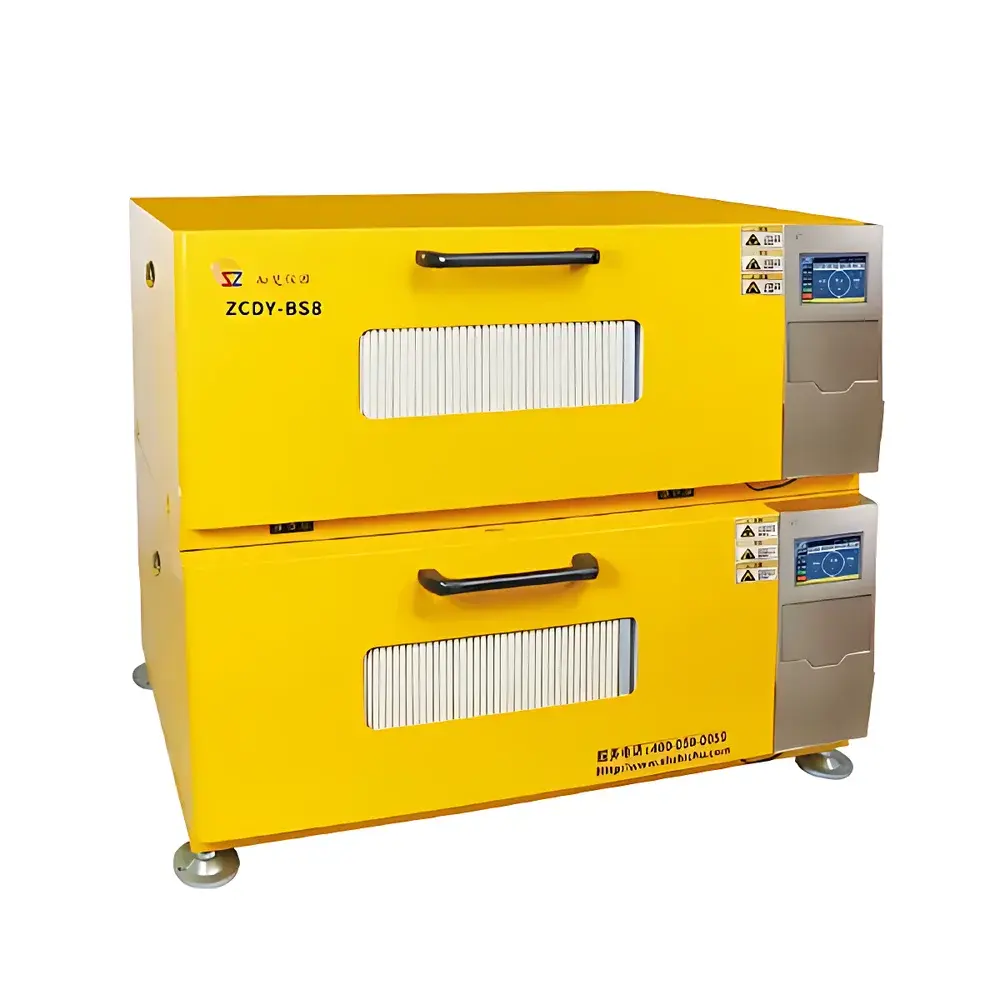
Zhichu ZCDY-BS8 Dual-Layer CO₂ Incubator Shaker
| Brand | Zhichu |
|---|---|
| Origin | Guangdong, China |
| Manufacturer Type | Authorized Distributor |
| Product Category | Domestic |
| Model | ZCDY-BS8 |
| Instrument Type | CO₂-Controlled Constant-Temperature Orbital Shaker |
| Timer Range | 0–999.9 h |
| Oscillation Frequency Accuracy | ±1 rpm |
| Orbit Diameter | Ø50 mm (standard), Ø26 mm (optional) |
| Temperature Range | 4–60 °C (ambient: 23–25 °C) |
| Number of Shaking Platforms | 2 |
Overview
The Zhichu ZCDY-BS8 Dual-Layer CO₂ Incubator Shaker is an integrated life science platform engineered for simultaneous temperature-controlled orbital shaking and precise CO₂ regulation—designed specifically for suspension cell culture, microbial fermentation, hybridoma expansion, and recombinant protein expression under physiologically relevant gaseous conditions. Unlike conventional shakers or standalone CO₂ incubators, this system implements a dual-layer stacked architecture with independent microprocessor control per deck, enabling concurrent operation at distinct temperatures (4–60 °C), rotational speeds (10–300 rpm), and CO₂ concentrations (0–20 %). Its core thermal and gas management subsystems rely on PID-driven feedback loops, infrared CO₂ sensing, and a two-stage humidification system to maintain stable, reproducible environmental parameters over extended durations—critical for long-term kinetic studies and GMP-aligned bioprocess development.
Key Features
- Dual-layer modular design: Two independently controllable shaking decks (each 928 mm × 530 mm) maximize volumetric throughput within minimal floor space (1360 mm × 845 mm footprint); supports up to 120 × 250 mL or 78 × 500 mL flasks per unit.
- Three-dimensional eccentric drive mechanism: Precision-machined offset crankshaft ensures smooth, low-vibration orbital motion with <55 dB(A) acoustic emission—even at maximum speed and load.
- CO₂ regulation system: High-stability NDIR infrared sensor (0.1% resolution, ±0.2% accuracy) coupled with proportional solenoid valve actuation enables rapid, drift-free CO₂ setpoint tracking across the full 0–20% range; chamber leak rate <0.1%/min (5% → 4.5% decay in ≥30 min).
- Humidification & condensation control: Integrated dual-tier evaporation tray delivers >90% RH at 37 °C; heated double-glazed observation window (tempered safety glass with resistive heating) prevents fogging during low-temperature/high-humidity operation.
- Intelligent thermal management: Variable-capacity eco-refrigeration circuit using R134a-free refrigerant; programmable defrost cycle (1–250 s duration, 30–600 min interval) prevents evaporator icing during sub-ambient runs.
- Secure user interface: 7-inch capacitive LCD touchscreen displays real-time and setpoint values for temperature, CO₂, speed, time, and humidity—all on a single screen; password-protected parameter locking and direction reversal (CW/CCW) support experimental protocol standardization.
Sample Compatibility & Compliance
The ZCDY-BS8 accommodates standard Erlenmeyer flasks (125–2000 mL), baffled bottles, and multi-well plates via interchangeable universal plastic clamps (one-hand loading) or stainless-steel fixture plates with one-touch release. Interior chamber surfaces feature medical-grade 304 stainless steel with R-corner (radius ≥15 mm) geometry and antimicrobial finish (≥99% bacterial inhibition per ISO 22196). All electrical components comply with IEC 61010-1 safety standards; CO₂ control firmware supports audit trails and electronic signature capability—aligning with GLP and FDA 21 CFR Part 11 requirements when paired with validated data export workflows. Optional UV-C germicidal lamp (254 nm) provides routine decontamination between runs.
Software & Data Management
Onboard memory retains up to five years of timestamped operational logs—including temperature, CO₂ concentration, speed, and humidity—with graphical trend visualization directly on the display. Data export is supported via USB 2.0 port (FAT32-formatted drive required); exported CSV files include UTC timestamps, sensor IDs, and calibration metadata for traceability. Optional cloud-connected module enables remote monitoring and alarm notification via secure HTTPS API (TLS 1.2+), compatible with institutional IT infrastructure and LIMS integration. Firmware updates are performed locally via USB without internet dependency—ensuring continuity in regulated environments.
Applications
- Mammalian cell line expansion under 5% CO₂ and 37 °C with continuous agitation (e.g., CHO, HEK293, hybridomas)
- Microbial growth kinetics in buffered liquid media (E. coli, P. pastoris, yeast) with controlled aeration and pH buffering
- Stem cell differentiation assays requiring precise O₂/CO₂ interplay and mechanical stimulation
- Biopharmaceutical upstream process development—scale-down modeling for bioreactor optimization
- Environmental microbiology studies involving thermophilic or psychrotrophic strains across broad temperature gradients
FAQ
What is the minimum operating temperature with CO₂ active?
The system maintains stable CO₂ control down to 10 °C; below this, CO₂ regulation remains functional but humidity retention decreases due to reduced saturation vapor pressure.
Can both decks operate at different CO₂ concentrations simultaneously?
No—CO₂ is supplied to the shared chamber volume; concentration is uniform across both decks. Independent temperature and speed control per deck is fully supported.
Is the UV sterilization cycle validated for ISO 14644-1 Class 5 environments?
UV irradiation is intended for chamber surface decontamination only—not cleanroom certification. Validation must be performed in situ per user-defined SOPs.
Does the system meet ASTM E1957 for shaker performance verification?
Yes—oscillation frequency accuracy (±1 rpm), temperature uniformity (±0.5 °C at 37 °C), and CO₂ stability meet or exceed ASTM E1957 Annex A2 criteria for incubated shakers.
What power protection features prevent data loss during grid fluctuations?
Integrated UPS-compatible power management includes brownout detection, non-volatile memory backup, and auto-resume functionality after recovery—retaining all active setpoints and runtime counters.




