
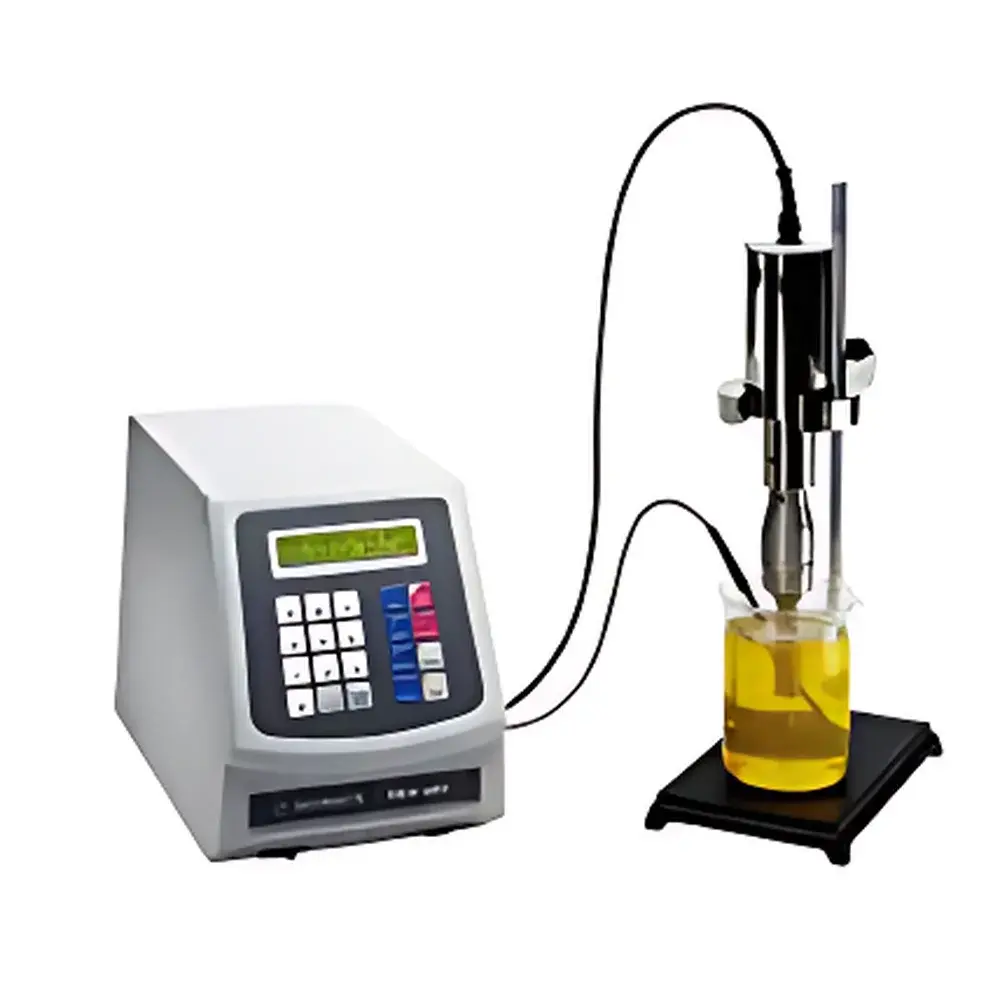
Sonics VCX255 / VCX500 / VCX800 Ultrasonic Liquid Processor
| Brand | Sonics |
|---|---|
| Origin | USA |
| Model | VCX255 / VCX500 / VCX800 |
| Ultrasonic Output Power | 255 W / 500 W / 800 W |
| Operating Frequency | 20 kHz |
| Sample Volume Range | 250 µL to several liters |
| Temperature Control Range | 1–100 °C |
| Dimensions (H×W×D) | 235 × 190 × 340 mm |
| Weight | 6.8 kg |
| Transducer Type | CV334 Piezoelectric Converter (PZT) |
| Probe Standard | Φ13 mm Titanium Alloy (Ti-6Al-4V), 136 mm length, 340 g |
| Power Input | 220–240 V, 50/60 Hz |
Overview
The Sonics VCX255, VCX500, and VCX800 Ultrasonic Liquid Processors are high-performance benchtop ultrasonic homogenizers engineered for precise cell disruption, emulsification, dispersion, lysis, and particle size reduction in life science and bioprocessing laboratories. Based on piezoelectric transduction at a fixed resonant frequency of 20 kHz, these instruments convert electrical energy into high-intensity mechanical vibrations transmitted through titanium alloy probes. The resulting cavitation—formation, growth, and implosive collapse of microbubbles in the liquid medium—generates localized shear forces, pressure differentials exceeding 1000 atm, and transient temperatures up to 5000 K, enabling efficient and reproducible disruption of bacterial, yeast, mammalian, and plant cells without chemical additives or excessive thermal load. Each model is calibrated to deliver nominal output power of 255 W, 500 W, or 800 W respectively, with real-time digital monitoring of actual delivered acoustic power—critical for method transfer, process validation, and regulatory compliance.
Key Features
- Microprocessor-controlled operation with programmable protocols: up to 10 user-defined methods stored internally, each including amplitude setpoint, pulse-on/pulse-off timing, total duration, temperature limit, and duty cycle.
- Integrated digital temperature monitoring and control: compatible with optional stainless-steel immersion temperature probe (P/N 830-00060), enabling closed-loop regulation within ±0.5 °C across 1–100 °C range—essential for heat-sensitive biomolecules and enzymatic assays.
- Hermetically sealed CV334 transducer housing: constructed from corrosion-resistant anodized aluminum and rated IP54, providing protection against moisture, dust, and aggressive vapors commonly encountered in molecular biology and fermentation labs.
- Real-time parameter display: LCD screen shows elapsed time, remaining time, instantaneous power (W), amplitude (%), temperature (°C), pulse count, and cumulative cavitation energy (J).
- Advanced acoustic regulation: automatic frequency tracking maintains resonance under variable load conditions; variable amplitude control (0–100%) with auto-compensation ensures consistent energy delivery regardless of probe wear or sample viscosity changes.
- Compact industrial design: 50% smaller footprint than prior-generation units; robust chassis with vibration-damped feet minimizes benchtop transmission; rear-panel IEC C14 inlet supports standard lab-grade power conditioning.
Sample Compatibility & Compliance
The VCX series accommodates sample volumes from 250 µL (microcentrifuge tubes, using microtip probes) to multi-liter jacketed reactors (with flow-through or immersion horn configurations). Standard Φ13 mm solid titanium probes support volumes of 10–250 mL; optional threaded-tip, microtip, cup-horn, and multi-well adapters extend application flexibility. All models comply with IEC 61000-6-3 (EMC emission standards) and IEC 61010-1 (safety requirements for laboratory equipment). When operated with validated protocols and audit-trail-enabled software (e.g., Sonics’ optional VCX-Link PC interface), systems support GLP/GMP environments and align with FDA 21 CFR Part 11 requirements for electronic records and signatures. Documentation packages—including Factory Acceptance Test (FAT) reports, calibration certificates traceable to NIST standards, and IQ/OQ templates—are available upon request.
Software & Data Management
While standalone operation requires no external software, the VCX series supports optional VCX-Link USB interface and Windows-based control suite for remote configuration, real-time data logging (power, temperature, time, amplitude), and automated report generation (CSV/PDF). Data fields are timestamped and include operator ID, method name, probe serial number, and environmental metadata—enabling full traceability per ISO/IEC 17025 and ASTM E2500-17 guidelines. Audit trails record all parameter modifications, method executions, and system events with immutable timestamps. Firmware updates are performed via secure signed binaries; configuration backups can be exported and version-controlled.
Applications
- Cell lysis for protein extraction (E. coli, S. cerevisiae, CHO, HEK293, primary neurons)
- Nanoparticle dispersion in drug delivery formulations (liposomes, polymeric micelles, exosomes)
- Chromatin shearing for ChIP-seq and ATAC-seq library preparation
- Homogenization of tissue lysates and plant extracts under cryogenic or ambient conditions
- Deagglomeration of ceramic, metallic, and carbon nanomaterials in suspension
- Preparation of stable oil-in-water and water-in-oil emulsions for food, cosmetic, and pharmaceutical R&D
FAQ
What is the difference between VCX255, VCX500, and VCX800 models?
The primary distinction lies in maximum continuous ultrasonic output power: 255 W, 500 W, and 800 W respectively. Higher-power models support larger sample volumes, higher-viscosity media, and faster processing times—but all share identical control architecture, transducer design, and software compatibility.
Can the VCX system be used for continuous-flow processing?
Yes—when paired with Sonics’ optional flow-through cell (P/N 101-056-025) and peristaltic pump integration, the VCX800 supports scalable continuous sonication at flow rates up to 2 L/min, validated for cGMP-compliant biomanufacturing unit operations.
Is probe calibration required before use?
No routine calibration is needed; however, amplitude verification using a calibrated interferometer or thermal calorimetry is recommended annually or after probe replacement. Sonics provides amplitude verification kits (P/N 830-00075) and NIST-traceable calibration services.
How does the system prevent overheating during extended runs?
The integrated temperature probe enables active feedback control: if sample temperature exceeds the user-defined setpoint, the processor automatically pauses sonication until cooling occurs—ensuring biomolecular integrity without manual intervention.
Are replacement probes and accessories available globally?
Yes—Sonics maintains a global distribution network with certified distributors stocking all standard probes, horns, cups, and service kits. Lead times for custom geometries (e.g., dual-tip, tapered, or cryo-compatible probes) are typically 4–6 weeks.
Related Products




