
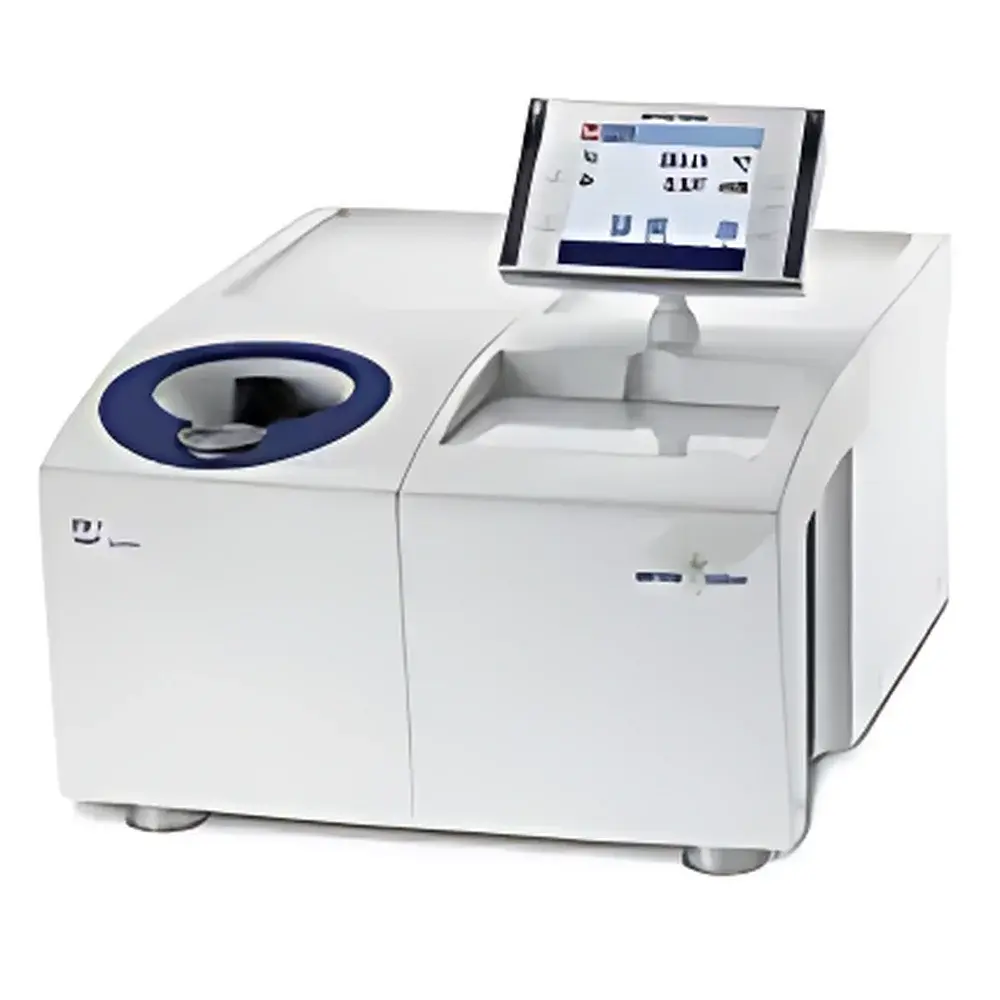
METTLER TOLEDO DSC 1 Differential Scanning Calorimeter
| Brand | METTLER TOLEDO |
|---|---|
| Origin | Switzerland |
| Model | DSC 1 |
| Temperature Range | –150 °C to 700 °C |
| Sensor Configuration | 56- or 120-pair star-arranged thermocouples |
| Optional Modules | UV-DSC, HP-DSC (up to 100 bar / down to 10 mbar), DSC-Microscopy System |
| Autosampler Capacity | Up to 34 samples |
Overview
The METTLER TOLEDO DSC 1 is a high-performance differential scanning calorimeter engineered for precision thermal analysis across academic, pharmaceutical, polymer, and materials science laboratories. It operates on the fundamental principle of heat-flux DSC, measuring the difference in heat flow between a sample and an inert reference as both are subjected to a controlled temperature program. This enables quantitative determination of enthalpy changes associated with physical transitions—such as glass transitions, melting, crystallization, and solid–solid phase changes—as well as chemical events including curing, decomposition, and oxidative stability. The instrument’s core sensor architecture features either 56 or 120 thermocouple pairs arranged in a radial star configuration, delivering exceptional baseline flatness, signal-to-noise ratio, and temperature resolution—critical for detecting subtle thermal events in complex formulations.
Key Features
- Wide operational temperature range from –150 °C to 700 °C, compatible with liquid nitrogen cooling and high-temperature furnace options;
- Modular platform supporting advanced measurement modes: conventional DSC, Temperature-Modulated DSC (TMDSC), and Multi-Frequency TMDSC for enhanced separation of reversing and non-reversing heat flow components;
- Expandable architecture with certified optional modules: UV-DSC for real-time photopolymerization kinetics under controlled irradiation; HP-DSC for pressure-dependent studies under inert or reactive atmospheres (0.01–100 bar); and DSC-Microscopy integration enabling synchronized optical observation of thermal events (e.g., melt front propagation, discoloration, bubbling, or phase segregation);
- Robust, fully automated sample handling via a 34-position autosampler, supporting method-independent loading—each position configurable with unique heating/cooling profiles, gas environments, and crucible types (aluminum, gold-plated, high-pressure, hermetic, or UV-transparent);
- Thermally isolated furnace design with active temperature control and high-stability platinum resistance thermometry ensuring long-term calibration integrity and inter-laboratory reproducibility.
Sample Compatibility & Compliance
The DSC 1 accommodates solid, semi-crystalline, amorphous, and viscous samples—including polymers, pharmaceuticals, composites, metals, and biomaterials—in standard and specialty crucibles. Its modular gas management system supports inert (N₂, Ar), oxidative (O₂, air), and reactive atmospheres with mass-flow-controlled purge rates. All configurations comply with international thermal analysis standards, including ASTM E794 (melting point), ASTM E1356 (glass transition), ISO 11357 series (polymer characterization), and USP for pharmaceutical thermal analysis. When equipped with audit-trail-enabled software and electronic signature functionality, the system meets FDA 21 CFR Part 11 requirements for regulated environments operating under GLP or GMP frameworks.
Software & Data Management
Controlled via STARe (Scientific Thermal Analysis Research) software, the DSC 1 provides intuitive method development, real-time data visualization, and comprehensive post-processing tools—including peak deconvolution, kinetic modeling (e.g., Ozawa-Flynn-Wall, ASTM E698), and multi-curve comparison. Raw data files are stored in vendor-neutral, timestamped formats compliant with FAIR principles (Findable, Accessible, Interoperable, Reusable). The software supports automated report generation with customizable templates, metadata embedding (operator, instrument ID, calibration status), and secure export to LIMS or ELN systems. Full traceability is maintained through integrated audit trails documenting all parameter modifications, calibration events, and user actions.
Applications
- Pharmaceutical development: polymorph screening, excipient compatibility, stability-indicating assays, and freeze-drying cycle optimization;
- Polymer science: crystallinity quantification, crosslink density estimation, aging behavior, and processing window definition;
- Materials engineering: heat capacity mapping, reaction enthalpy determination for composites, and thermal degradation profiling under varying atmospheres;
- Photocurable systems: UV-initiated cure kinetics, gel point identification, and light-dose–temperature–conversion correlations using UV-DSC;
- High-pressure thermodynamics: phase behavior of hydrocarbons, clathrate formation, and catalytic reaction energetics under industrially relevant pressure conditions;
- In situ morphological correlation: direct visual confirmation of thermal events (e.g., spherulite growth, charring onset, or liquid crystal transitions) via synchronized DSC-microscopy acquisition.
FAQ
What is the maximum pressure rating for the HP-DSC module?
The HP-DSC module supports pressures up to 100 bar and vacuum levels down to 10 mbar, with full thermal and mechanical stability across the entire DSC temperature range.
Can the DSC 1 perform isoconversional kinetic analysis?
Yes—STARe software includes built-in isoconversional methods (e.g., Friedman, Kissinger-Akahira-Sunose) for model-free activation energy determination across multiple heating rates.
Is the autosampler compatible with hermetic or high-pressure crucibles?
Yes—the autosampler accepts all METTLER TOLEDO DSC crucible types, including hermetic aluminum, stainless steel high-pressure, and quartz UV-transparent variants, with automatic lid sealing detection.
Does the DSC-Microscopy system support time-resolved image capture during dynamic scans?
Yes—it records synchronized video at up to 30 fps with timestamp-aligned thermal data, enabling frame-by-frame correlation of morphological change with heat flow signals.
How often does the system require recalibration?
Factory calibration is traceable to NIST standards; routine verification uses certified indium, zinc, and tin standards. Annual recalibration is recommended for GLP/GMP compliance, with optional on-site service contracts available.



