
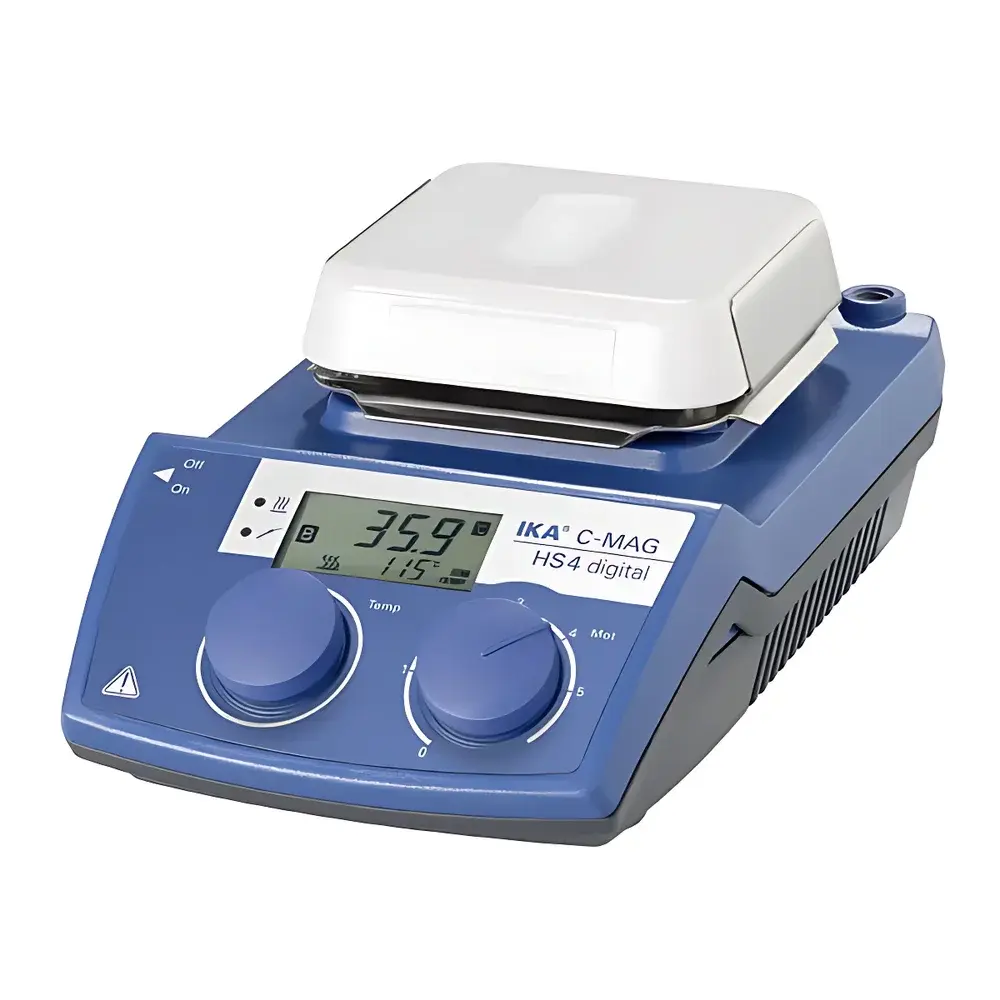
IKA C-MAG HS4 Digital Hotplate Magnetic Stirrer
| Brand | IKA |
|---|---|
| Origin | Germany |
| Model | HS4 |
| Stirring Volume (max) | 5 L (water) |
| Speed Range | 100–1500 rpm |
| Heating Temperature Range | 50–500 °C |
| Safety Cut-off | 550 °C |
| Plate Material | Seamless Ceramic |
| Control Type | Microprocessor-based, Dual Independent Control (Speed & Temp) |
| Optional External Temperature Monitoring | Compatible with ETS-D5 Contact Thermometer (HS7/HS10 only) |
| Panel Design | Elevated Control Interface for Splash Resistance and Enhanced Readability |
Overview
The IKA C-MAG HS4 Digital Hotplate Magnetic Stirrer is a precision-engineered benchtop instrument designed for reliable, reproducible heating and stirring of laboratory samples under controlled thermal and mechanical conditions. Utilizing a permanent magnet coupling system and a high-torque brushless DC motor, the HS4 delivers consistent rotational energy transfer to magnetic stir bars across a wide viscosity range — from low-viscosity aqueous solutions to moderately viscous organic media. Its integrated ceramic heating plate operates via resistive heating elements embedded beneath a monolithic, chemically inert surface, enabling rapid thermal response and uniform heat distribution. Unlike analog predecessors, the HS4 employs closed-loop microprocessor control to continuously monitor and adjust both motor speed and plate temperature in real time, minimizing drift and ensuring experimental fidelity. This architecture supports applications requiring defined thermal ramping profiles, extended unattended operation, and strict adherence to method-defined parameters — particularly relevant in quality control laboratories operating under GLP or ISO/IEC 17025 frameworks.
Key Features
- Seamless ceramic plate surface: Fully fused, pore-free construction resists corrosion from acids, bases, solvents, and halogenated reagents — eliminating crevices where residue accumulation or thermal degradation could occur.
- Dual independent digital control: Separate, high-resolution LED displays for speed (rpm) and plate temperature (°C), enabling precise replication of multi-step protocols without cross-parameter interference.
- Intelligent thermal safety system: Automatic power cutoff at 550 °C prevents overheating damage; dynamic LED warning indicator pulses during active heating to signal elevated surface temperature — supporting lab safety compliance per OSHA 1910.1200 and EU Directive 2006/42/EC.
- Elevated control panel design: Raised bezel minimizes liquid ingress risk from splashes or condensation, preserving display legibility and tactile feedback integrity during prolonged use.
- High-efficiency magnetic drive: Optimized pole geometry and flux density ensure stable coupling with standard PTFE- or glass-coated stir bars up to 80 mm length — suppressing “jumping” even at 1500 rpm with viscous loads (e.g., 40% w/v polymer solutions).
- Robust thermal regulation: PID-controlled heating circuit maintains ±3 °C stability over full 50–500 °C range (load-dependent); temperature overshoot < 5 °C during setpoint transitions.
Sample Compatibility & Compliance
The HS4 accommodates standard laboratory glassware including beakers (up to 1000 mL), Erlenmeyer flasks (up to 2000 mL), and round-bottom flasks (with appropriate support). It is compatible with all commercially available magnetic stir bars rated for temperatures ≤ 500 °C (e.g., PTFE-coated, PEEK-coated, or ceramic-core variants). While the HS4 itself does not provide solution temperature feedback, its ceramic plate interface ensures minimal thermal lag when used with external contact probes such as the IKA ETS-D5 (sold separately; supported on HS7/HS10 models). The device conforms to IEC 61010-1:2010 for electrical safety in laboratory equipment and carries CE marking for EMC and Low Voltage Directive compliance. It meets material compatibility requirements outlined in ASTM D4586 (ceramic surface resistance to chemical exposure) and supports audit-ready documentation practices required under FDA 21 CFR Part 11 when paired with validated data logging systems.
Software & Data Management
The HS4 operates as a standalone instrument without proprietary software dependencies. All operational parameters are set and monitored directly via front-panel controls and dual LED displays. For laboratories requiring traceable parameter recording, the HS4 supports integration with third-party data acquisition systems via optional analog output modules (e.g., 0–10 V signals for speed and temperature, available on HS7/HS10 variants). Though the HS4 lacks built-in USB or Ethernet connectivity, its stable analog outputs enable seamless connection to PLCs, SCADA platforms, or validated LabVantage/STARLIMS workflows. Calibration certificates for speed and temperature can be generated using NIST-traceable reference standards (e.g., Fluke 729 for pressure-assisted rpm verification; Hart Scientific 1529 for thermal calibration), satisfying internal QA requirements and external accreditation audits.
Applications
- Preparative chemistry: Homogenization of reaction mixtures prior to reflux or distillation; dissolution of solid reagents in heated solvent systems.
- Materials science: Dispersion of nanoparticles in polymer matrices under controlled thermal activation; solvent evaporation kinetics studies.
- Pharmaceutical QC: Dissolution testing of solid dosage forms per USP , where consistent agitation and bath-equivalent temperature control are critical.
- Environmental analysis: Digestion of soil or sediment samples in acid mixtures (e.g., HNO₃/HF) at elevated temperatures under fume hood conditions.
- Biotechnology: Buffer equilibration and reagent warming prior to chromatography or electrophoresis setups — avoiding thermal shock to sensitive biomolecules.
FAQ
Does the HS4 include a built-in temperature probe for solution monitoring?
No — the HS4 regulates only the ceramic plate temperature. For accurate solution temperature control, an external contact thermometer (e.g., IKA ETS-D5) must be used with compatible models (HS7/HS10).
What is the maximum recommended viscosity for stable stirring at 1500 rpm?
Stable operation is verified up to 10,000 mPa·s (e.g., 30% glycerol/water at 25 °C) using a 40 mm stir bar; performance decreases above this threshold depending on vessel geometry and bar alignment.
Is the ceramic plate resistant to hydrofluoric acid (HF)?
No — while highly resistant to most common lab chemicals, the Al₂O₃-based ceramic is susceptible to HF attack; alternative PTFE-coated hotplates are recommended for HF-containing protocols.
Can the HS4 be operated inside a nitrogen-purged glovebox?
Yes — its sealed electronics and lack of forced-air cooling make it suitable for inert atmosphere environments; verify O-ring integrity on control buttons if used under positive pressure.
What calibration standards are recommended for routine verification?
Speed: Optical tachometer traceable to NIST SRM 2034; Temperature: Calibrated thermocouple or RTD probe with uncertainty ≤ ±0.5 °C, per ISO/IEC 17025 Clause 6.5.



