
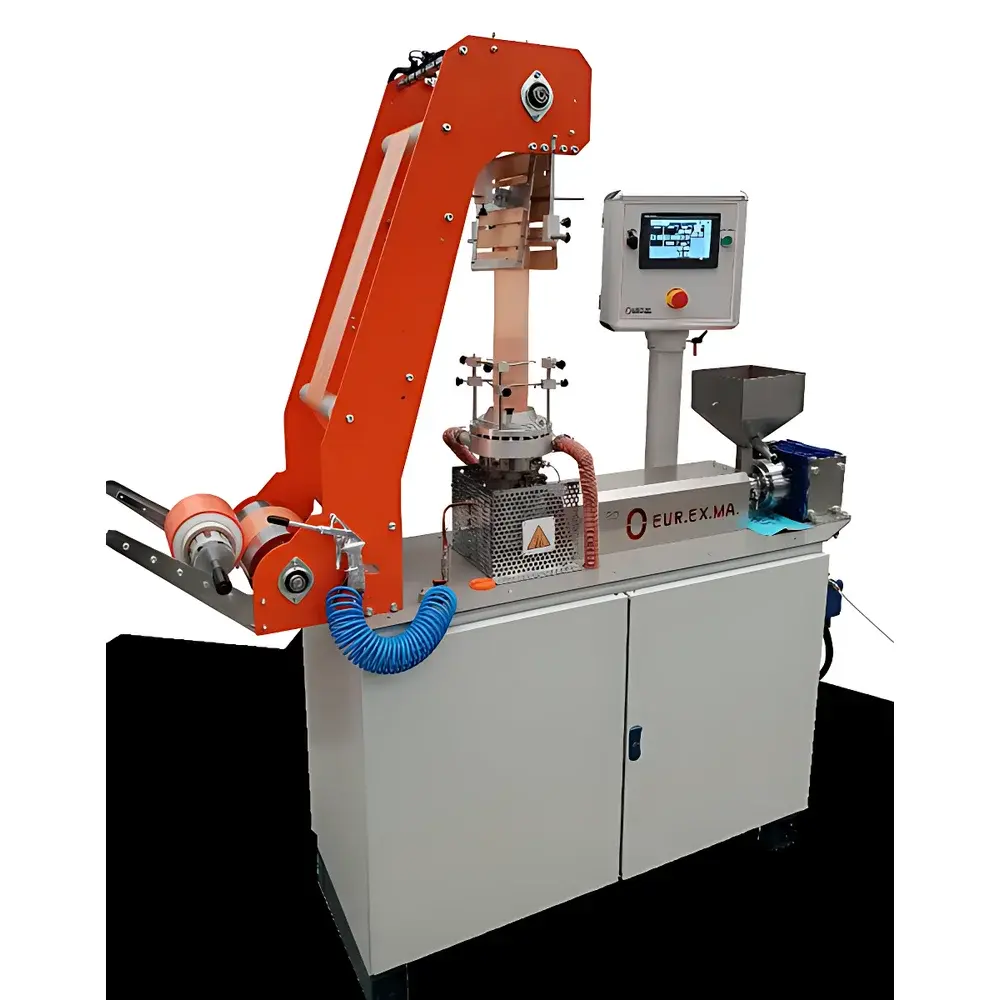
EUROTECH D20 Single-Layer Laboratory Blown Film Extrusion Line
| Key | Brand: EUROTECH |
|---|---|
| Origin | Italy |
| Model | D20 |
| Screw Diameter | 20 mm |
| Die Diameter | 30 mm |
| Max Film Width | 200 mm |
| Max Output Speed | 15 m/min |
| Max Tension Control | 20 N |
| Melt Temperature Range | up to 450 °C |
| Screw Speed | 0–200 rpm |
| Torque Capacity | 1000 N·m (closed-loop controllable up to 500 N·m) |
| Heating Zones | 4 electrically heated & air-cooled barrel zones |
| Die Gap Options | 1.0 mm and 1.5 mm |
| Control System | Full-color LCD touchscreen with OPC UA & web-based remote interface |
| Compliance | Designed for GLP-compliant R&D environments, supports ASTM D2617, ISO 1183, and ISO 1421 test method integration |
Overview
The EUROTECH D20 Single-Layer Laboratory Blown Film Extrusion Line is a compact, precision-engineered system designed for polymer research laboratories, material development centers, and petrochemical R&D facilities requiring controlled, repeatable blown film production at pilot scale. Based on the fundamental principles of tubular film extrusion—where molten polymer is extruded vertically through an annular die, inflated into a bubble by internal air pressure, and cooled via a circumferential air ring—the D20 integrates a single-screw extruder, a precision-adjustable blow die, a bubble stabilization tower (BFT-300), and a fully synchronized traction & winding unit (W-9). Its modular architecture enables rapid configuration changes for formulation screening, additive dispersion studies, melt rheology correlation, and inline process validation. Unlike industrial-scale lines, the D20 prioritizes measurement fidelity and operational transparency: all critical process variables—including melt temperature (via calibrated RTD sensors), melt pressure (with piezoresistive transducers), screw torque, air-ring airflow distribution, and real-time tension—are continuously monitored and logged with traceable timestamps.
Key Features
- 20 mm diameter single-screw extruder with 25:1 L/D ratio, nitrided alloy steel barrel (4 independent heating/cooling zones), and digital asynchronous servo drive delivering 9.1 kW output power and 1000 N·m peak torque
- 30 mm diameter annular blow die with interchangeable 1.0 mm and 1.5 mm gap inserts; compatible with standard polyolefin, EVOH, PA, and biopolymer formulations
- BFT-300 bubble stabilization tower featuring six-channel radial airflow control, adjustable guide roller height (2100–3200 mm), and dual pneumatic nip rolls (one rubber-coated, one chrome-plated)
- W-9 traction & winding station with AC servo-driven rollers, automatic tension regulation (0–20 N range), real-time diameter calculation, and integrated high-voltage static elimination
- Full-color TFT touchscreen HMI supporting multi-language UI, parameter recipe storage, alarm logging, and audit-trail-enabled operation history
- OPC UA server and browser-accessible web interface enabling remote monitoring, parameter adjustment, and integration into centralized lab automation platforms (e.g., LabVantage, Thermo Fisher SampleManager)
Sample Compatibility & Compliance
The D20 accommodates thermoplastic resins in pellet or granule form—including LDPE, LLDPE, HDPE, PP, PS, and functionalized copolymers—with feed rates optimized for laboratory batch sizes (typically 0.5–3 kg/h). Feed section cooling (via Julabo chiller) ensures stable solids conveying for heat-sensitive or hygroscopic materials. All wetted components—including screw, barrel, die body, and nip rolls—utilize ion-nitrided tool steels meeting ISO 4957:2018 specifications for surface hardness (>900 HV) and corrosion resistance. The system is engineered to support method development aligned with ASTM D2617 (film thickness measurement), ISO 1183 (density of plastics), and ISO 1421 (tensile properties of elastomeric films). Data acquisition complies with ALCOA+ principles; electronic records include operator ID, timestamp, environmental conditions (optional external sensor input), and full parameter traceability—facilitating 21 CFR Part 11 readiness when deployed in regulated GMP/GLP environments.
Software & Data Management
Control firmware runs on a deterministic real-time OS with dual redundancy for safety-critical functions (e.g., emergency torque cutoff, melt pressure over-limit shutdown). Process data—including 10 Hz sampled melt temperature gradients, screw speed profiles, air-ring differential pressure, and traction tension curves—is stored locally in CSV/SQLite format and optionally synced to network shares or cloud repositories via configurable FTP/SFTP. The embedded web server provides live dashboards showing real-time film width, bubble diameter, line speed, and calculated specific energy consumption (kWh/kg). Historical datasets can be exported with metadata tags for statistical analysis in JMP, MATLAB, or Python-based Jupyter workflows. Audit logs record every parameter change, user login/logout, and alarm event—including source IP address for remote sessions—supporting regulatory review requirements.
Applications
- Polymer formulation optimization: evaluating the effect of slip agents, antiblock additives, or nanofillers on bubble stability and gauge uniformity
- Melt strength characterization: correlating extensional viscosity behavior with die swell ratio and frost line height under controlled draw-down ratios
- Process window mapping: determining optimal melt temperature, blow-up ratio (BUR), and take-up ratio (TUR) combinations for new resin grades
- In-line quality assurance: generating reference films for subsequent testing of haze (ASTM D1003), tensile strength (ISO 527), or seal integrity (ASTM F88)
- Academic polymer processing research: teaching core concepts of viscoelastic flow, heat transfer in thin-film quenching, and instability mechanisms (e.g., helical melt fracture)
FAQ
What is the maximum film width achievable with the D20 configuration?
The D20 system is rated for a maximum stabilized film width of 200 mm, consistent with its 30 mm die diameter and 20 mm screw geometry.
Does the system support multi-layer coextrusion?
No—the D20 is configured exclusively for single-layer extrusion. EUROTECH offers the D25 and D35 platforms for dual- and triple-layer configurations.
Can melt pressure and temperature data be exported in real time to third-party SCADA systems?
Yes—via the built-in OPC UA server, all sensor channels are exposed as standardized data nodes compatible with Ignition, Siemens WinCC, and Rockwell FactoryTalk.
Is nitrogen purging capability available for oxygen-sensitive polymers?
Optional inert gas purge kits (N₂ or Ar) can be integrated into the die head and bubble chamber upon request, with mass flow controllers and O₂ residual monitoring.
What maintenance intervals are recommended for the servo drives and gearbox?
All AC servo motors and planetary gearboxes are sealed and maintenance-free per ISO 15243; no scheduled lubrication is required within the first 10,000 operating hours.






