
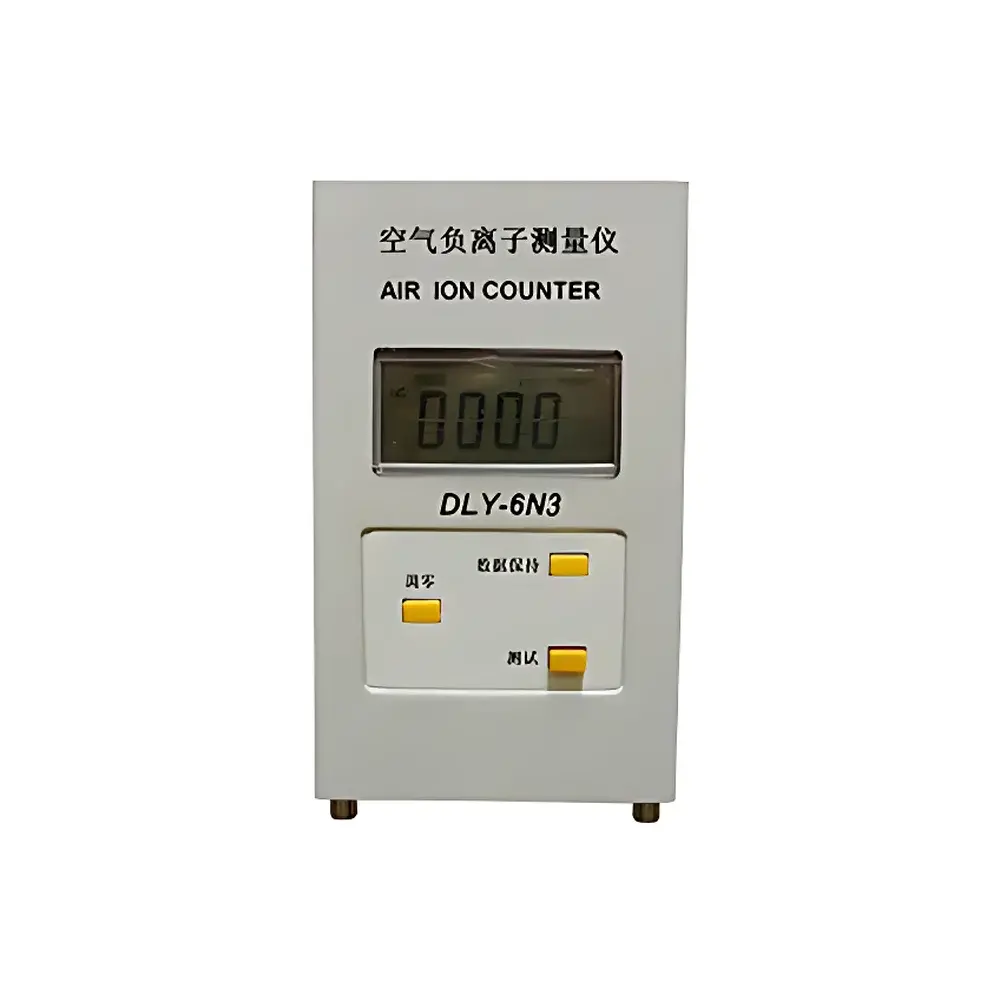
DLY-6N3 Air Negative Ion Detector
| Origin | Beijing |
|---|---|
| Manufacturer Type | Distributor |
| Origin Category | Domestic (China) |
| Model | DLY-6N3 |
| Price Range | USD 0.14 – 714.29 |
| Detection Range | 10–3999 × 10⁰ ions/cm³ |
| Resolution | 10 ions/cm³ |
| Ion Mobility | 0.4 cm²/(V·s) |
| Dimensions | 18 × 10.5 × 5 cm |
| Power Supply | Sealed maintenance-free rechargeable battery (AC 220 V or 12 V automotive battery compatible) |
| Sensor Type | Gold-plated parallel-plate air ion collector (Wesix principle) |
| Display | LCD, direct readout in ions/cm³ |
| Compliance | GB/T 18809–2002 (Chinese National Standard for Air Ion Measurement Instruments) |
Overview
The DLY-6N3 Air Negative Ion Detector is a portable, field-deployable instrument engineered for quantitative measurement of negative air ions (NAIs) in ambient and controlled environments. It operates on the well-established Wesix parallel-plate collector principle—originally developed by air ion physicist Dr. Beckett and widely adopted in metrological practice for its high charge collection efficiency and low recombination loss. The detector employs a gold-plated parallel-plate ion collector, which enhances surface conductivity and minimizes electrostatic charge retention, thereby improving signal stability and long-term reproducibility. Ion mobility is calibrated at 0.4 cm²/(V·s), corresponding to small, fast-moving cluster ions (e.g., O₂⁻·(H₂O)ₙ or CO₃⁻·(H₂O)ₙ) commonly found in natural and indoor atmospheres. The instrument conforms to GB/T 18809–2002, the People’s Republic of China National Standard for General Technical Requirements of Air Ion Measuring Instruments, which defines performance criteria including linearity, zero drift, temperature dependence, and response time under defined environmental conditions (20–30 °C, RH < 80 %). Its compact form factor (18 × 10.5 × 5 cm) and lightweight aluminum alloy enclosure enable routine deployment in outdoor monitoring campaigns, forest ecology studies, indoor air quality assessments, and validation of ion-generating devices.
Key Features
- Gold-plated parallel-plate ion collector with optimized electrode geometry for high-efficiency charge transfer and minimal polarization effects
- Direct digital LCD display showing real-time negative ion concentration in units of ions/cm³, without need for post-processing conversion
- Measurement range of 10–3999 ions/cm³ with a fixed resolution of 10 ions/cm³—sufficient for background-level monitoring and moderate-output ionizer verification
- Integrated sealed maintenance-free rechargeable battery system, supporting dual charging modes: standard AC 220 V mains and 12 V DC automotive power sources
- Rugged anodized aluminum housing providing electromagnetic shielding, mechanical durability, and thermal stability during extended field use
- No internal fan or forced airflow—relies on natural convection, eliminating mechanical noise and reducing calibration drift associated with pump-induced pressure differentials
Sample Compatibility & Compliance
The DLY-6N3 is designed exclusively for gaseous-phase sampling of atmospheric negative ions under ambient pressure (≈101.3 kPa) and non-condensing humidity conditions (RH ≤ 80 %). It does not support particulate-bound ion analysis, positive ion quantification, or operation in corrosive or explosive atmospheres. Instrument calibration follows traceable procedures aligned with GB/T 18809–2002, including zero-point verification using filtered air and span calibration with certified ion sources where available. While not certified to ISO/IEC 17025 or accredited per ILAC requirements, its design and test methodology reflect internationally recognized practices for ionometric instrumentation. Users performing regulatory reporting (e.g., environmental impact assessments or occupational health surveys in China) may reference compliance with GB/T 18809–2002 as part of method validation documentation.
Software & Data Management
The DLY-6N3 operates as a standalone, embedded-system instrument with no onboard data logging or USB/Bluetooth connectivity. All measurements are displayed in real time on the integrated LCD; no external software, drivers, or proprietary platforms are required. For longitudinal studies, users manually record readings at defined intervals—suitable for field notebooks, spreadsheet-based trend analysis, or integration into custom SCADA-like monitoring frameworks via optional analog voltage output (not included in base configuration). No firmware updates, cloud synchronization, or audit-trail functionality is provided; therefore, it is not compliant with FDA 21 CFR Part 11 or GLP/GMP electronic record requirements. Its simplicity ensures operational reliability in resource-constrained settings where network dependency or software validation is impractical.
Applications
- Baseline air ion mapping in forests, mountains, coastal zones, and urban green spaces
- Performance evaluation of commercial and medical-grade negative ion generators (e.g., corona discharge, radioactive α-source, or photoelectric emitters)
- Educational laboratory demonstrations of atmospheric electricity and gas-phase ion chemistry
- Indoor air quality (IAQ) audits in offices, hospitals, and schools—particularly where ion-mediated particle agglomeration or pathogen inactivation is hypothesized
- Environmental research on ion–aerosol interactions, including nucleation event detection and boundary layer ion profiling
- Calibration reference for lower-cost sensor arrays in distributed air quality networks
FAQ
Does the DLY-6N3 measure both positive and negative ions?
No. It is configured exclusively for negative air ion detection using a negatively biased collector plate. Positive ion measurement requires polarity reversal and separate calibration, which this model does not support.
Can it be used indoors near electronic equipment?
Yes—its passive sampling design and metal shielding minimize electromagnetic interference (EMI), but avoid placement within 30 cm of strong RF sources (e.g., Wi-Fi routers, microwave ovens) to prevent signal noise.
What is the recommended recalibration interval?
GB/T 18809–2002 recommends annual functional verification using zero-air and reference ion sources; field users should perform zero checks before each deployment session.
Is temperature compensation built into the firmware?
No. The instrument assumes stable ambient temperature (20–30 °C); significant deviations (>±5 °C from calibration point) may affect mobility-based concentration calculations and require manual correction per Annex B of GB/T 18809–2002.
Does it comply with international standards such as ISO 16000 or ASTM D6851?
No. GB/T 18809–2002 is a national standard specific to China. While its technical approach aligns broadly with principles in ISO 16000-24 (indoor air—determination of air ions), formal equivalence has not been established through interlaboratory comparison or certification.







