
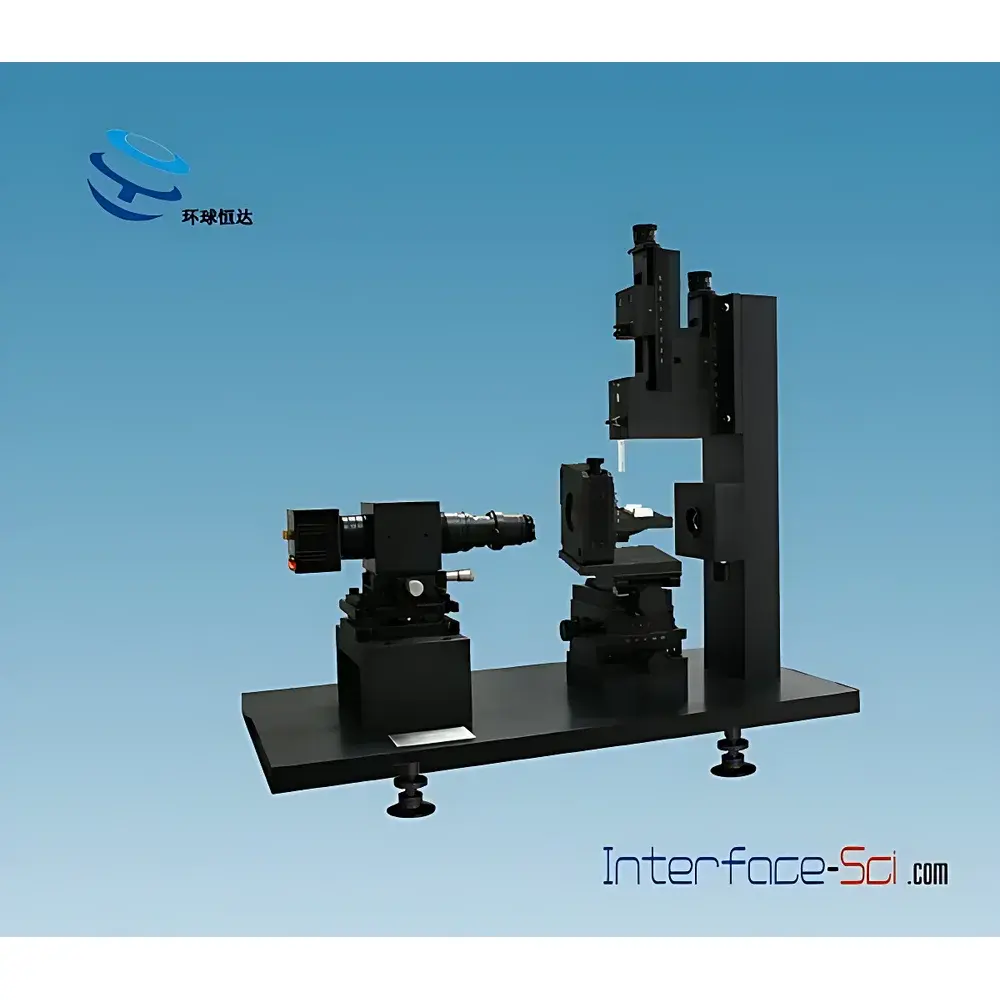
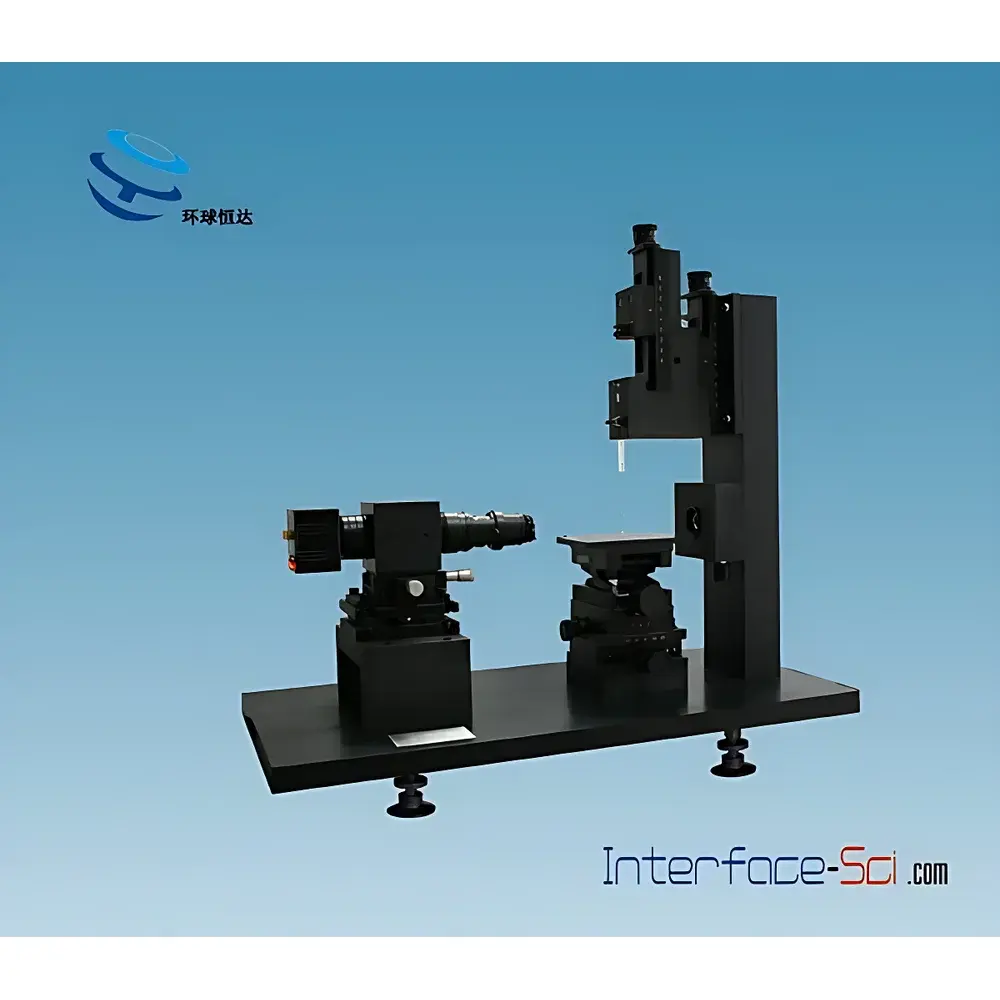
Interface SCI2000B Video-Based Optical Contact Angle & Roll-Off Angle Analyzer
| Brand | Interface |
|---|---|
| Origin | Beijing, China |
| Model | SCI2000B |
| Instrument Type | Benchtop Laboratory Video Optical Contact Angle Meter |
| Contact Angle Measurement Range | 0–180° |
| Contact Angle Accuracy | ±0.1° |
| Contact Angle Resolution | 0.01° |
| Roll-Off Angle Measurement Range | 0–360° |
| Surface/Interfacial Tension Range | 5.0–2000 mN/m |
| Surface Tension Resolution | 0.001 mN/m |
| Sample Stage Dimensions | 120 × 100 mm |
| Minimum Image Resolution | 1280 × 1024 pixels |
| Optical Magnification | 0.7–5.0× continuous zoom (industrial-grade 60× effective magnification) |
| Frame Rate (standard) | 25 fps (upgradable to 2000 fps) |
| Power Supply | AC 220 V, 50 Hz |
| Dimensions (W × D × H) | 300 × 500 × 420 mm |
| Weight | 15 kg |
Overview
The Interface SCI2000B is a high-precision, benchtop video-based optical contact angle and roll-off angle analyzer engineered for rigorous surface wettability characterization in research and quality control laboratories. It operates on the principle of digital image capture and geometric contour analysis of sessile, pendant, captive, or tilted droplets—enabling quantitative determination of solid–liquid–gas interfacial interactions. The system leverages Young–Laplace equation fitting for surface and interfacial tension measurements via pendant drop analysis, and integrates advanced baseline detection, asymmetric droplet modeling, and curvature-corrected contact angle computation. Designed for reproducible static and dynamic contact angle assessment—including advancing, receding, equilibrium, and roll-off angles—the SCI2000B supports comprehensive wetting thermodynamics evaluation across diverse material classes: polymers, metals, ceramics, fibers, thin films, biological substrates, and porous media. Its modular architecture allows seamless integration of motorized rotation stages, high-speed imaging, and precision syringe pump modules—ensuring adaptability to evolving experimental protocols in surface science, materials engineering, and formulation development.
Key Features
- High-resolution optical imaging system featuring an industrial-grade continuous-zoom lens (0.7–5.0×) with 60× effective magnification, low-distortion optics, and extended depth of field for accurate droplet contour delineation
- Adjustable cold LED backlighting with parallel-optics collimation for uniform illumination and enhanced edge contrast—critical for sub-degree contact angle resolution
- Manually actuated five-axis sample stage (X/Y/Z + tilt + rotation) with micrometer-level positioning (0.1 mm linear, 0.01° angular resolution); optional motorized 360° rotation platform for automated roll-off and hysteresis measurements
- Modular liquid dispensing system: standard manual 5-channel peristaltic pump; upgradeable to programmable syringe pumps with bidirectional control, 0.1 mm volumetric precision, and interchangeable stainless-steel or PTFE needles (0.14–0.9 mm ID)
- Real-time image acquisition at up to 25 fps (standard), with optional high-speed camera modules supporting 60–2000 fps for transient wetting dynamics, droplet oscillation, or electrowetting studies
- Automated baseline detection, multi-method droplet fitting (tangent, circle, ellipse, conic section, Young–Laplace), and curvature compensation for convex/concave or rough surfaces
Sample Compatibility & Compliance
The SCI2000B accommodates a broad range of specimen geometries and surface states: flat solids (max. 180 × ∞ × 60 mm), fibers, membranes, plant leaves, powder compacts, and textured coatings. Optional fixtures—including fiber clamps, film holders, and leaf-mounting stages—enable robust measurement on non-planar or low-rigidity samples. The instrument complies with internationally recognized standards for surface wettability assessment, including ASTM D724 (paper wettability), ASTM D5946-2004 (corona-treated polymer films), and ISO 15989 (water contact angle of treated plastic films). Its hardware and software architecture support GLP/GMP-aligned workflows: timestamped data logging, user-access controls, audit trails, and exportable metadata-rich reports compatible with FDA 21 CFR Part 11 requirements when deployed with validated configurations.
Software & Data Management
The proprietary analysis suite provides integrated modules for contact angle, interfacial tension, and surface free energy quantification. It implements over six analytical algorithms—including tangent, height-width, five-point polynomial, and Young–Laplace curve fitting—to accommodate symmetric and asymmetric droplet profiles. Surface free energy calculations are supported by 12 established models (e.g., Owens–Wendt–Rabel, Wu, van Oss–Chaudhury–Good, Neumann Equation of State), drawing from an embedded database of 300 reference liquids and 500 physicochemical parameters. All measurements are stored in a relational database with one-to-one image–data linkage; results can be exported to Excel, annotated PNG/JPEG, or AVI video files. Batch processing, multi-point sequential analysis, automatic averaging of left/right contact angles, and real-time tension calculation during pendant drop formation are fully scriptable and repeatable.
Applications
The SCI2000B serves as a core tool in interdisciplinary surface science applications: evaluation of plasma, corona, or chemical surface treatments on polymers and metals; optimization of ink, coating, and adhesive formulations; characterization of hydrophobic/hydrophilic functionalization in microelectronics and medical devices; assessment of cleaning efficacy and contamination on semiconductor wafers or optical components; quantification of biofouling resistance in biomaterials; and fundamental studies of surfactant adsorption kinetics at fluid interfaces. It is routinely employed in R&D and QC environments across industries including advanced packaging, lithium-ion battery separator development, filtration membrane design, pharmaceutical tablet coating, agricultural spray adjuvant screening, and nanomaterial surface modification.
FAQ
What measurement methods does the SCI2000B support?
Sessile drop (2- and 3-phase), pendant drop, captive bubble, and slide (tilt) methods—including dynamic roll-off angle determination.
Can it measure interfacial tension between two immiscible liquids?
Yes—using pendant drop analysis with Young–Laplace fitting and optional Bashford–Adams table-based calibration.
Is the system compliant with regulatory documentation requirements?
When configured with user authentication, electronic signatures, and audit-trail-enabled software, it meets foundational requirements for GLP, GMP, and 21 CFR Part 11 compliance.
What sample types are compatible beyond flat solids?
Fibers, textiles, plant leaves, powders (pressed pellets), porous scaffolds, and flexible films—using application-specific mounting accessories.
How is contact angle hysteresis quantified?
By sequential measurement of advancing and receding angles during controlled droplet volume increase/decrease, or via automated tilting to determine roll-off threshold.
Can surface free energy be calculated for high-energy surfaces like metals or oxides?
Yes—through acid–base (van Oss–Chaudhury–Good) and Equation of State models, which explicitly account for polar and dispersive interaction components.



