
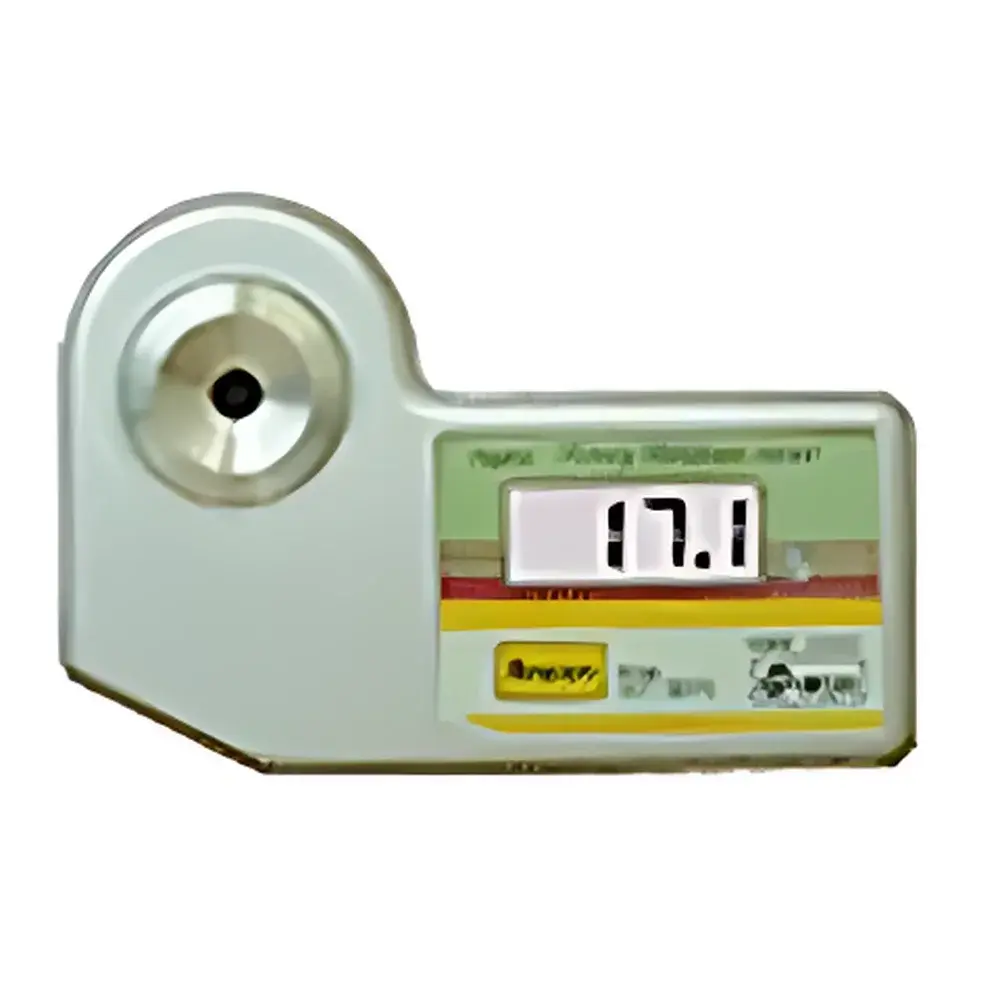
G-WON GMK-315AC Capacitance-Based Honey Moisture Analyzer
| Brand | G-WON |
|---|---|
| Origin | South Korea |
| Model | GMK-315AC |
| Measurement Range | 12–40% w/w |
| Accuracy | ±0.2% |
| Resolution | 0.1% |
| Temperature Compensation | Automatic |
| Display | LCD (Large-Digit) |
| Power Supply | 9 V DC (1 × 9V battery) |
| Dimensions | 154 × 105 × 43 mm |
| Weight | ~1.0 kg |
Overview
The G-WON GMK-315AC is a dedicated capacitance-based moisture analyzer engineered for rapid, non-destructive quantification of water content in honey and other viscous, high-sugar liquid matrices. Unlike loss-on-drying (LOD) or Karl Fischer titration methods, this instrument operates on the principle of dielectric permittivity measurement: water molecules exhibit significantly higher relative permittivity (~80 at 20 °C) compared to honey’s primary constituents (sugars, organic acids, and trace volatiles), enabling selective detection within the 12–40% (w/w) operational range. The device employs a calibrated parallel-plate capacitor sensor integrated into a compact handheld probe assembly, where sample-induced changes in capacitance are linearly correlated to moisture concentration via factory-established calibration curves traceable to gravimetric reference standards. Designed for field-deployable use in apiaries, packing facilities, and QC laboratories, the GMK-315AC delivers repeatable results in under 10 seconds without sample preparation, heating, or reagents—making it compliant with routine inspection workflows under ISO 21527-1:2022 (microbiological analysis of honey) and aligned with FAO/WHO Codex Alimentarius Standard CXS 12-1981 (honey specifications), particularly Clause 3.2 on moisture limits.
Key Features
- Capacitance sensing architecture optimized for high-dielectric contrast between water and honey matrix, minimizing interference from temperature fluctuations via real-time automatic compensation.
- Large-digit LCD display with backlight-independent readability under ambient lighting conditions—critical for use in variable environments such as beekeeping sheds or mobile inspection vans.
- Low-battery indicator integrated into display logic, ensuring uninterrupted operation during extended sampling sessions; powered by a single standard 9 V alkaline battery (IEC 6LR61) with typical service life exceeding 2000 measurements per charge.
- Compact ergonomic form factor (154 × 105 × 43 mm) and sub-kilogram mass (≈1.0 kg) facilitate one-handed operation and integration into portable QA kits without compromising structural rigidity or sensor alignment stability.
- Factory-calibrated against NIST-traceable reference honey standards across the full 12–40% range, with documented linearity (R² ≥ 0.999) and repeatability (RSD < 0.8% at 18% and 25% levels).
Sample Compatibility & Compliance
The GMK-315AC is validated exclusively for raw, filtered, and pasteurized honey—including acacia, clover, manuka, and multifloral varieties—with viscosity up to 12,000 cP at 20 °C. It is not suitable for crystallized, fermented, or adulterated samples containing added water, syrups, or glycerol, which distort dielectric response. The instrument meets IEC 61000-4-2 (ESD immunity) and IEC 61000-4-3 (radiated RF immunity) requirements for industrial environments. While not certified to GLP or GMP Annex 11, its deterministic measurement algorithm, absence of software-configurable parameters, and immutable calibration firmware support audit-ready documentation per FDA 21 CFR Part 11 when used in conjunction with controlled lab notebooks and electronic records systems.
Software & Data Management
The GMK-315AC operates as a standalone hardware analyzer with no embedded microprocessor-based data logging or USB/Bluetooth connectivity. All measurements are displayed in real time only; no internal memory or export functionality is provided. This design eliminates validation overhead associated with electronic record integrity, aligning with regulatory preferences for “dumb terminal” instruments in low-risk QC applications. Users maintain traceability through manual transcription into paper-based or LIMS-integrated spreadsheets, with each reading annotated by operator ID, timestamp, batch code, and ambient temperature—practices consistent with ISO/IEC 17025:2017 Clause 7.7 (result reporting).
Applications
- Routine moisture verification prior to bottling, ensuring compliance with national limits (e.g., ≤20% in EU Regulation (EU) No 1169/2011; ≤23% in US FDA Grade A standards).
- Field screening of hive-stored honey to assess optimal harvest timing and prevent fermentation onset.
- Supplier qualification audits where rapid pass/fail decisions are required without laboratory turnaround delays.
- Educational demonstrations of dielectric property relationships in food science curricula.
- Process monitoring during thermal concentration or vacuum dehydration steps where real-time feedback informs endpoint control.
FAQ
Does the GMK-315AC require periodic recalibration?
Yes—annual recalibration against certified honey reference materials is recommended per manufacturer guidelines and ISO/IEC 17025 Clause 6.4. Calibration certificates include uncertainty budgets derived from gravimetric intercomparison.
Can it measure moisture in maple syrup or agave nectar?
No—the calibration is honey-specific due to unique dielectric behavior arising from fructose/glucose ratio, hydroxymethylfurfural (HMF) content, and colloidal particle dispersion; cross-matrix use invalidates stated accuracy.
Is the sensor probe resistant to crystallized honey residue?
The stainless-steel electrode surface is mechanically cleanable with warm water and lint-free cloth; abrasive cleaning or solvent immersion may degrade dielectric coating integrity and void warranty.
What ambient temperature range supports specified accuracy?
10–35 °C, with automatic compensation active across this interval; measurements outside this range require correction using published temperature coefficients in the technical manual.
How does it compare to AOAC Official Method 950.46?
The GMK-315AC is not an AOAC-validated method; it serves as a rapid screening tool. Confirmatory testing for regulatory submission must follow AOAC 950.46 (gravimetric oven drying) or ISO 12099:2017 (near-infrared spectroscopy).






