
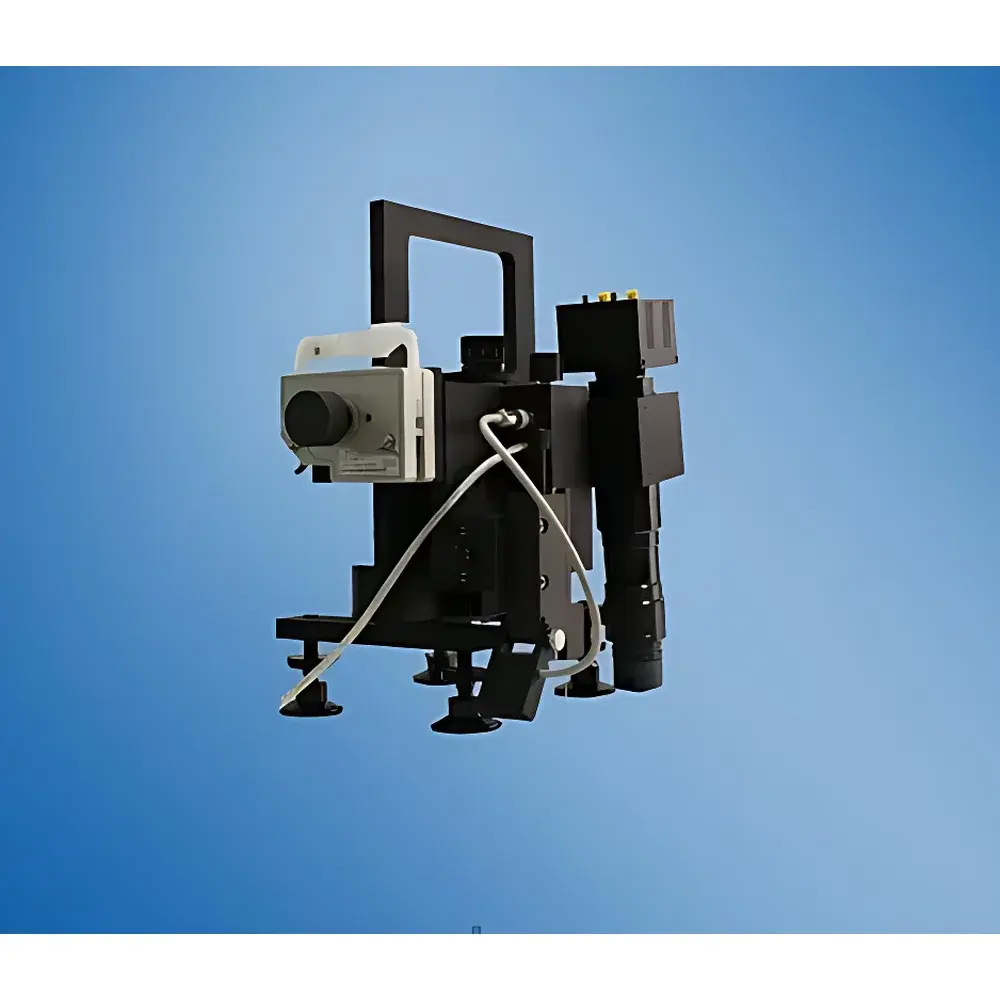
PowerTouch JC2000P2 Portable Video-Based Contact Angle Analyzer
| Origin | Beijing, China |
|---|---|
| Manufacturer Type | Authorized Distributor |
| Product Origin | Domestic (China) |
| Model | JC2000P2 |
| Price Range | USD 7,000–14,000 |
| Instrument Category | Video Optical Contact Angle Meter |
| Form Factor | Portable |
| Contact Angle Measurement Range | 0–180° |
| Contact Angle Resolution | 0.1° or 0.5° (selectable) |
| Sample Stage Dimensions | 100 × 100 mm (fixed) |
| Image Resolution | 800 × 600 pixels |
| Surface/Interfacial Tension Range | 0–1000 mN/m |
Overview
The PowerTouch JC2000P2 Portable Video-Based Contact Angle Analyzer is an engineered solution for rapid, field-deployable assessment of solid-liquid interfacial wettability under ambient conditions. Utilizing the principle of video-based optical goniometry, the system captures high-fidelity side-view images of sessile or pendant liquid droplets on solid substrates and computes contact angles via geometric analysis of the droplet profile. This method adheres to ISO 19403-2 (2017) and ASTM D7334–15 standards for contact angle measurement, ensuring traceability and comparability across laboratories. Unlike benchtop systems requiring sample transport and environmental control, the JC2000P2 integrates a compact optical train, USB-powered imaging, and real-time image acquisition—enabling in situ evaluation of surface treatments, coating uniformity, cleaning efficacy, and hydrophobic/hydrophilic modification on large-format or immovable substrates such as architectural glass, solar panels, coated metal sheets, and composite laminates.
Key Features
- True portable architecture: 155 × 80 × 200 mm footprint, 2.5 kg total mass—designed for lab-to-field continuity without sacrificing optical stability.
- High-sensitivity 1.3 MP CCD camera with 800 × 600 pixel resolution and 25 fps frame rate, synchronized with adjustable cold LED illumination to minimize thermal drift and evaporation artifacts.
- Multi-algorithm analytical engine supporting θ/2 method, height-width method (3-point planar / 4-point curved), 5-point polynomial curve fitting (for advancing/receding angle differentiation), and tangent-line (geometric) analysis—each algorithm validated per ISO/IEC 17025-compliant calibration protocols.
- Selectable angular resolution: 0.1° for R&D-grade surface energy mapping; 0.5° for routine QC screening—configurable via software interface without hardware modification.
- Integrated peristaltic dosing pump enables precise, vibration-free microdispensing (1–10 µL increments), critical for repeatable droplet formation on low-energy or textured surfaces.
- No dedicated sample stage required: direct placement on flat or gently curved surfaces up to 100 × 100 mm active area; accommodates irregular geometries including fibers, textiles, and pressed powder compacts.
Sample Compatibility & Compliance
The JC2000P2 supports heterogeneous sample classes without destructive preparation: rigid solids (glass, silicon wafers, ceramics), flexible films (PET, PVDF), fibrous media (nonwovens, carbon fiber mats), and consolidated particulates (pressed pellets ≥5 mm thickness). It measures both static and dynamic contact angles—including advancing, receding, and roll-off angles—under ambient temperature and humidity (15–35°C, <70% RH). All measurement data comply with GLP documentation requirements: timestamped AVI/BMP capture, audit-trail-enabled parameter logging, and exportable CSV reports containing raw coordinates, fitted parameters, and uncertainty estimates. Software output conforms to FDA 21 CFR Part 11 readiness when deployed on validated Windows platforms (Windows 7 SP1 or later).
Software & Data Management
The proprietary PowerTouch Analysis Suite runs natively on Windows OS (7/10/11, 64-bit) and interfaces via USB 2.0. It provides real-time droplet contour detection, automatic baseline correction, and dual-angle reporting (left/right asymmetry analysis). Surface free energy is calculated using Owens-Wendt-Rabel-Kaelble (OWRK) and Wu harmonic mean models; interfacial tension is derived from pendant drop shape analysis (Young-Laplace equation inversion). All results are stored in structured project files (.PTP) with embedded metadata (operator ID, date/time, environmental notes). Batch processing mode enables statistical evaluation across ≥50 samples, generating Cp/Cpk indices for process capability assessment in ISO 9001-certified manufacturing environments.
Applications
- Quality assurance of anti-reflective, anti-fog, and self-cleaning coatings on architectural glazing and automotive windshields.
- In-process verification of plasma, corona, or flame treatment efficacy on polymer films prior to printing or lamination.
- Surface energy profiling of battery electrode coatings (anode/cathode slurries) to optimize slurry wetting and calendering adhesion.
- Rapid screening of nanocomposite film hydrophobicity during R&D of breathable membranes and filtration media.
- CMC determination of surfactant solutions via dynamic contact angle vs. concentration curves.
- Forensic analysis of contamination-induced wettability shifts on semiconductor wafer handling surfaces.
FAQ
Is the JC2000P2 suitable for measuring contact angles on curved or textured surfaces?
Yes—its manual tilt-adjustable CCD platform and multi-point curve-fitting algorithms accommodate convex, concave, and micro-roughened surfaces (Ra ≤ 5 µm); validation data available upon request.
Does the system support compliance with regulatory audit requirements?
Yes—the software maintains full electronic records including operator logs, calibration history, and version-controlled analysis settings, satisfying FDA 21 CFR Part 11 and EU Annex 11 expectations when operated on validated IT infrastructure.
Can interfacial tension be measured for liquid-liquid systems?
Yes—using pendant drop analysis with immiscible phase pairs (e.g., water/oil), provided density difference ≥0.1 g/cm³ and interfacial age <30 s.
What is the minimum droplet volume required for reliable measurement?
Optimal range is 2–8 µL; volumes <1 µL may require environmental enclosure to suppress evaporation-induced error.
Is external PC hardware supplied with the instrument?
No—users must provide a Windows-based host PC meeting minimum specifications (Intel Core i3+, 4 GB RAM, USB 2.0 port, SSD storage); optional pre-configured validation-ready systems available separately.



