
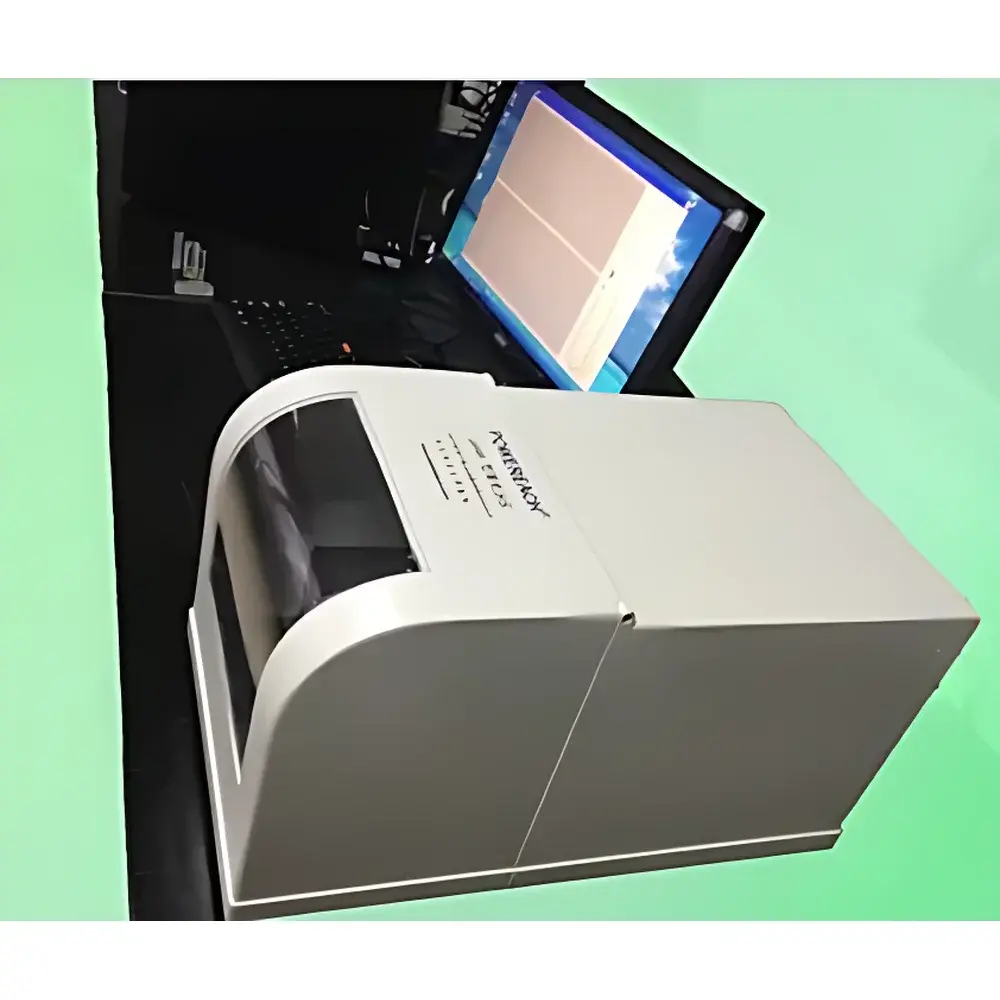
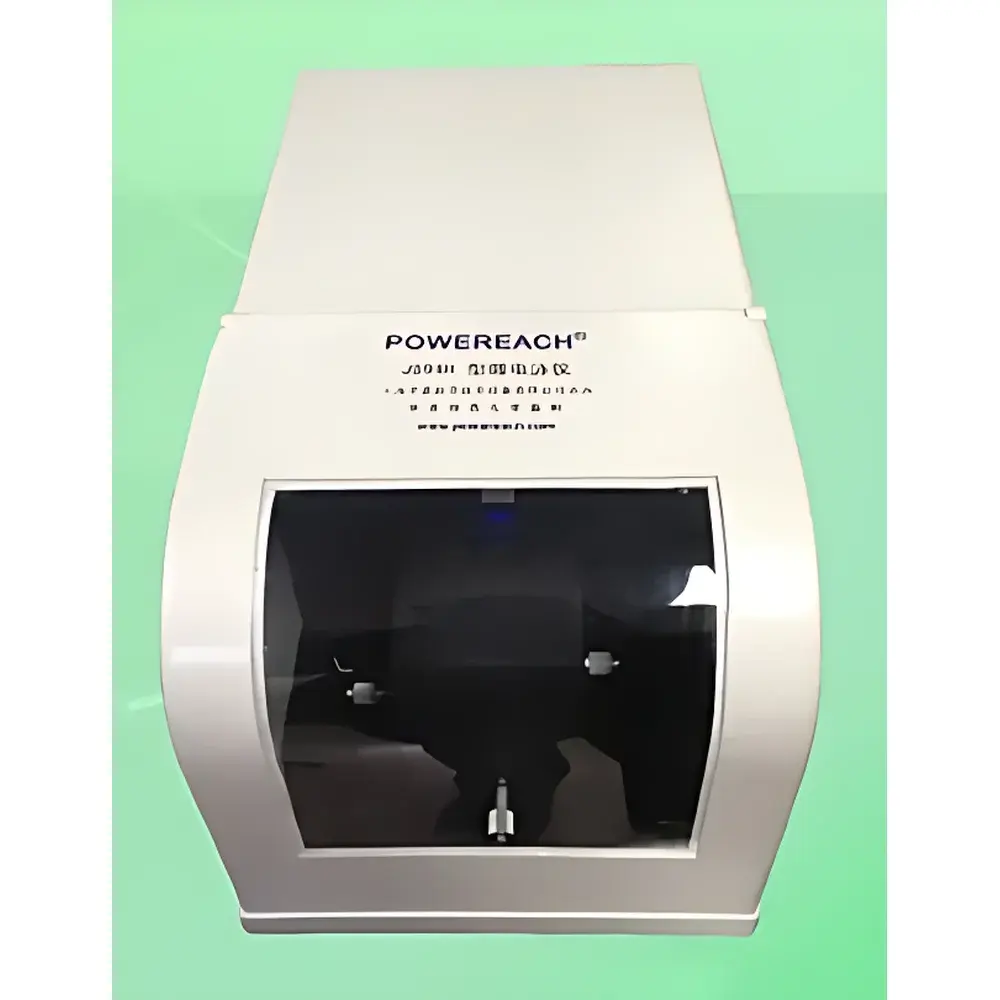
Zykx JS94TM Zeta Potential Analyzer for Colloidal Soil Systems
| Brand | Zykx |
|---|---|
| Model | JS94TM |
| Origin | Beijing, China |
| Type | Electrophoretic Light Scattering (ELS) Zeta Potential Analyzer |
| Particle Size Range | 0.2–50 µm (aqueous dispersions) |
| Zeta Potential Range | ±3000 mV |
| Accuracy | ±5% |
| pH Range | 0.00–14.00 |
| pH Resolution | 0.1 pH unit |
| Zeta Resolution | 1 mV |
| Temperature Range | −5.0 to 105.0 °C (±0.1 °C) |
| Optional Thermostatic Stage | −10 to 95 °C |
| Power Supply | 220 V, 50 Hz |
| Power Consumption | 150 W |
| Sample Volume per Measurement | 0.5 mL |
| Electrode Configuration | Integrated Ag/AgCl–Pt–Ti tri-metal electrode system in precision-machined 0.5 cm-thick optical glass electrophoresis cell |
| Optical System | Near-field semiconductor illumination (blue/green LEDs, <100 µW), 1200× digital magnification, real-time dual-direction grayscale image capture |
| Voltage Control | Adjustable DC bias with polarity reversal (0.30–1.20 s interval), anti-polarization design |
| Data Acquisition | Automated temperature-compensated ELS image sequence capture and centroid velocity calculation |
Overview
The Zykx JS94TM Zeta Potential Analyzer is a dedicated electrophoretic light scattering (ELS) instrument engineered for precise determination of zeta potential (ζ) in colloidal soil systems and other aqueous particulate dispersions. It operates on the fundamental principle of laser Doppler microelectrophoresis: under an applied electric field, charged particles migrate at a velocity proportional to their surface potential; this electrophoretic mobility is optically tracked via high-magnification, low-heat semiconductor illumination and converted to zeta potential using the Smoluchowski or Henry equation—calibrated for aqueous media with known dielectric constant and viscosity. Designed specifically for soil science laboratories, environmental geochemistry, and colloidal interface research, the JS94TM enables quantitative assessment of particle surface charge behavior across wide pH (0.00–14.00) and temperature (−5.0 to 105.0 °C) ranges—critical for evaluating clay mineral reactivity, contaminant adsorption thresholds, and dispersion stability in saturated/unsaturated zone modeling.
Key Features
- Integrated electrophoresis cell with 0.5 cm-thick optical-grade borosilicate glass and embedded tri-metal electrodes (Ag/AgCl reference, Pt working, Ti counter), optimized via computational microfluidic simulation to minimize edge effects and eliminate stagnant layer artifacts.
- Patented open-cup electrode holder enabling rapid cell insertion, alignment, and thermal equilibration—reducing measurement turnaround time without compromising positional repeatability.
- Near-field blue/green LED optical system (<100 µW output) eliminates thermal convection interference and supports reliable visualization of sub-micron particles (down to 0.2 µm) at 1200× effective digital magnification.
- Real-time bidirectional image capture: four synchronized grayscale frames per cycle are acquired and processed to compute centroid displacement vectors, yielding robust electrophoretic mobility values even in polydisperse or weakly charged suspensions.
- Programmable voltage polarity reversal (0.30–1.20 s intervals) suppresses electrode polarization while maintaining measurement integrity over extended runs—essential for low-conductivity soil leachates and natural organic matter-rich extracts.
- Onboard Pt100 temperature probe provides continuous feedback to the acquisition software, enabling automatic correction of medium viscosity and dielectric permittivity in zeta potential calculations per ISO 13099-2:2012.
Sample Compatibility & Compliance
The JS94TM accommodates native soil colloids, clay suspensions (kaolinite, montmorillonite, illite), humic acid–mineral complexes, biochar nanoparticles, and engineered nanomaterials in aqueous matrices. Its 0.5 mL sample requirement minimizes preparation artifacts and supports sequential pH titration protocols. The instrument complies with core metrological requirements outlined in ASTM D7826–17 (Standard Test Method for Zeta Potential of Nanoparticles in Aqueous Media) and aligns with data integrity expectations under GLP-regulated environmental testing workflows. While not FDA 21 CFR Part 11–certified out-of-box, its audit-trail-capable software architecture supports configuration for regulated environments upon customer-specific validation.
Software & Data Management
Acquisition and analysis are performed via Zykx ZetaSoft v3.x—a Windows-based application supporting automated pH sweeps, temperature ramping, and multi-cycle mobility averaging. Raw image sequences, voltage/time logs, and thermal profiles are stored in HDF5 format with embedded metadata (operator ID, timestamp, calibration checksum). Export options include CSV (for statistical packages), PDF reports (with traceable uncertainty estimates), and XML (compatible with LIMS integration). All processing algorithms—including centroid tracking, velocity regression, and Smoluchowski conversion—are fully documented in the user manual per ISO/IEC 17025 traceability guidelines.
Applications
- Determination of isoelectric point (IEP) of soil clays and iron/aluminum oxides to predict cation/anion adsorption edges in variable-charge soils.
- Quantifying surface charge modulation during redox cycling (e.g., Fe²⁺/Fe³⁺ transitions) or organic ligand complexation (e.g., oxalate, citrate).
- Evaluating colloidal stability of eroded sediments in runoff simulations and groundwater transport modeling.
- Characterizing surface functionalization efficiency of biochar or nanoscale zero-valent iron (nZVI) used in soil remediation.
- Supporting pedogenic process studies—e.g., weathering-induced charge development in volcanic ash or lateritic profiles.
- Teaching laboratory implementation of interfacial electrokinetics in soil physics, environmental chemistry, and colloid science curricula.
FAQ
What particle size range is validated for zeta potential measurement on the JS94TM?
The instrument is validated for aqueous colloidal suspensions between 0.2 µm and 50 µm, as verified by NIST-traceable latex standards and natural clay reference materials (e.g., SWy-2 bentonite). Sub-0.5 µm resolution relies on high-contrast imaging and frame-differencing algorithms—not dynamic light scattering.
Can the JS94TM measure zeta potential in high-salinity or non-aqueous media?
It is calibrated exclusively for aqueous systems. Measurements in >100 mM ionic strength require conductivity compensation and may exhibit reduced accuracy due to field screening; non-aqueous solvents are not supported.
Is the electrophoresis cell reusable and cleanable?
Yes—the glass cell and electrodes are chemically resistant and designed for repeated rinsing with deionized water, dilute HNO₃ (0.1 M), and ethanol. Full cleaning protocol is included in Section 4.2 of the operation manual.
Does the system support automated pH titration?
When paired with a compatible programmable titrator (e.g., Metrohm 809 Titrando), ZetaSoft accepts external pH input via RS-232 and triggers sequential measurements—enabling full IEP mapping without manual intervention.
How is temperature control implemented during extended measurements?
The optional thermostatic stage (−10 to 95 °C) uses Peltier elements with PID feedback; ambient temperature drift is continuously compensated in real time using the integrated Pt100 sensor and built-in medium property lookup tables.



