
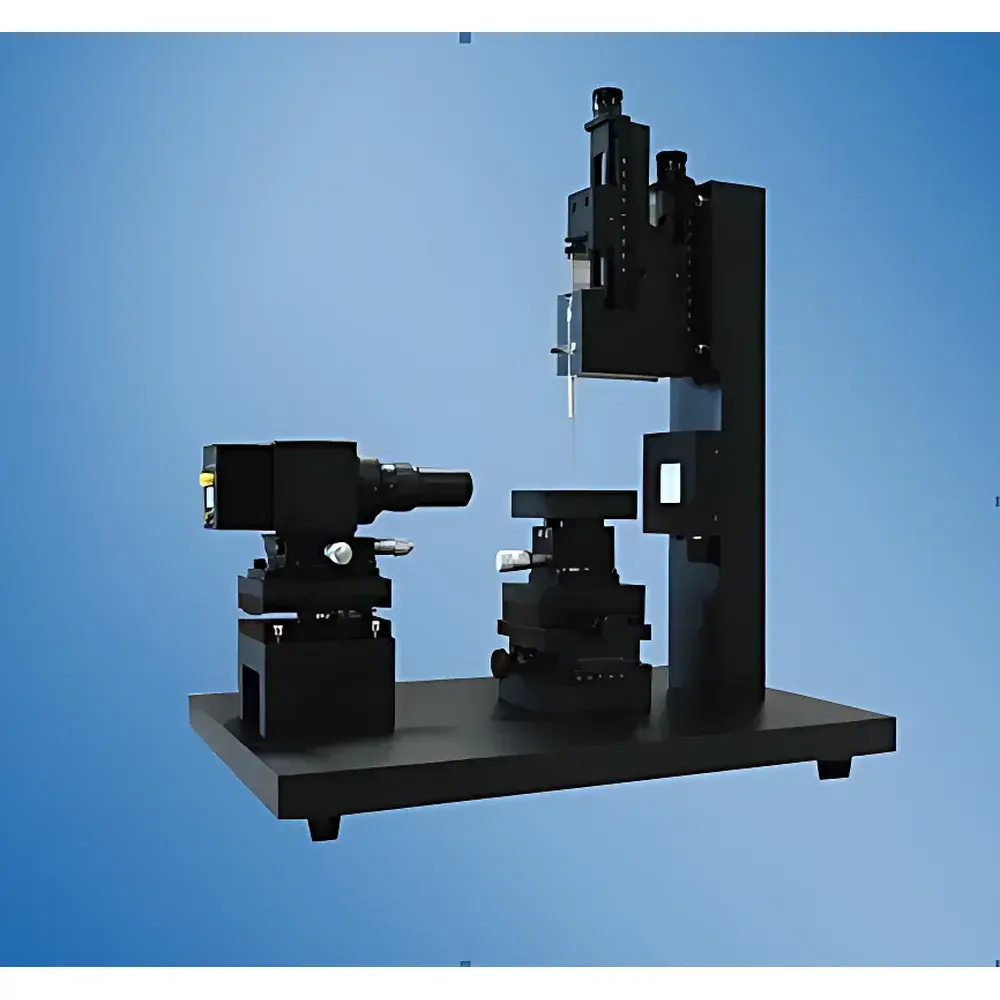
PowerView JC2000DM Precision Video-Based Contact Angle Goniometer
| Origin | Beijing, China |
|---|---|
| Manufacturer Type | Authorized Distributor |
| Origin Category | Domestic (PRC) |
| Model | JC2000DM |
| Price Range | USD 2,800–7,000 |
| Instrument Class | Video Optical Contact Angle Analyzer |
| Form Factor | Benchtop Laboratory System |
| Contact Angle Measurement Range | 0–180° |
| Contact Angle Accuracy | ±0.1° (θ/2 Method) |
| Sample Stage Dimensions | 100 × 70 mm |
| Optical Magnification | 0.7–5× (55–320 pixel/mm) |
| Surface/Interfacial Tension Range | 0–1000 mN/m |
Overview
The PowerView JC2000DM Precision Video-Based Contact Angle Goniometer is an engineered optical instrument designed for quantitative characterization of solid–liquid–gas interfacial interactions. It operates on the principle of high-resolution digital image capture and geometric contour analysis of sessile or pendant liquid droplets, enabling precise determination of contact angle (θ) — defined as the angle formed between the tangent to the liquid–vapor interface and the solid surface at the three-phase contact line. The system supports multiple measurement modes including static, advancing/receding, tilting, rolling, and captive bubble configurations, making it suitable for dynamic wettability assessment under controlled environmental conditions. Its core architecture integrates a motorized-precision optical train, a thermally stable mechanical platform, and calibrated fluid dispensing hardware — all optimized for reproducible measurements in research-grade laboratories and industrial QC environments.
Key Features
- High-fidelity imaging subsystem featuring an industrial-grade low-light CCD camera (1280 × 1028 resolution, 25 fps), coupled with a continuously variable magnification lens (0.7–5×) and adjustable cold LED backlighting (50 high-intensity LEDs with acrylic diffuser)
- Manually actuated XYZ sample stage with ±50 mm X/Y travel (0.1 mm resolution) and 25 mm Z-axis lift (0.01 mm resolution); stage dimensions support standard substrates up to 100 × 70 mm
- Manual syringe-based liquid delivery system with interchangeable gas-tight glass microsyringes (50 µL and 100 µL), PTFE-coated needles (0.7 mm ID), and fine-positioning controls for both dispensing and focus alignment
- Seven-degree-of-freedom mechanical adjustment platform for precise leveling of sample surface, lens axis, and overall instrument orientation
- Six validated analytical algorithms — including θ/2, circle/ellipse fitting, tangent method, height-width method, pendant drop shape analysis, and fully automated edge-detection-based segmentation — ensuring robustness across asymmetric, irregular, or low-contrast droplet profiles
- Integrated surface energy modeling engine supporting nine established theoretical frameworks (e.g., Owens–Wendt, Fowkes, Wu harmonic mean, van Oss–Chaudhury–Good) for both low-energy polymers and high-energy metals/ceramics
Sample Compatibility & Compliance
The JC2000DM accommodates a broad range of solid substrates without modification: rigid planar materials (glass, silicon wafers, metals), flexible films (PET, PI), fibers, woven/nonwoven textiles, and consolidated powder compacts (via standardized pelletization). Its non-destructive optical methodology complies with ASTM D7334–22 (“Standard Practice for Surface Wettability of Coated Surfaces by Contact Angle Measurement”) and ISO 19403–2:2017 (“Paints and Varnishes — Determination of Contact Angle — Part 2: Static Contact Angle”). While not inherently GLP/GMP-certified, the system supports audit-ready data handling when configured with timestamped metadata logging, user-access control, and exportable raw image archives — prerequisites for internal quality assurance workflows aligned with FDA 21 CFR Part 11 principles.
Software & Data Management
The proprietary PowerView software suite provides full acquisition-to-analysis workflow automation. It enables batch-mode sequential image capture at user-defined intervals (up to 60 fps), real-time contact angle computation, and side-by-side left/right interface evaluation. All measurements are stored with embedded calibration parameters, operator ID, timestamp, and environmental notes. Database functionality includes lossless backup, compression, and direct export to Excel (.xlsx) or annotated PNG/JPEG files containing overlayed fit curves and numerical results. Video recording (AVI format) supports documentation for training, presentations, or regulatory submissions. Surface tension calculation employs Young–Laplace equation solving for pendant drops; CMC determination is supported via concentration-series interfacial tension profiling.
Applications
This goniometer serves critical roles across academia and industry where interfacial behavior governs performance: evaluating hydrophobicity/hydrophilicity of functional coatings (anti-fog, self-cleaning, anti-corrosion); assessing fiber wettability in textile dyeing and composite resin impregnation; characterizing nanoparticle surface modification efficacy; optimizing inkjet print head compatibility; validating membrane pore wetting thresholds in filtration R&D; and quantifying biofilm adhesion resistance on medical device surfaces. Users include materials science labs studying graphene oxide dispersion stability, OLED manufacturers screening encapsulation barrier layers, and pharmaceutical firms developing transdermal patch formulations.
FAQ
Does the JC2000DM support automated advancing/receding contact angle measurement?
Yes — when equipped with an optional motorized tilt stage (sold separately), the system performs dynamic contact angle sequences including continuous tilt-and-capture protocols per ASTM D7490–21.
Can surface free energy be calculated for rough or heterogeneous surfaces?
The software includes empirical correction modules for convex/concave curvature and basic roughness compensation; however, rigorous surface energy deconvolution requires supplementary profilometry data.
Is the system compatible with corrosive or volatile solvents?
Standard PTFE needle tips and glass syringes tolerate common organic solvents (e.g., chloroform, ethanol, toluene); extended exposure to strong acids/bases requires custom chemically resistant components.
What calibration standards are recommended for routine verification?
Certified reference slides with known contact angles (e.g., 60° ± 0.5° and 110° ± 0.5° polycarbonate standards traceable to NIST SRM 2800 series) are advised for daily system validation.
Is remote technical support available outside mainland China?
Yes — firmware updates, software patches, and application troubleshooting are provided globally via secure web portal and encrypted file transfer; on-site service is coordinated through regional authorized partners.



