
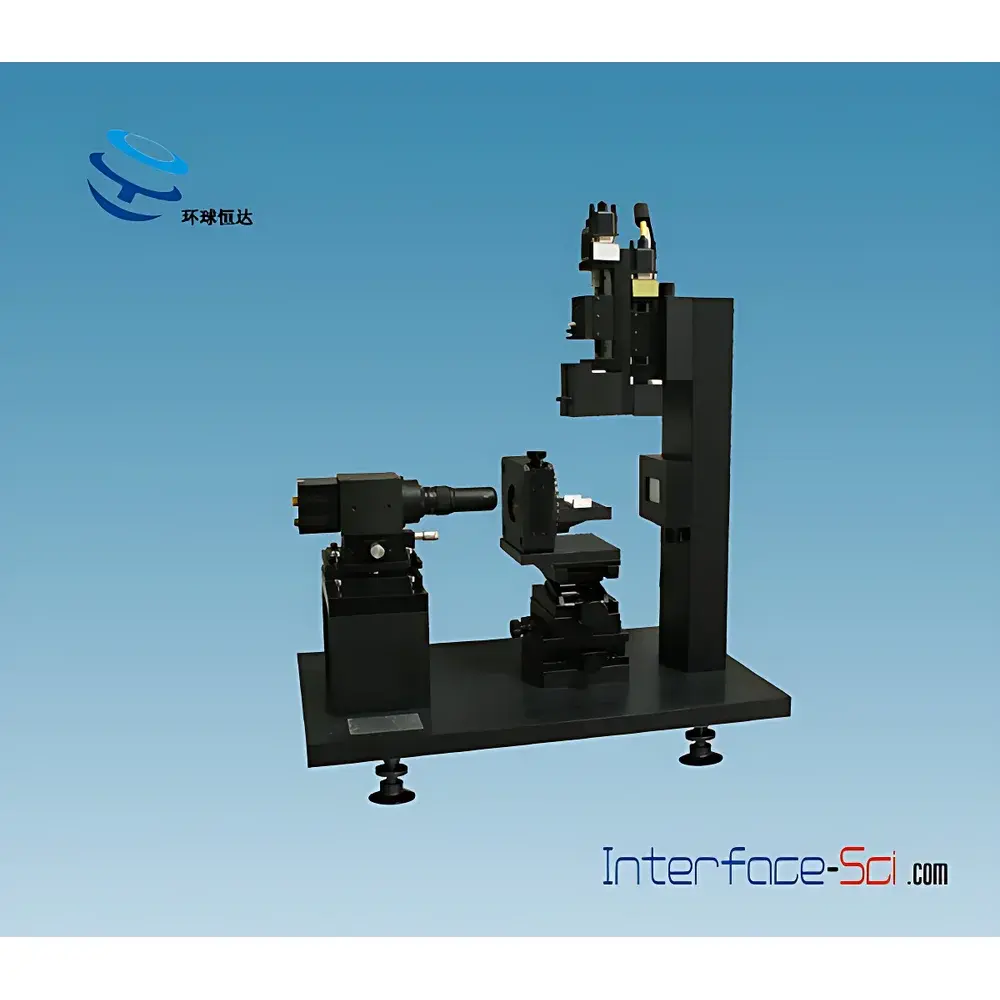
Interface SCI2000D Fully Automated Dynamic Contact Angle Analyzer
| Brand | Interface |
|---|---|
| Origin | Beijing, China |
| Manufacturer Type | Authorized Distributor |
| Product Category | Domestic |
| Model | SCI2000D |
| Instrument Type | Benchtop Video-Based Optical Contact Angle Analyzer |
| Contact Angle Measurement Range | 0–180° |
| Contact Angle Accuracy | ±0.1° |
| Fixed Sample Stage Dimensions | 120 × 100 mm |
| Minimum Image Resolution | 1280 × 1024 pixels |
| Surface/Interfacial Tension Measurement Range | 5.0–2000 mN/m |
Overview
The Interface SCI2000D Fully Automated Dynamic Contact Angle Analyzer is an advanced benchtop optical instrument engineered for high-precision quantification of solid–liquid interfacial phenomena. It operates on the principle of video-based silhouette imaging combined with rigorous geometric and physical modeling—primarily leveraging sessile drop, pendant drop, captive bubble, and tilting plate methodologies. The system captures high-fidelity grayscale images of liquid–solid interfaces under controlled environmental conditions and applies multiple mathematical fitting algorithms (e.g., Young–Laplace equation solving, ellipse/curve fitting, baseline detection) to extract thermodynamically relevant contact angles—including static, advancing, receding, rolling, and dynamic equilibrium values. Designed for rigorous materials science and surface chemistry laboratories, the SCI2000D supports comprehensive wettability characterization across heterogeneous substrates (e.g., fibers, films, porous media, rough or curved surfaces) and enables concurrent measurement of surface and interfacial tension via pendant drop analysis.
Key Features
- Fully automated dynamic contact angle acquisition with adjustable frame rates up to 2000 fps (optional high-speed camera modules)
- Precision mechanical architecture: five-axis sample stage with manual vertical travel (60 mm, 0.1 mm resolution), horizontal translation (up to 100 mm), and optional 360° rotation platform (0.01° angular resolution) for robust advancing/receding and roll-angle measurements
- Optimized optical train: industrial-grade continuous zoom lens (0.7–5.0× magnification), ultra-low distortion optics, and motorized or manual dual-axis lens tilt adjustment for precise focus and alignment
- High-sensitivity imaging: standard USB 2.0 monochrome CCD camera (1280 × 1024 @ 25 fps); upgrade paths available for 60–2000 fps acquisition to resolve rapid wetting dynamics
- Uniform cold LED backlighting with parallel-optics collimation and continuously adjustable intensity—ensuring sharp droplet contour definition and long-term photometric stability
- Modular fluid delivery: dual-mode dispensing system featuring both manual micrometer-driven syringe actuation and optional programmable peristaltic or syringe pump control (bidirectional flow, sub-microliter precision)
- Comprehensive needle library: stainless steel capillaries (0.14–0.9 mm ID), PTFE-coated tips, and application-specific fixtures for fibers, leaves, thin films, and irregular geometries
Sample Compatibility & Compliance
The SCI2000D accommodates a broad spectrum of sample types without modification: rigid solids (metals, glass, silicon wafers), flexible films (PET, PI, OLED substrates), fibrous assemblies (carbon fiber, textiles), biological specimens (leaf surfaces, hydrogels), and compressed powders. Its 120 × 100 mm stage and open-top design permit samples up to 180 mm wide and 60 mm tall. The instrument complies with internationally recognized test standards including ASTM D724 (paper wettability), ASTM D5946-2004 (corona-treated polymer films), and ISO 15989 (water contact angle on treated plastic films). Data integrity meets GLP/GMP-aligned documentation requirements: all measurements are timestamped, image-anchored, and stored with full metadata (camera settings, stage position, lighting intensity, calibration parameters). Audit trails and user-access logs support 21 CFR Part 11 readiness when integrated with validated software environments.
Software & Data Management
The proprietary analysis suite implements six distinct contact angle calculation methods—tangent, height, circle/ellipse fitting, conic section, Young–Laplace inversion, and automated edge-detection–based segmentation—to address symmetric, asymmetric, and distorted droplets. Real-time dynamic tracking enables time-resolved contact angle evolution at intervals as short as 0.04 s. Surface energy calculations employ 11 established theoretical models (Owen–Wendt–Rabel, Wu, van Oss–Chaudhury–Good, Neumann Equation of State, Zisman critical surface tension, etc.) using an embedded database of >300 probe liquids. All results—including fitted curves, contact angle vs. time plots, surface energy components, and interfacial tension values—are exportable to Excel, CSV, or annotated PNG/TIFF formats. Video capture (AVI) functionality supports method validation, training, and regulatory submission. Database architecture ensures one-to-one mapping between raw images, processed data, and metadata—enabling full traceability and version-controlled reanalysis.
Applications
The SCI2000D serves as a foundational tool in R&D and QC workflows across academia and industry. In microelectronics, it evaluates plasma treatment efficacy on wafer passivation layers and assesses photoresist adhesion. In biomedical engineering, it characterizes protein adsorption kinetics on implant coatings and quantifies lung surfactant spreading behavior. In coatings and ink formulation, it correlates surfactant concentration with dynamic wetting on low-energy substrates. In energy materials, it measures electrolyte infiltration into battery separators and wettability of catalyst layers in PEM fuel cells. Additional use cases include: corona treatment validation for packaging films; hydrophobicity grading of insulators in power transmission; surface cleanliness verification in semiconductor cleaning processes; and fundamental studies of electrowetting-on-dielectric (EWOD) actuation mechanisms. Its versatility extends to high-temperature molten polymer droplet analysis (with optional heating stage) and pressure-dependent interfacial tension studies (with environmental chamber integration).
FAQ
What measurement methods does the SCI2000D support?
Sessile drop (static, advancing, receding), pendant drop (surface/interfacial tension), captive bubble (hydrophobic surface analysis), and tilting plate (rolling angle, dynamic hysteresis).
Can it analyze non-planar or rough surfaces?
Yes—via curvature correction algorithms (convex/concave surface modeling) and specialized fixtures for fibers, membranes, and textured substrates.
Is the software compliant with FDA 21 CFR Part 11 requirements?
The base software provides audit trail logging, electronic signatures, and secure user roles; full Part 11 compliance requires documented validation protocol execution in the user’s operational environment.
What is the minimum resolvable contact angle increment?
0.01°, with measurement accuracy certified at ±0.1° under ISO/IEC 17025–accredited calibration conditions.
Does the system support interfacial tension measurement between two immiscible liquids?
Yes—using pendant drop analysis of liquid–liquid interfaces, with Young–Laplace curve fitting and BA table or ADSA-PD algorithm options.



