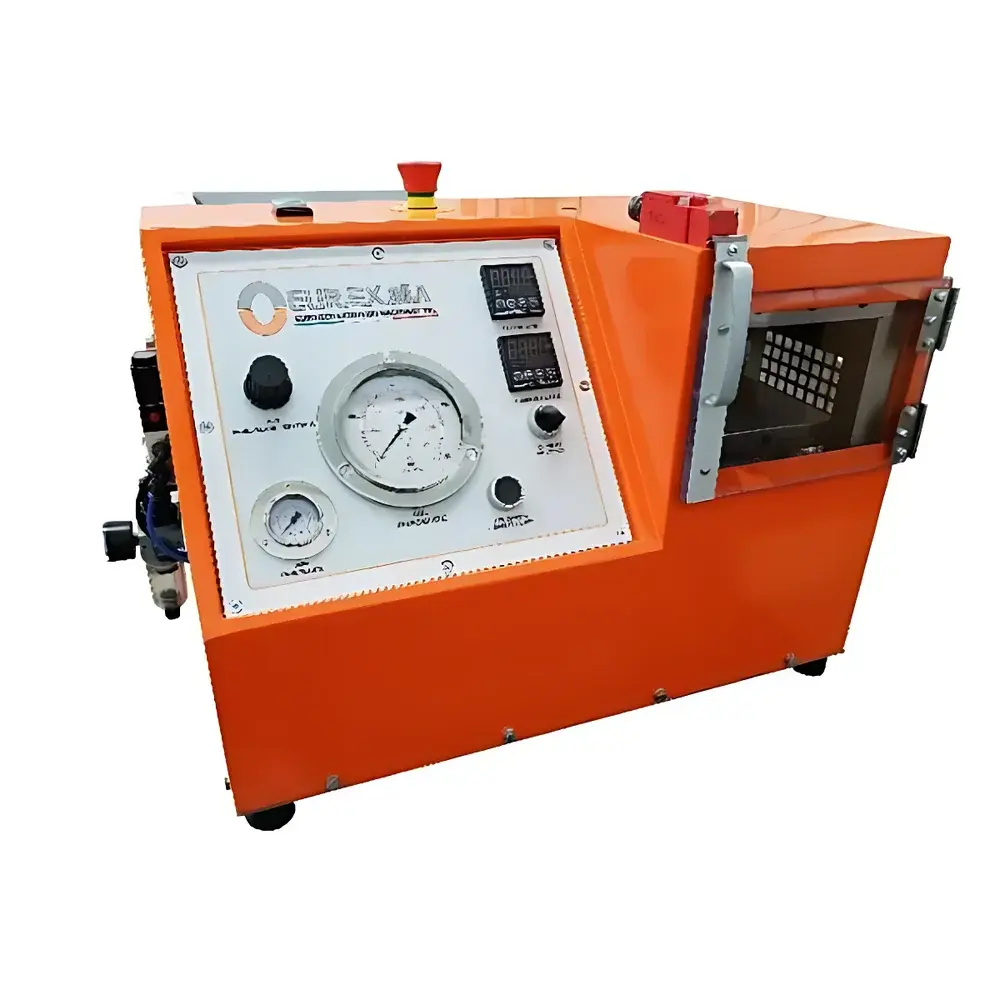
Eurotech KP-150 Desktop Hot Plate Press
| Brand | Eurotech |
|---|---|
| Origin | Italy |
| Model | KP-150 |
| Platen Size | 150 × 150 mm |
| Type | Desktop Vulcanization Press |
| Application | Rubber & Thermoplastic Sample Curing and Compression Molding |
Overview
The Eurotech KP-150 Desktop Hot Plate Press is a compact, precision-engineered laboratory-scale vulcanization press designed for controlled thermal compression molding of rubber compounds, thermoplastic elastomers (TPEs), and polymer composites. Based on the fundamental principles of heat transfer and uniaxial compressive force application, the KP-150 enables reproducible sample preparation under defined temperature, pressure, and dwell time conditions—critical parameters in ASTM D5345, ISO 6502, and GB/T 16584 standard test methods for vulcanization characterization. Its integrated dual-zone heating system ensures uniform platen surface temperature distribution (±1.5 °C across the 150 × 150 mm active area), minimizing thermal gradients that compromise crosslink homogeneity in cured specimens. The press operates within a nominal temperature range of ambient to 250 °C and supports adjustable hydraulic or mechanical loading systems (depending on configuration), delivering consistent clamping force without manual torque dependency.
Key Features
- Compact desktop footprint (W × D × H ≈ 420 × 480 × 510 mm) optimized for space-constrained QC labs and R&D workbenches
- Stainless steel-faced, machined parallel platens with high flatness tolerance (< 5 µm) to ensure uniform specimen thickness and dimensional repeatability
- Digital PID temperature controller with real-time monitoring, ±0.5 °C setpoint accuracy, and programmable ramp/soak profiles
- Integrated safety interlocks including overtemperature cutoff, emergency stop button, and platen gap limit switch
- Modular design supporting optional accessories: digital force transducer kit, timer-based auto-release module, and platen cooling channel interface
- Compliance-ready architecture: firmware supports audit trail logging (optional) and meets mechanical safety requirements per EN 692 and EN ISO 13857
Sample Compatibility & Compliance
The KP-150 accommodates standard ASTM D3182 test specimens—including 12.7 mm diameter discs, 100 × 100 mm sheets, and custom molds up to 150 × 150 mm planar dimension. It is routinely deployed in rubber formulation development, quality conformance testing (e.g., Mooney viscosity pre-cure validation), and ISO 9001-certified production support environments. All thermal and mechanical operations align with ISO 14001 environmental management protocols through energy-efficient standby mode and low thermal mass platen design. For regulated pharmaceutical elastomer applications (e.g., stopper compound qualification), the system can be validated per IQ/OQ protocols and integrated into GMP documentation workflows when paired with Eurotech’s optional calibration certificate package (traceable to NIST standards).
Software & Data Management
While the base KP-150 operates via front-panel controls, optional Eurotech LabLink™ software (v3.2+) enables PC-based operation, data acquisition, and report generation. The software logs timestamped records of temperature, applied load (if equipped), and cycle duration—exportable as CSV or PDF for GLP/GMP traceability. Audit trail functionality complies with FDA 21 CFR Part 11 requirements when configured with user role management, electronic signatures, and immutable log archiving. Raw sensor data is sampled at 2 Hz, supporting post-cycle analysis of cure kinetics (e.g., t90, scorch time) when used in conjunction with rheometric or dielectric cure monitoring systems.
Applications
- Preparation of standardized test plaques for tensile, hardness, and compression set evaluation (ASTM D412, D2240, D395)
- Curing of silicone, EPDM, NBR, and fluorocarbon compounds prior to rheological or DMA analysis
- Compression molding of thermoplastic polyurethane (TPU) and polyolefin blends for morphology studies
- Development and verification of mold release agent efficacy under controlled thermal stress
- Small-batch prototyping of rubber-metal bonded components requiring precise interfacial temperature control
FAQ
What is the maximum recommended operating temperature for continuous use?
The KP-150 is rated for continuous operation up to 230 °C; intermittent exposure to 250 °C is permissible for ≤15 minutes per cycle.
Does the press include pressure calibration certification?
Standard delivery includes factory calibration documentation; ISO/IEC 17025-accredited pressure calibration is available as an add-on service.
Can the KP-150 be integrated into an automated lab workflow?
Yes—RS-232 and optional Ethernet interfaces support SCADA integration and PLC-triggered start/stop commands.
Is platen parallelism adjustable by the end user?
No; parallelism is factory-set and verified via optical interferometry. Re-alignment requires authorized Eurotech service personnel.
What maintenance intervals are recommended for hydraulic models?
Hydraulic fluid inspection every 12 months; full replacement every 36 months or after 2,000 operational cycles, whichever occurs first.