
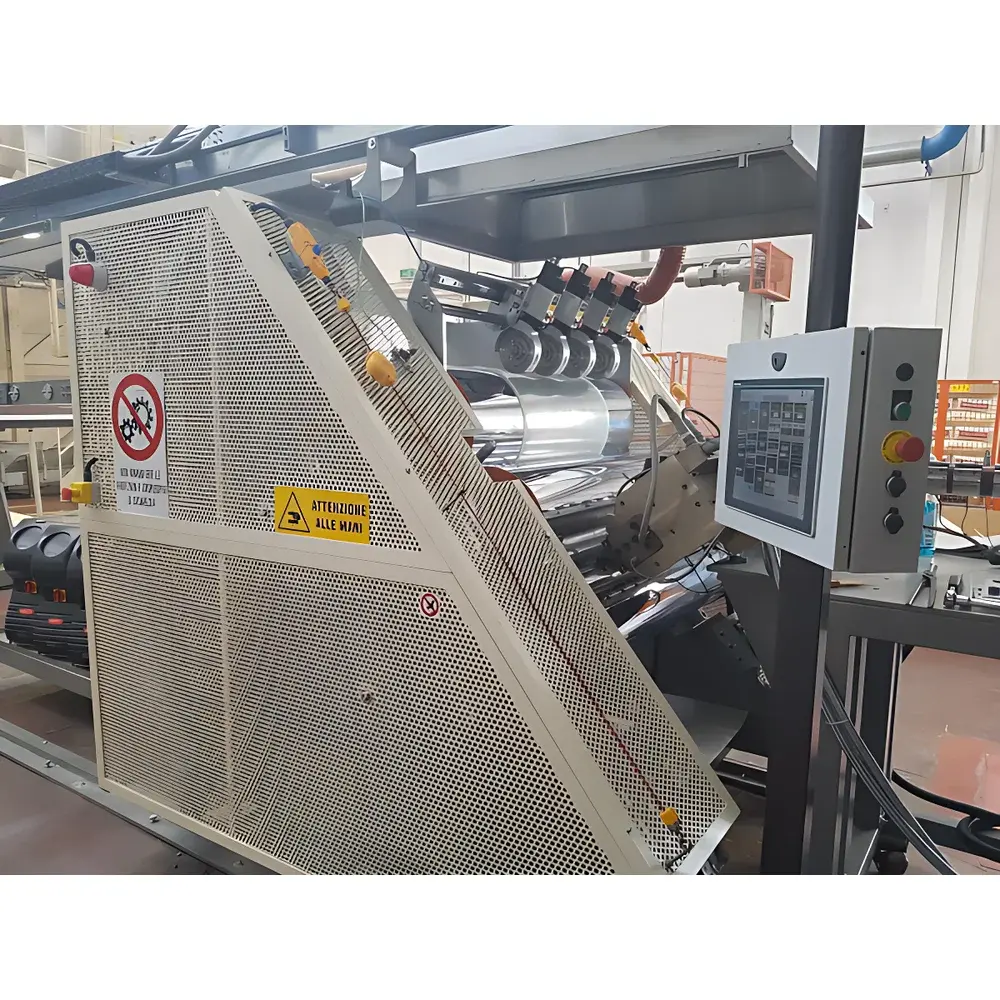
Eurotech D35–120mm E-FOIL Extrusion Line for Precision Film & Sheet Production
| Brand | Eurotech |
|---|---|
| Origin | Italy |
| Extruder Screw Diameter Range | 35–120 mm |
| Maximum Web Width | 1200 mm |
| Thickness Range | 0.1–8 mm |
| Production Capacity | 400 kg/h |
| Roll Stand Max. Winding Diameter | 1000 mm |
| Calender Configuration | Triple-roll (vertical/horizontal/adjustable tilt) |
| Slitting Capability | Up to 8 mm thickness |
| Type | Single-screw extrusion line for monolayer & multilayer polymer films and sheets |
| Compliance | Designed per CE Machinery Directive 2006/42/EC, compliant with ISO 14001 & ISO 9001 manufacturing practices |
Overview
The Eurotech D35–120mm E-FOIL Extrusion Line is an integrated, CE-certified single-screw extrusion system engineered for the precision continuous production of monolayer and multilayer thermoplastic films and sheets. Based on the modular XTR series extruders (screw diameters from 35 mm to 120 mm), the line employs classical melt-conveying and distributive mixing principles under controlled shear and thermal profiles. Melt is fed through a precision die with adjustable lip geometry—enabling fine-tuned thickness uniformity across a maximum web width of 1200 mm. Downstream processing includes triple-roll calendering (configurable in vertical, horizontal, or variable-tilt orientation) for surface finish control, tension-regulated winding onto shafted or mandrel-type roll stands (max. 1000 mm diameter), and synchronized slitting with hardened steel rotary knives rated for materials up to 8 mm thickness. With a nominal throughput of 400 kg/h, the system supports stable operation across common engineering polymers including LDPE, HDPE, PP, PS, PETG, and TPU—subject to screw design, barrel heating zones, and die pressure optimization.
Key Features
- Modular XTR single-screw extruders (35–120 mm screw diameter) with segmented barrel zones, PID-controlled electric heating, and forced-air cooling for precise melt temperature management.
- Adjustable-die head with manual or motorized lip-gap actuation, enabling real-time profile correction and cross-web thickness compensation without mechanical disassembly.
- Triple-roll calender station with independent drive control, surface-ground chrome-plated rolls (±1 µm roundness tolerance), and hydraulic or servo-assisted nip pressure regulation (0.5–8 MPa range).
- Tension-controlled winder with dancer arm feedback loop, pneumatic shaft clamping, and automatic core loading—capable of handling finished rolls up to 1000 mm outer diameter and 1500 mm face width.
- Slitter module with interchangeable knife holders, digital blade-depth setting (0.01 mm resolution), and quick-change tooling for rapid grade transitions.
- Integrated HMI panel with recipe storage, alarm logging, and I/O traceability; all safety circuits conform to EN ISO 13857 and EN 60204-1 standards.
Sample Compatibility & Compliance
The E-FOIL line accommodates a broad spectrum of thermoplastic resins in pellet, flake, or regrind form—including polyolefins, styrenics, amorphous and semi-crystalline polyesters, and thermoplastic elastomers—provided material thermal stability, melt viscosity (10²–10⁵ Pa·s at processing shear rates), and moisture content (<50 ppm for hygroscopic grades) fall within validated process windows. All mechanical and electrical subsystems comply with EU Machinery Directive 2006/42/EC, Electromagnetic Compatibility Directive 2014/30/EU, and Low Voltage Directive 2014/35/EU. The control architecture supports audit-ready data integrity per FDA 21 CFR Part 11 when paired with validated SCADA-level software (e.g., Siemens WinCC or Rockwell FactoryTalk). Documentation includes full EC Declaration of Conformity, risk assessment reports per EN ISO 12100, and machine-specific operating manuals in English and Italian.
Software & Data Management
The standard control interface features a 10.4″ touchscreen HMI running embedded Linux OS, supporting up to 256 user-defined process recipes with version-controlled parameter sets (screw speed, zone temperatures, roll speeds, winding tension, slit position). Real-time data logging records all analog inputs (temperature, pressure, current, encoder pulses) at 10 Hz sampling frequency, stored locally on industrial-grade SSD with 30-day circular buffer. Optional OPC UA server integration enables bidirectional communication with MES platforms (e.g., SAP ME, Siemens Opcenter) for batch traceability, OEE calculation, and preventive maintenance scheduling. Audit trails capture operator login/logout events, parameter modifications, and emergency stop activations—retained for minimum 12 months per internal GLP-aligned retention policy.
Applications
- Production of carrier films for lithium-ion battery electrode lamination (e.g., PP separator base films, aluminum-laminated current collector substrates).
- Manufacturing of packaging-grade mono- and co-extruded films for pharmaceutical blister packs, food wrap, and medical pouches meeting ISO 11607-1 requirements.
- Continuous sheet extrusion for thermoforming applications—including automotive interior trim, signage substrates, and medical device housings.
- R&D-scale prototyping of novel polymer blends and nanocomposite films, leveraging the line’s wide screw-size scalability and die flexibility for rapid iteration.
- Recycled polymer valorization: stable processing of post-industrial and post-consumer PP/PE blends with consistent gauge control and optical clarity.
FAQ
What polymer types are validated for use with the D35–120mm E-FOIL line?
Standard validation covers LDPE, LLDPE, HDPE, PP (homo- and copolymer), PS, ABS, PETG, and TPU. Engineering resins such as PEEK or PEI require custom screw geometry and barrel cooling upgrades—available upon technical review.
Can the line be configured for co-extrusion?
The base configuration is monolayer. Co-extrusion capability (up to 3-layer) is available as an engineered option, requiring auxiliary extruders, multi-manifold feedblock, and melt-pump metering—all designed to EN 61000-6-2 EMC immunity standards.
Is remote diagnostics supported?
Yes—via optional secure VPN-enabled Ethernet port with TLS 1.2 encrypted telemetry. Remote access requires customer-side firewall whitelisting and adherence to ISO/IEC 27001-aligned network segmentation policies.
What maintenance intervals are recommended for the calender rolls?
Surface inspection every 500 operational hours; chrome layer thickness verification via eddy-current testing every 5,000 hours; full roll regrinding recommended at 20,000 hours or upon measured deviation >3 µm from nominal roundness.
Does Eurotech provide installation supervision and FAT/SAT documentation?
Yes—factory acceptance testing (FAT) includes no-load and load-run validation against contractual performance criteria; site acceptance testing (SAT) includes 72-hour continuous production trial with witness by customer-appointed QA personnel. Full FAT/SAT reports include calibration certificates for all critical sensors (RTDs, load cells, encoders).





