
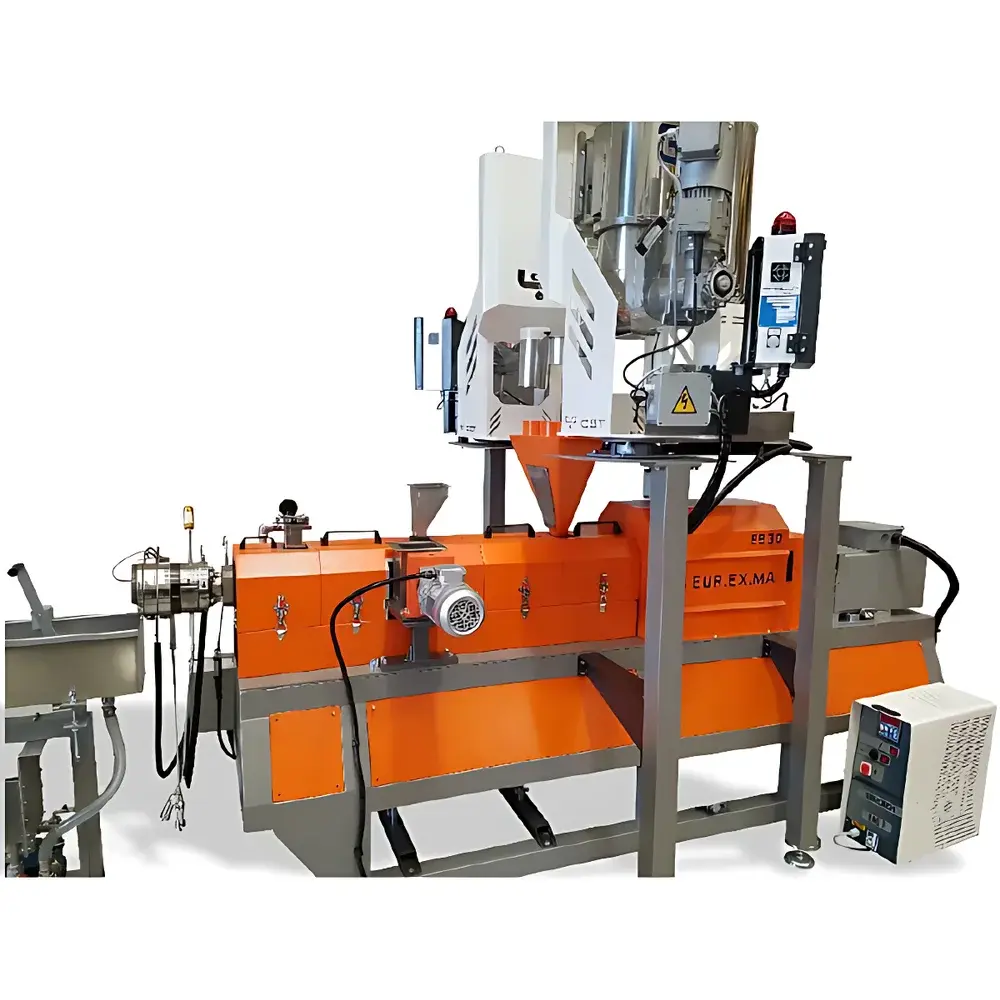
Eurotech E-Lab 30 Twin-Screw Extruder for Polymer Compounding & Masterbatch Development
| Brand | Eurotech |
|---|---|
| Origin | Italy |
| Model | E-Lab 30 |
| Screw Diameter | 30 mm |
| L/D Ratio | 30–48 |
| Drive System | High-Performance Gearmotor with Mechanical/Electromechanical Safety Coupling |
| Barrel Configuration | Modular, Water-Cooled Jacketed Sections |
| Feed Options | Gravimetric Main Feeder, Optional Side Feeder (Powder/Liquid), Vacuum Venting Port |
| Screw Design | Multi-Component, Interchangeable Elements on Multi-Threaded Shaft |
| Application Scope | Lab-Scale Polymer Compounding, Recycled Material Formulation, Additive Masterbatch Production |
Overview
The Eurotech E-Lab 30 is a precision-engineered, co-rotating twin-screw extruder designed specifically for research, formulation development, and small-batch production in polymer science laboratories. Operating on the fundamental principle of intermeshing co-rotating screws within a modular barrel assembly, it enables controlled shear history, precise residence time distribution, and reproducible melt processing conditions — critical parameters for evaluating compound stability, dispersion efficiency, thermal degradation thresholds, and rheological response under dynamic shear. Unlike single-screw systems, its self-wiping screw geometry ensures consistent material conveyance, enhanced mixing intensity, and superior heat transfer management across diverse thermoplastic, thermoset, and elastomeric feedstocks. The system is purpose-built for laboratories serving R&D departments in compounding, recycling, color masterbatch, and functional additive development — where scalability from lab to pilot line demands traceable process parameters and geometric fidelity.
Key Features
- Modular barrel architecture with segmented, water-jacketed zones enabling independent temperature control (typically 20–350 °C) across feeding, melting, mixing, venting, and metering sections;
- Co-rotating, intermeshing twin-screw configuration with 30 mm screw diameter and adjustable L/D ratios (30D to 48D) to tailor residence time and shear intensity;
- High-torque gearmotor drive coupled via mechanical or electromechanical safety coupling — providing overload protection and torque monitoring capability;
- Multi-component screw design mounted on a precision multi-threaded shaft, allowing rapid reconfiguration with conveying, kneading, reverse, and mixing elements optimized for specific polymer/additive interactions;
- Integrated gravimetric main feeder with ±0.5% accuracy; optional side feeder modules supporting powder dosing or pressurized liquid injection (e.g., plasticizers, stabilizers, coupling agents);
- Vacuum venting port located downstream of the melting zone for moisture removal, volatile extraction, or devolatilization during reactive extrusion trials;
- Robust stainless-steel construction compliant with ISO 8501-1 surface preparation standards and suitable for cleanroom-integrated environments.
Sample Compatibility & Compliance
The E-Lab 30 accommodates a broad spectrum of polymeric materials including polyolefins (PP, PE), engineering thermoplastics (PA6/66, PC, PBT), biopolymers (PLA, PHA), filled composites (glass/carbon fiber, mineral fillers), conductive formulations (CB, graphene), and post-consumer recycled streams. Its modular design supports ASTM D790 (flexural properties), ISO 1133 (melt flow rate correlation), and ISO 20432 (extrusion-based compound characterization). While not certified as GMP equipment per se, its documented process parameters, calibration traceability (via integrated temperature and torque sensors), and audit-ready operational logs align with GLP-compliant laboratory practices and preclinical formulation workflows subject to FDA 21 CFR Part 11 data integrity requirements.
Software & Data Management
The extruder integrates with Eurotech’s proprietary E-Control Suite, a Windows-based HMI platform delivering real-time monitoring of screw speed (0–600 rpm), motor torque (0–100% full scale), barrel zone temperatures (±0.5 °C), melt pressure (optional sensor), and feed rate (kg/h). All operational variables are time-stamped and logged at user-defined intervals (100 ms–5 s), exportable in CSV or HDF5 format for statistical process analysis (SPC), DOE modeling, or integration into LIMS environments. The software supports recipe-based operation, parameter locking for SOP enforcement, and electronic signature functionality compatible with ALCOA+ principles.
Applications
- Development and optimization of polymer blends and filled composites for automotive, packaging, and medical device applications;
- Rapid screening of compatibilizers, flame retardants, nucleating agents, and antimicrobial additives;
- Formulation of color masterbatches with uniform pigment dispersion and minimal thermal stress;
- Processing trials for post-industrial and post-consumer recycled resins — assessing degradant impact, viscosity recovery, and stabilization efficacy;
- Reactive extrusion studies including grafting, crosslinking, and transesterification under controlled stoichiometric feed conditions;
- Preparation of reference materials for rheological testing (e.g., capillary or rotational rheometry) and morphology analysis (SEM/TEM).
FAQ
What is the standard L/D ratio supplied with the E-Lab 30 unit?
The base configuration ships with a 30D L/D ratio; extended lengths up to 48D are available as modular barrel add-ons.
Can the E-Lab 30 be used for reactive extrusion with monomer injection?
Yes — when equipped with a high-pressure liquid side feeder and vacuum venting, it supports controlled monomer addition and subsequent devolatilization.
Is torque measurement included as a standard sensor?
Torque monitoring is integral to the drive system and displayed in real time; absolute torque calibration requires optional load-cell verification per ISO 17025-accredited service.
Does Eurotech provide screw element libraries for specific polymer families?
Yes — application-specific screw configuration guides (e.g., for TPU, PP-r, or rPET) are provided with purchase, along with CAD models for custom element design.
What maintenance protocols are recommended for long-term repeatability?
Quarterly inspection of barrel liner wear, annual gearbox oil analysis, and biannual recalibration of temperature sensors against NIST-traceable references are advised per Eurotech Technical Bulletin TB-E30-MNT-2023.



