
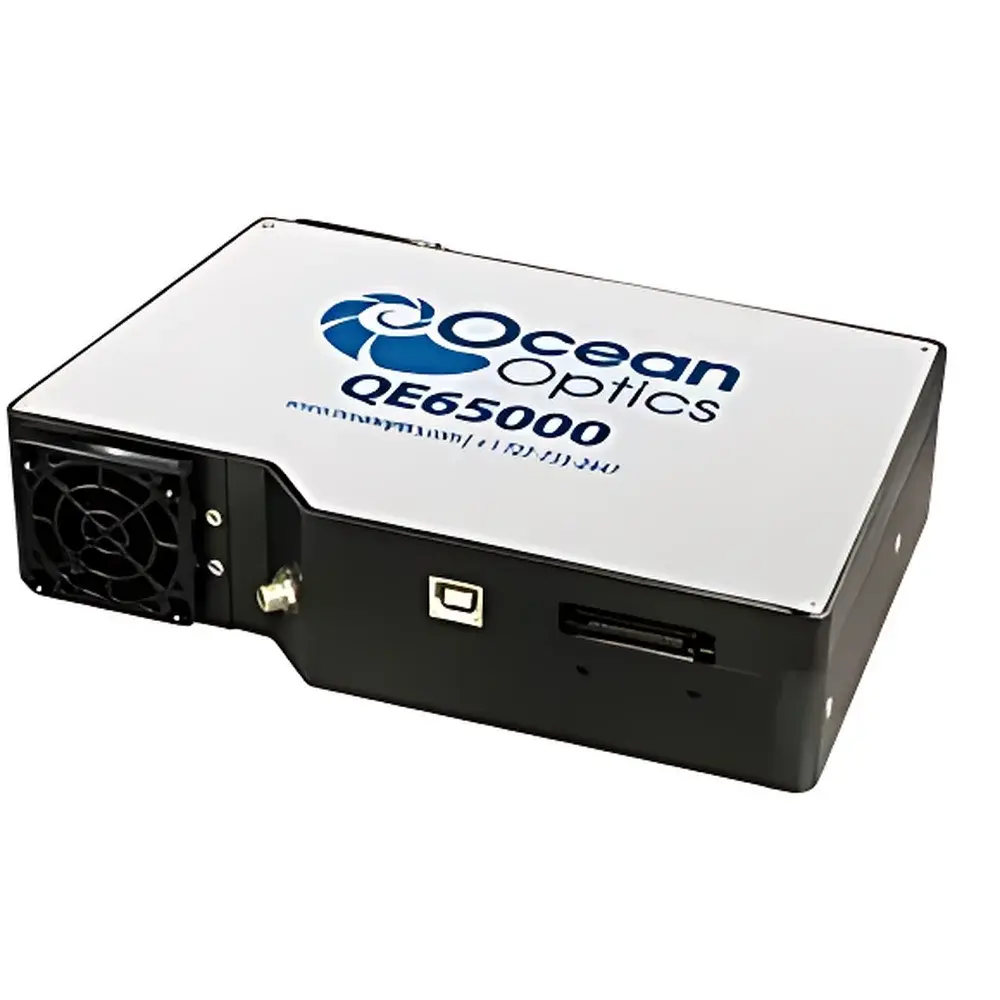
Ocean Optics QE65000 Portable Scientific-Grade CCD Spectrometer
| Brand | Ocean Optics |
|---|---|
| Origin | USA |
| Model | QE65000 |
| Detector Type | Back-Illuminated, Deep-Depletion CCD |
| Cooling | Thermoelectric (TE) to –15 °C |
| Spectral Range | 200–1100 nm (configurable) |
| Optical Resolution (FWHM) | 0.10–10.0 nm (dependent on grating & slit) |
| Pixel Count | 1024 × 58 |
| Signal-to-Noise Ratio | >1000:1 (at full signal, 1 s integration) |
| Integration Time | 8 ms – 15 min |
| Interface | USB 2.0 |
| Compliance | CE, RoHS, FCC Class B |
Overview
The Ocean Optics QE65000 is a portable, scientific-grade fiber-optic spectrometer engineered for high-fidelity spectral acquisition in demanding laboratory, field, and industrial environments. Built around a back-illuminated, deep-depletion CCD detector with thermoelectric cooling to –15 °C, the QE65000 delivers exceptional quantum efficiency (>90% peak), low dark current, and high dynamic range—critical attributes for low-light applications such as fluorescence, Raman, and weak-emission spectroscopy. Its optical architecture follows the Czerny–Turner design, supporting interchangeable slits (10–200 µm), gratings (ranging from 150 to 2400 lines/mm), and optional order-sorting filters to optimize resolution, sensitivity, and spectral coverage across the UV-VIS-NIR range (200–1100 nm). Unlike benchtop or OEM-integrated systems, the QE65000 maintains laboratory-grade performance in a compact, USB-powered chassis weighing under 400 g—enabling deployment in mobile labs, process monitoring stations, environmental sampling sites, and educational fieldwork without compromising measurement integrity.
Key Features
- Back-illuminated, deep-depletion CCD sensor with peak QE >90% and enhanced NIR response (700–1100 nm)
- Thermoelectric cooling to –15 °C, reducing dark noise by up to 90% compared to uncooled detectors
- Configurable optical resolution from 0.10 nm (with narrow slit and high-line-density grating) to 10.0 nm (broadband mode)
- USB 2.0 interface with plug-and-play compatibility; no external power supply required
- Robust aluminum housing rated for operation between 0–40 °C ambient temperature and <80% RH non-condensing
- Factory-calibrated radiometric and photometric options available (NIST-traceable upon request)
Sample Compatibility & Compliance
The QE65000 interfaces seamlessly with standard SMA 905 fiber optic cables (core diameters 50–600 µm), enabling flexible coupling to diverse sample interfaces—including integrating spheres, cuvette holders, remote probes, and microscope adapters. It supports both reflectance, transmittance, and emission measurements per ASTM E308 (computing CIE color coordinates), ISO 13655 (spectral measurement of graphic arts), and USP (UV-Vis spectrophotometric system suitability). The instrument complies with CE marking requirements (EMC Directive 2014/30/EU and Low Voltage Directive 2014/35/EU), RoHS 2011/65/EU, and FCC Part 15 Class B for electromagnetic emissions. When operated with OceanView or Ocean Insight’s SpectraSuite software under validated configurations, it meets audit-ready data integrity criteria aligned with FDA 21 CFR Part 11 (electronic records/signatures) and GLP/GMP documentation workflows.
Software & Data Management
Ocean Insight provides native support via OceanView (Windows/macOS) and SpectraSuite (cross-platform), both offering real-time spectral visualization, batch acquisition scripting, multichannel averaging, and automated baseline correction. Raw data export is supported in CSV, TXT, and HDF5 formats—with metadata embedded per IEEE 1851-2019 standards for spectral data provenance. Application programming interfaces (APIs) are available for Python (via oceanoptics-spectra), MATLAB, LabVIEW, and C/C++ to enable integration into custom QC/QA automation frameworks or LIMS platforms. All software versions undergo quarterly security patching and maintain backward compatibility with firmware revisions dating to 2018.
Applications
- Quantitative fluorescence analysis of biological markers and quantum dots
- In-line monitoring of pharmaceutical tablet coating uniformity (per USP )
- Soil and water nutrient profiling using VIS-NIR reflectance spectroscopy
- LED and OLED spectral power distribution (SPD) characterization for photobiological safety (IEC 62471)
- Art conservation pigment identification via reflectance spectroscopy (CIE 15:2018 compliant)
- Educational spectroscopy labs requiring reproducible, low-noise spectral datasets
FAQ
Is the QE65000 suitable for Raman spectroscopy?
Yes—when paired with a 785 nm or 830 nm laser excitation source and appropriate edge filters, the QE65000’s high NIR QE and low dark noise support detection of Stokes-shifted Raman bands down to ~200 cm⁻¹.
Can I use the QE65000 in outdoor field conditions?
It is rated for operation at 0–40 °C and <80% RH; however, direct sunlight exposure should be avoided. Use with a shaded enclosure or temperature-stabilized probe head is recommended for extended ambient deployments.
Does the QE65000 support radiometric calibration?
Yes—NIST-traceable irradiance and radiance calibrations are available as factory options, including cosine-corrected input optics for ambient light or solar spectrum measurements.
What is the maximum achievable optical resolution?
With a 2400 lines/mm grating and 10 µm slit, the theoretical FWHM resolution is ~0.10 nm (at 500 nm); actual system resolution depends on optical alignment, fiber coupling, and signal-to-noise constraints.
How does thermoelectric cooling improve measurement stability?
TE cooling suppresses thermal dark current drift, enabling stable integration times up to 15 minutes—essential for low-light applications requiring long dwell times and high signal averaging.





