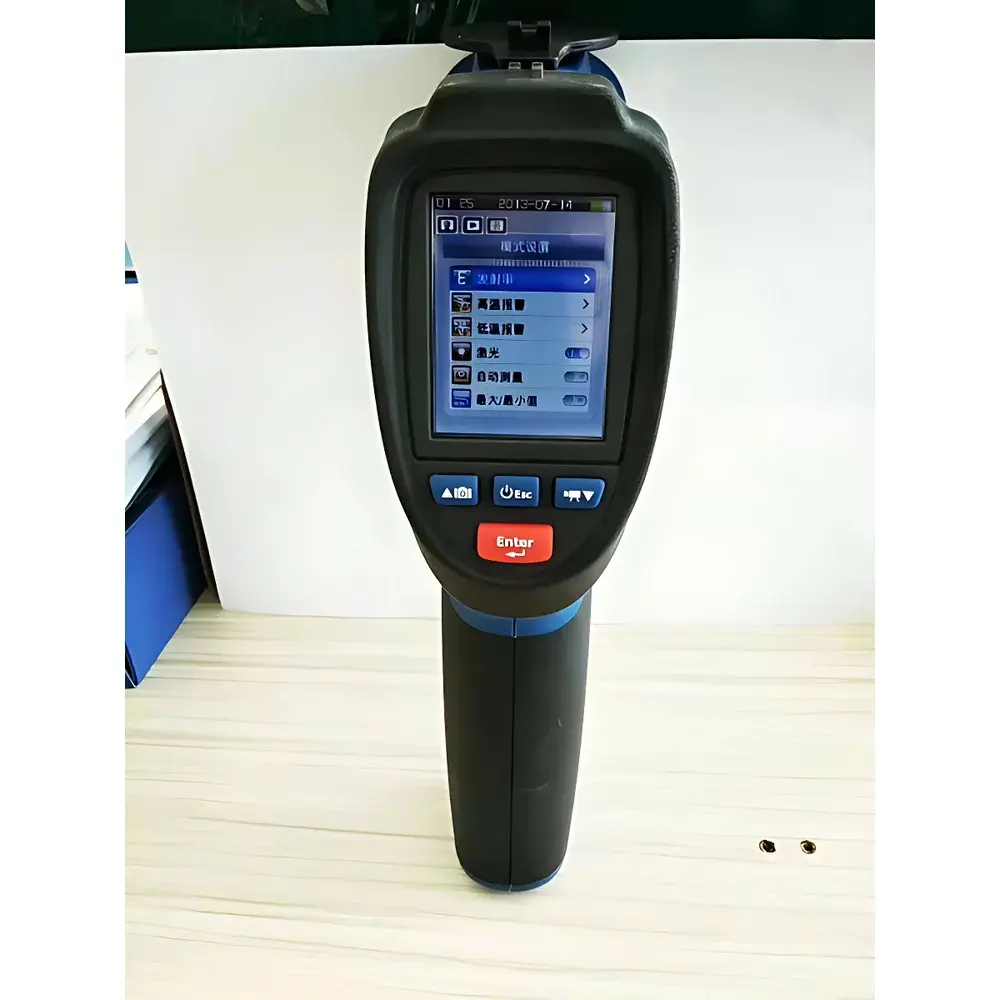
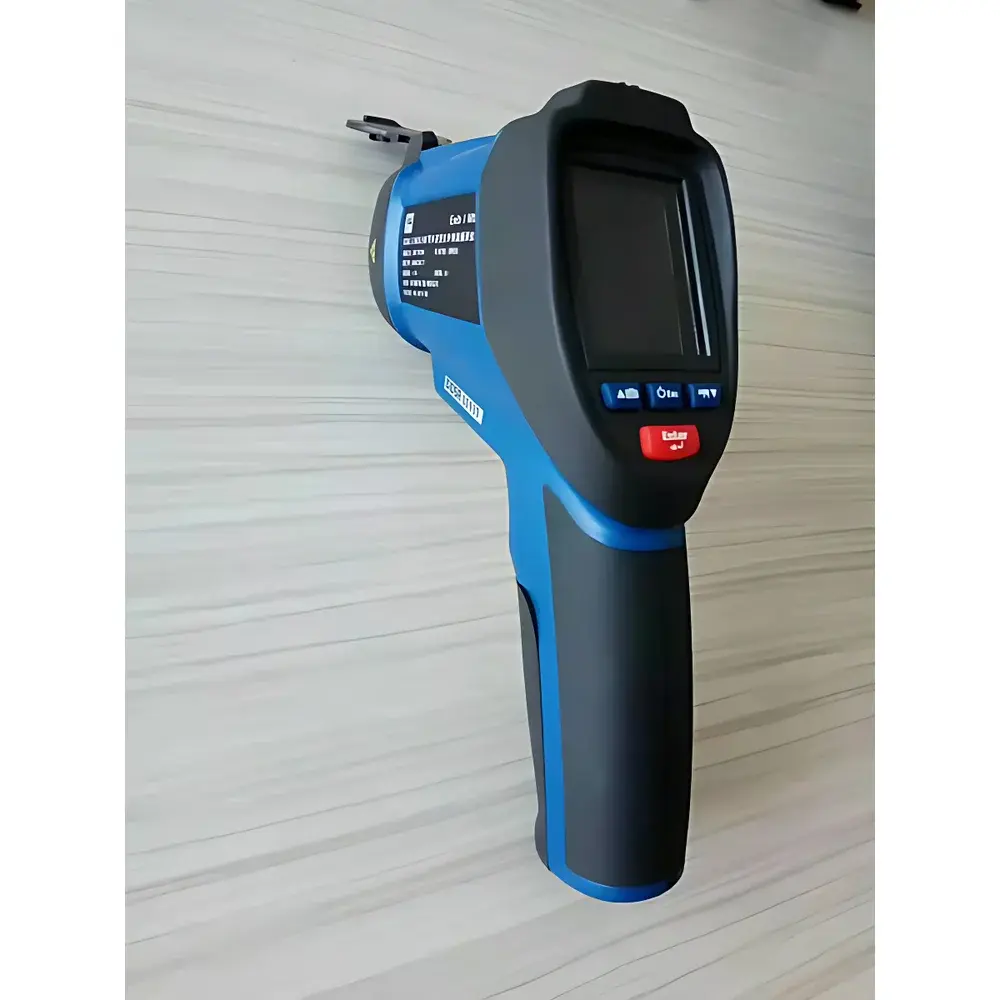
KBA3.7/1450LH Intrinsically Safe Infrared Thermographic Camera for Mining Applications
| Origin | Beijing, China |
|---|---|
| Manufacturer Type | Authorized Distributor |
| Origin Category | Domestic (PRC) |
| Model | KBA3.7/1450LH |
| Price Range | USD 1–9,999 |
| Instrument Type | Portable |
| IR Temp Range | −50°C to 1500°C |
| Display Resolution | 0.1°C (≤1000°C), 1°C (>1000°C) |
| IR Accuracy | ±1.5% of reading |
| Response Time | 150 ms |
| Spectral Response | 6–14 µm |
| Display | 2.2″ color LCD, 1024×768 px |
| Distance-to-Spot Ratio | 50:1 |
| Emissivity Adjustment | 0.10–1.00 |
| K-Type Thermocouple Range | −50°C to 1370°C |
| K-Type Accuracy | ±0.5% |
| Ambient Temp Range | 0–50°C |
| Ambient Temp Accuracy | ±0.5°C |
| RH Range | 0–100% RH |
| RH Accuracy | ±3.5% RH (20–80% RH) |
| Wet-Bulb Temp Range | 0–50°C |
| Storage | microSD up to 128 GB (8 GB preinstalled) |
| Power | 1× 18500 LiMnO₂ rechargeable battery, 3.7 V, 1300 mAh, ≤150 mA operating current |
| Explosion Protection | Exib I Mb |
| IP Rating | IP54 |
| Dimensions | 243 × 140 × 40 mm |
| Weight | 450 g |
| Certifications | CNEX explosion-proof certificate, MA safety mark for coal mine use, third-party type test report |
Overview
The KBA3.7/1450LH Intrinsically Safe Infrared Thermographic Camera is a certified Class I, Division 1 (Exib I Mb) portable diagnostic instrument engineered specifically for hazardous environments in underground coal mines and other explosive atmospheres. It integrates non-contact infrared thermometry, contact-based K-type thermocouple measurement, ambient temperature and relative humidity sensing, real-time thermal imaging, digital photography, and time-stamped video recording into a single ruggedized handheld platform. Its core infrared sensor operates within the long-wave spectral band (6–14 µm), optimized for high emissivity surfaces common in mining infrastructure—including conveyor belts, motor windings, hydraulic couplings, transformer bushings, and ventilation ducts—while maintaining immunity to solar loading and ambient thermal interference. Designed to comply with GB 3836.1–2010 (IEC 60079-0) and GB 3836.4–2010 (IEC 60079-11) for intrinsic safety, the device ensures safe operation in methane-air mixtures (CH₄, Group I) without risk of ignition under fault conditions.
Key Features
- Simultaneous multi-parameter acquisition: infrared surface temperature, contact temperature (via K-type probe), ambient air temperature, relative humidity, dew point, and wet-bulb temperature
- Dual-laser targeting system for precise spatial alignment and spot size verification at variable working distances (50:1 optical resolution)
- Adjustable emissivity (0.10–1.00) with material-specific presets and manual fine-tuning for accurate compensation on oxidized metal, refractory brick, rubber, and composite linings
- Real-time thermal curve plotting and statistical analysis (MAX/MIN/AVG/DIF), with configurable high- and low-temperature alarms (AT/DP) and audible/visual alerts
- Integrated 2.2-inch high-resolution color display (1024×768) supporting dual-unit switching (°C/°F) and overlay of measurement metadata on live thermal imagery
- Onboard microSD storage (8 GB standard, expandable to 128 GB) enabling persistent logging of radiometric JPEGs, thermal video clips (AVI), and CSV-formatted measurement datasets with timestamps
- Robust mechanical design compliant with IP54 ingress protection and certified for continuous operation in ambient temperatures from 0°C to 50°C and relative humidity up to 100% RH
Sample Compatibility & Compliance
The KBA3.7/1450LH is validated for use on metallic components (e.g., bearings, gearboxes, electrical terminations), refractory surfaces (furnace linings, kiln shells), elastomeric materials (belt splices, sealants), and insulating layers (cable jackets, duct insulation) encountered in coal mine infrastructure. Its measurement methodology adheres to ASTM E1933-19 (Standard Test Methods for Measuring and Compensating for Emissivity Using Infrared Imaging Systems) and ISO 18434-1:2008 (Condition monitoring and diagnostics of machines — Thermography — Part 1: General procedures). All safety certifications—including the China National Explosive Certification (CNEX) and the Mine Safety Approval Mark (MA)—are issued by nationally accredited laboratories and remain valid under periodic revalidation per AQ 1043-2007 (Safety Technical Requirements for Electrical Equipment in Coal Mines).
Software & Data Management
Field-collected data are stored in vendor-neutral formats compatible with industry-standard post-processing tools. Radiometric JPEGs embed full measurement metadata (emissivity, distance, ambient RH, timestamp, lens calibration ID) in EXIF headers. Thermal videos retain frame-by-frame temperature matrices. The included PC software supports batch export to CSV or Excel, customizable report generation (PDF/HTML), emissivity map assignment, and comparative trend analysis across multiple inspection sessions. Audit trail functionality records user login, parameter changes, and file export actions—supporting GLP-aligned documentation requirements. Data integrity is preserved via SHA-256 checksum validation during transfer; no proprietary encryption impedes third-party integration.
Applications
- Predictive maintenance of belt conveyor drive systems: detection of overheated idlers, misaligned pulleys, and slipping couplings prior to catastrophic failure
- Electrical asset screening: identification of loose connections, unbalanced phase loads, and deteriorating insulation in substations, switchgear, and lighting circuits
- Ventilation system diagnostics: quantification of airflow resistance through regulators, detection of damper leakage, and thermal stratification mapping in return airways
- Fire risk assessment: early-stage smoldering detection in coal stockpiles, conveyor galleries, and abandoned workings using differential thermal anomaly algorithms
- Environmental compliance monitoring: validation of dust suppression system performance via surface cooling rate analysis and RH correlation
- Post-incident investigation: forensic thermal reconstruction of equipment failure sequences using time-synchronized image/video archives
FAQ
Is the KBA3.7/1450LH certified for use in gassy coal mines?
Yes. It carries the Exib I Mb intrinsic safety certification and the MA safety mark, permitting deployment in Zone 0/1 methane-hazardous areas per GB 3836 and AQ 1043.
Can the device measure through glass or plastic enclosures?
No. Standard silica-based windows are opaque in the 6–14 µm band. Measurements require direct line-of-sight to the target surface.
What is the minimum resolvable spot size at 1 meter distance?
With a 50:1 D:S ratio, the instantaneous field of view (IFOV) yields a spot diameter of 20 mm at 1 m—sufficient for inspecting bolted joints, cable lugs, and small-diameter piping.
Does the instrument support calibration traceability to national standards?
Yes. Each unit ships with a factory calibration certificate traceable to NIM (National Institute of Metrology, China) reference blackbodies, with optional annual recalibration services available under ISO/IEC 17025-accredited procedures.
How is data security maintained during wireless transfer?
The device does not feature built-in Wi-Fi or Bluetooth. Data transfer occurs exclusively via physically isolated microSD card removal—eliminating remote cyber intrusion vectors and satisfying strict industrial cybersecurity policies.