
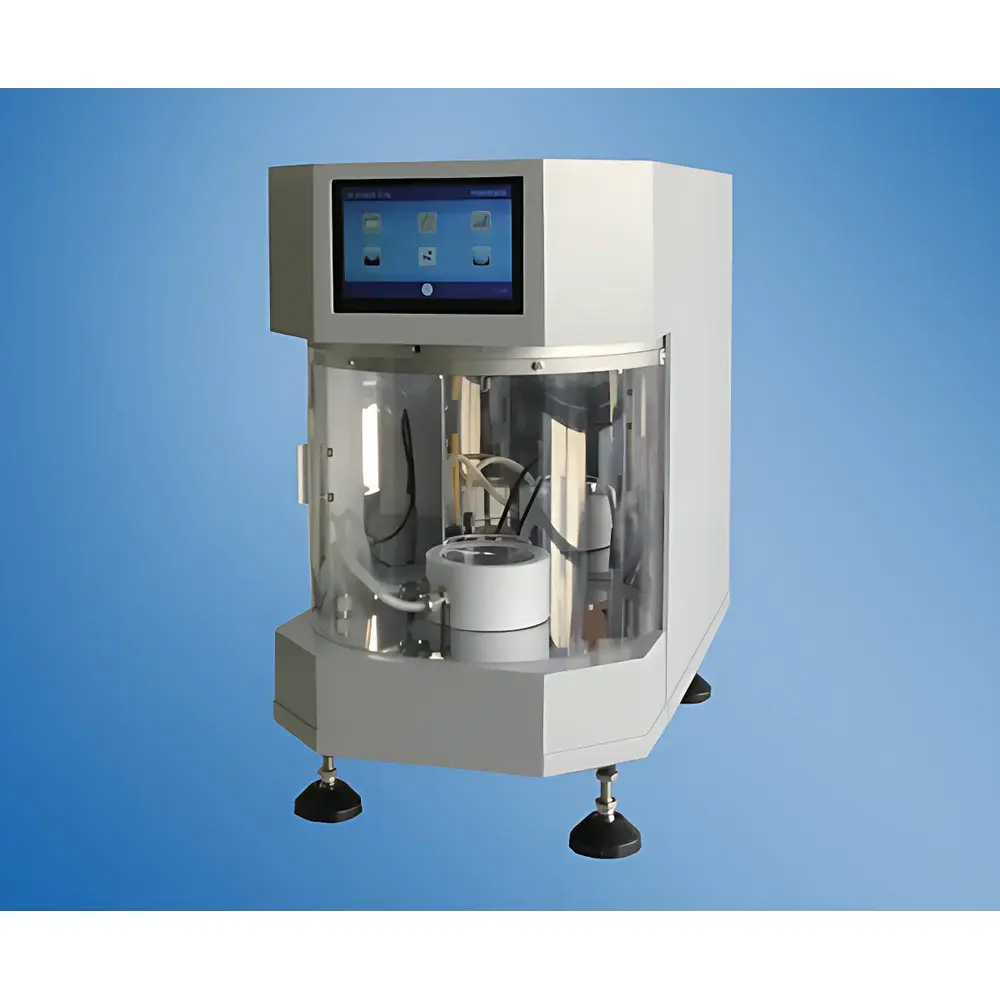
JK99M Advanced Automatic Surface & Interfacial Tensiometer
| Origin | Beijing, China |
|---|---|
| Manufacturer Type | Authorized Distributor |
| Origin Category | Domestic (PRC) |
| Model | JK99M |
| Price Range | USD 7,000–14,000 |
| Measurement Range | 0–1000 mN/m |
| Resolution | 0.01 mN/m |
| Accuracy | ±0.01 mN/m |
| Temperature Display Range | Ambient to 200 °C |
| Temperature Display Accuracy | ±0.1 °C |
| Measurement Methods | Du Noüy Ring Method and Wilhelmy Plate Method |
Overview
The JK99M Advanced Automatic Surface & Interfacial Tensiometer is a precision laboratory instrument engineered for high-reproducibility measurement of surface tension (γLV) and liquid–liquid interfacial tension (γLL) using two standardized physical methods: the Du Noüy ring method and the Wilhelmy plate method. Based on the principle of force balance at the solid–liquid interface—where the measured tensile force exerted on a calibrated platinum probe is directly proportional to the interfacial tension—the JK99M delivers traceable, operator-independent results compliant with fundamental thermodynamic definitions of interfacial energy. Its dual-method capability enables method cross-validation, supports method selection per sample rheology and volatility, and satisfies diverse regulatory expectations across R&D, QC, and production environments. Designed for routine operation in analytical labs, polymer research centers, petrochemical QA departments, and pharmaceutical formulation units, the JK99M integrates metrological rigor with operational efficiency—eliminating manual calibration drift, minimizing operator-induced variability, and enabling unattended data acquisition over extended time series.
Key Features
- High-stability METTLER TOLEDO load cell sensor (0–1000 mN range) with long-term linearity and thermal drift compensation, ensuring <0.01 mN/m resolution and repeatability ≤±0.01 mN/m under GLP-controlled conditions.
- Dual-probe compatibility: interchangeable platinum ring (40–50 mL sample volume) and platinum plate (20–30 mL), both pre-calibrated and certified per ISO 1409 and ASTM D971/D1331 standards.
- Motorized vertical stage with micro-stepping control and active vibration damping; platform travel precision ±0.1 µm, enabling precise immersion depth control critical for dynamic interfacial studies.
- Integrated magnetic stirring system with adjustable speed (0–1200 rpm), allowing homogeneous bulk-phase conditions during equilibrium or kinetic measurements.
- Modular thermal management: standard circulation-compatible platform with embedded Pt100 sensor (±0.1 °C accuracy); optional electric heating module or external thermostatic bath integration via standardized fluid ports.
- Onboard touchscreen interface (optional) with real-time curve plotting, auto-zeroing (manual, software-triggered, or scheduled), and local data storage—enabling standalone operation without PC dependency.
- Comprehensive hardware-level validation suite: includes certified calibration ring weights, leveling gauge, stainless-steel sample holders, and traceable documentation aligned with ISO/IEC 17025 internal audit requirements.
Sample Compatibility & Compliance
The JK99M accommodates a broad spectrum of Newtonian and moderately non-Newtonian liquids—including surfactant solutions, crude oils, lubricants, inks, coatings, pharmaceutical emulsions, and biological fluids—without requiring solvent dilution or phase separation. Its robust mechanical architecture supports measurements up to 1000 mN/m, making it suitable for high-salinity brines, molten polymers (below decomposition threshold), and viscous formulations where conventional capillary rise or pendant drop systems fail. The instrument conforms to multiple national and international test standards: GB/T 22237–2008 (surfactant surface tension), GB/T 5549–2010 (Wilhelmy plate method), GB/T 6541–1986 (interfacial tension of oil–water systems), and harmonized with ISO 6295, ASTM D971, and ASTM D1331. All firmware and software modules support full audit trail logging, electronic signatures, and 21 CFR Part 11–compliant user access controls when deployed in regulated GMP/GLP environments.
Software & Data Management
Bundled Windows-based application software provides full instrument control, real-time data visualization (tension vs. time, concentration, or temperature), and automated calculation of CMC (critical micelle concentration), adsorption kinetics, and diffusion-controlled relaxation profiles. Raw force–displacement datasets are saved in ASCII and CSV formats; processed results include statistical summaries (mean, SD, CV%), trend analysis, and export-ready reports compatible with LIMS integration. The software embeds built-in correction algorithms for buoyancy, meniscus curvature, and plate wetting angle—eliminating manual post-processing. Optional modules extend functionality to dynamic bubble pressure analysis (0–66 bubbles/sec), contact angle mapping (via add-on goniometer), density determination (using integrated microbalance option), and sedimentation rate quantification. All software updates, calibration templates, and method protocols are provided free of charge under lifetime technical support.
Applications
- Surfactant development: CMC determination, HLB optimization, and structure–activity relationship (SAR) modeling.
- Petrochemical QA: interfacial tension screening of enhanced oil recovery (EOR) formulations, demulsifier efficacy testing, and asphaltene stability assessment.
- Coatings & inks: wetting behavior prediction, substrate adhesion evaluation, and dispersion stability monitoring.
- Pharmaceutical sciences: emulsion and liposome formulation characterization, excipient–API interaction analysis, and dissolution enhancement studies.
- Food & cosmetics: foam stability profiling, emulsifier performance benchmarking, and ingredient compatibility verification.
- Academic research: interfacial rheology coupling (with optional oscillatory extension), Langmuir monolayer studies, and temperature-dependent phase transition mapping.
FAQ
Does the JK99M support both static and dynamic interfacial tension measurements?
Yes—it performs equilibrium surface/interfacial tension (via Wilhelmy plate or Du Noüy ring) and, with optional dynamic bubble module, measures time-resolved interfacial tension down to 100 ms resolution.
Can the instrument be validated for ISO/IEC 17025 accreditation?
Yes—full traceable calibration documentation, uncertainty budget templates, and hardware verification tools (ring weights, level gauges, reference fluids) are included to support laboratory accreditation workflows.
Is external temperature control mandatory for accurate measurements?
No—ambient temperature operation is fully supported; however, for temperature-dependent studies or volatile samples, integration with an external thermostatic bath (via standard circulation ports) is recommended and fully enabled.
What sample volume is required for each method?
Platinum plate method: 20–30 mL; platinum ring method: 40–50 mL—both volumes accommodate standard crystallizing dishes and minimize evaporation artifacts.
How does the JK99M handle high-viscosity or particulate-laden samples?
The motorized lift mechanism and low-speed immersion protocol prevent probe dragging or particle interference; optional magnetic stirring ensures homogeneity prior to measurement initiation.



