
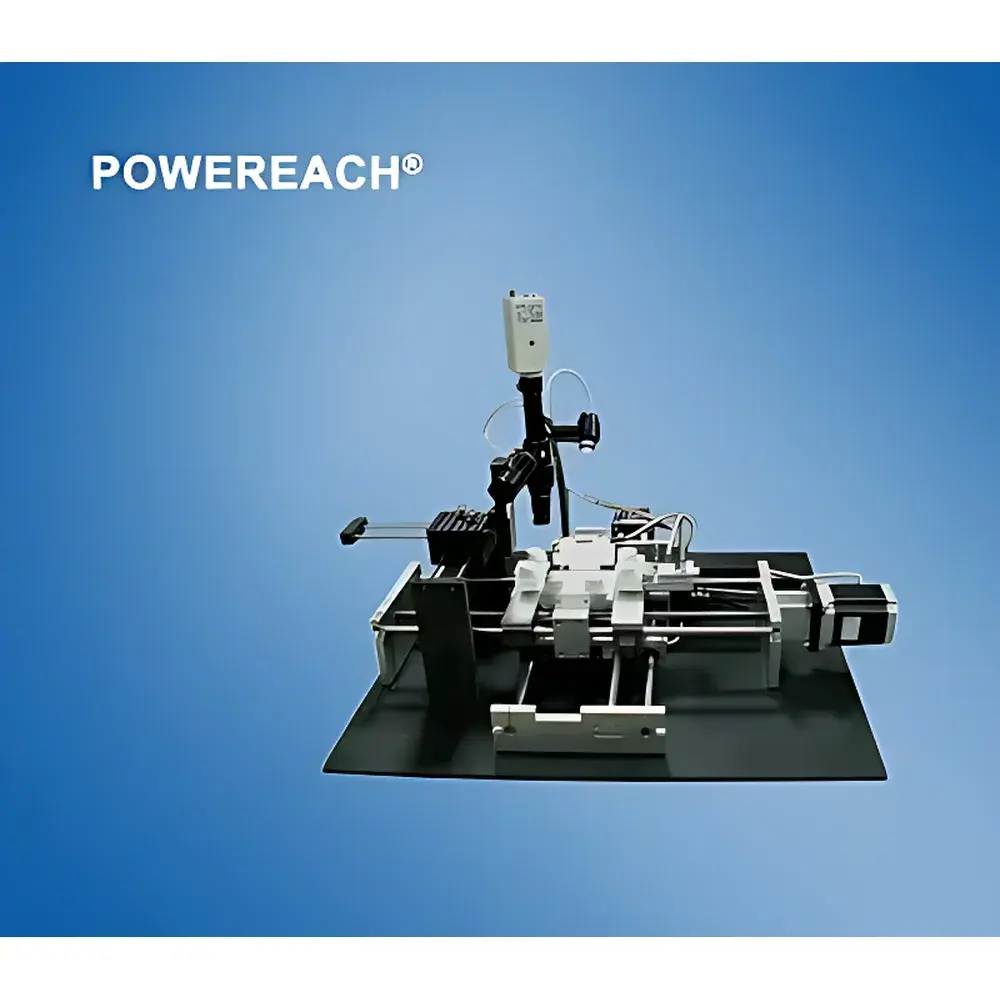
JDS05A Dual-Axis Fabric Mechanical & Structural Analyzer (50 kg Capacity)
| Origin | Beijing, China |
|---|---|
| Manufacturer Type | Authorized Distributor |
| Origin Category | Domestic (PRC) |
| Model | JDS05A |
| Pricing | Available Upon Request |
Overview
The JDS05A Dual-Axis Fabric Mechanical & Structural Analyzer is an integrated laboratory instrument engineered for synchronized mechanical characterization and high-resolution structural imaging of woven, knitted, nonwoven, and composite textile materials. Unlike conventional uniaxial tensile testers, the JDS05A implements true biaxial force application—applying controlled, independent tensile loads along two orthogonal axes (typically warp and weft directions)—to replicate in-service deformation states encountered in apparel, technical textiles, geotextiles, and flexible composites. Its dual-function architecture combines a precision electromechanical biaxial testing frame with a modular optical imaging subsystem, enabling real-time correlation between macroscopic mechanical response (e.g., stress–strain behavior, Poisson’s ratio, anisotropic modulus, rupture energy) and microstructural evolution (e.g., yarn migration, interlacing distortion, fiber slippage, surface topography changes). The system operates on fundamental principles of Hookean and post-Hookean solid mechanics, calibrated per ISO 13934-1 (tensile properties of fabrics), ASTM D5035 (strip method), and GB/T 3923.1 (Chinese national standard for fabric tensile testing).
Key Features
- Biaxial force control: Two independently actuated servo-driven axes, each capable of applying up to 500 N tensile load with force resolution of 0.05 N (1/10,000 full scale) and positional repeatability ±1.5 µm.
- Integrated optical metrology: Long-working-distance zoom lens (continuous magnification range 0.7×–4.5×), motorized Z-axis focus control, and dual illumination modes—transmitted LED backlight for contour contrast and adjustable reflective coaxial LED ring light for surface texture enhancement.
- High-fidelity image acquisition: Monochrome CMOS sensor with 8 µm/pixel spatial sampling at maximum optical magnification; supports time-lapse capture synchronized with load/displacement data at user-defined intervals (down to 10 ms frame interval).
- Modular夹具 interface: Standard M6 threaded mounting platform compatible with pneumatic, wedge-grip, and custom-designed textile-specific fixtures—including low-slip serrated jaws for high-modulus synthetic fibers and compliant soft-jaw inserts for delicate natural or elastomeric fabrics.
- Environmental adaptability: Designed for ambient lab operation (15–30 °C, <70% RH); optional enclosure available for humidity-controlled testing per ISO 139 (standard atmosphere conditioning).
Sample Compatibility & Compliance
The JDS05A accommodates specimens ranging from single yarns (diameter ≥10 µm) to full-width fabric swatches (max. 300 mm × 300 mm planar area). It supports standardized specimen geometries defined in ISO 13934-1 (strip test), ISO 13935-1 (grab test), and ASTM D4964 (biaxial tensile test for coated fabrics). All mechanical calibration procedures adhere to ISO/IEC 17025 requirements for testing laboratories, with traceable force verification using NIST-traceable deadweight standards. Software-generated test reports include metadata required for GLP-compliant documentation: operator ID, environmental conditions, calibration certificate numbers, and raw data timestamps.
Software & Data Management
The proprietary JDS-Control Suite v3.2 provides unified control of mechanical actuation and optical acquisition. It features real-time dual-channel plotting (load vs. displacement + pixel displacement vs. time), automated ROI tracking for strain mapping, and export of synchronized .csv/.tdms datasets compatible with MATLAB, Python (NumPy/Pandas), and commercial FE pre-processors. Audit trail functionality complies with FDA 21 CFR Part 11 requirements, including electronic signatures, immutable event logs, and role-based user access levels (Admin, Operator, Reviewer). Raw image sequences are stored in lossless TIFF format with embedded EXIF metadata (magnification, illumination mode, exposure time).
Applications
- Quantifying biaxial tensile anisotropy in smart textiles and shape-memory fabrics
- Evaluating seam strength and bias extension behavior in automotive upholstery composites
- Correlating surface pilling initiation (via time-resolved texture analysis) with subsurface fiber rearrangement
- Validating finite element models of woven reinforcement fabrics used in CFRP layup simulation
- Assessing dimensional stability of medical barrier fabrics under multi-directional strain
- Supporting R&D for ISO/ASTM method development in emerging textile standards (e.g., ISO/TC 38/WG 21 on biaxial testing protocols)
FAQ
What standards does the JDS05A support for biaxial textile testing?
The system is configured to execute test protocols aligned with ISO 13934-1, ASTM D5035, GB/T 3923.1, and draft ISO/CD 23322 (Biaxial Tensile Testing of Woven Fabrics). Custom method scripting is available for client-specific or internal SOPs.
Can the optical module resolve individual yarn interlacing points in tight weaves?
Yes—under optimal lighting and 4.5× magnification, the system achieves effective resolution of ~12 µm, sufficient to distinguish individual cotton or polyester yarns in plain weaves with thread count ≤300 ends/inch.
Is third-party force calibration certification included?
Each unit ships with a factory calibration report traceable to CNAS-accredited metrology labs. Optional annual recalibration service with ISO/IEC 17025-certified certificate is available.
Does the software support automated pass/fail evaluation against specification limits?
Yes—threshold-based pass/fail logic can be defined per parameter (e.g., “break elongation ≥25%” or “modulus deviation ≤±5% from reference”), with visual alerts and PDF report flagging.
What is the minimum specimen size required for valid biaxial testing?
For reliable grip-to-grip biaxial measurement, the recommended minimum specimen is 150 mm × 150 mm with ≥25 mm free length between clamps on each axis. Smaller samples may be tested using auxiliary frame adapters (optional accessory).







