
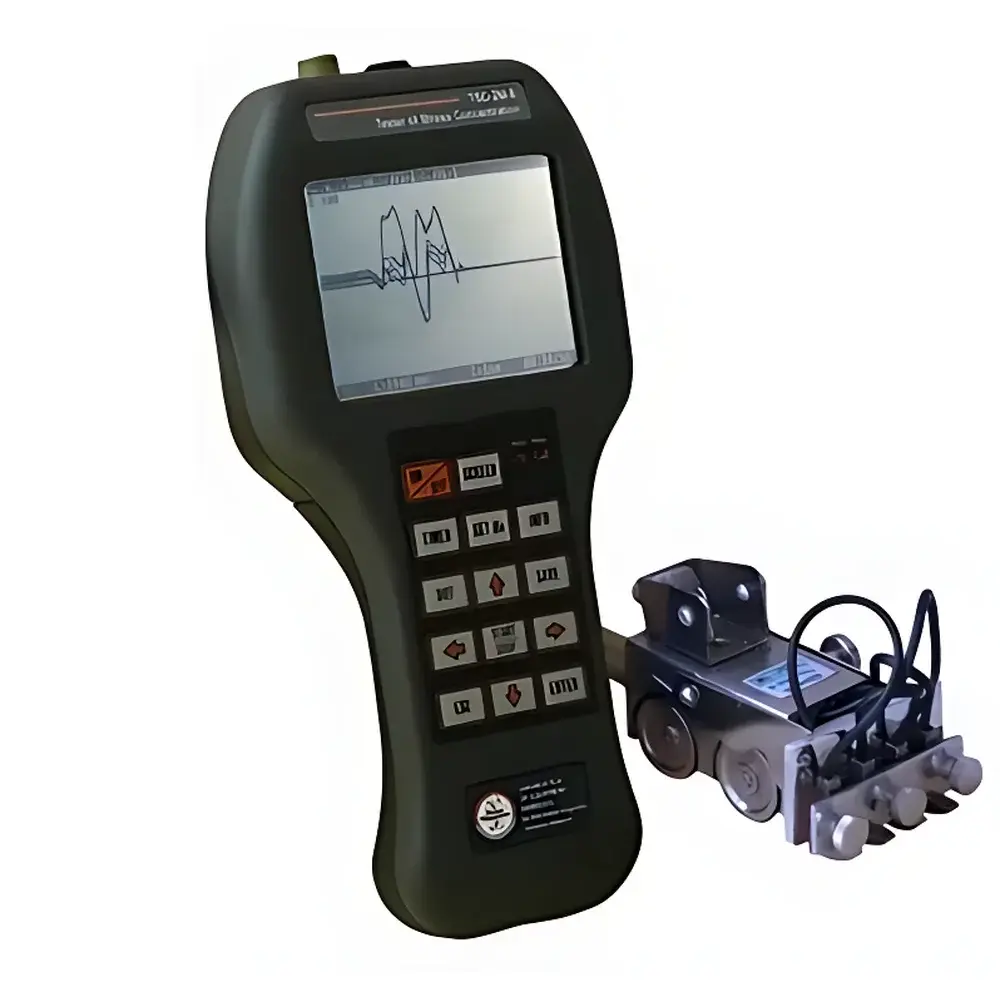
TSC-2M-8 Metal Magnetic Memory (MMM) Testing Instrument
| Origin | Russia |
|---|---|
| Manufacturer Type | Authorized Distributor |
| Origin Category | Imported |
| Model | TSC-2M-8 |
| Pricing | Upon Request |
Overview
The TSC-2M-8 Metal Magnetic Memory (MMM) Testing Instrument is a portable, multi-channel diagnostic system engineered for non-destructive evaluation of residual stress distribution and early-stage fatigue damage in ferromagnetic metallic structures. Developed by Diagnostics Ltd. (Russia), the instrument implements the patented Metal Magnetic Memory method—a physical NDT technique grounded in the magneto-mechanical effect, wherein localized stress concentrations induce irreversible changes in the self-magnetic leakage field (Hp) at the surface of loaded ferromagnetic materials. Unlike conventional magnetic particle inspection or eddy current methods, MMM requires no artificial magnetization; it detects naturally occurring magnetic anomalies arising from microstructural dislocation accumulation under cyclic or static loading. The TSC-2M-8 measures the normal (Hpy) and tangential (Hpx) components of the magnetic field intensity (in A/m) along a scan path, with spatial resolution down to 1 mm. Its core function is to identify Stress Concentration Zones (SCZs)—regions where d(Hp)/dx (the gradient of the Hp signal) exceeds threshold values correlated with elevated risk of crack initiation—enabling predictive structural health monitoring prior to macroscopic defect formation.
Key Features
- Eight independent measurement channels supporting simultaneous acquisition of Hpx and Hpy components across multiple sensor configurations (single-, dual-, or tri-axial)
- High-contrast 320 × 240 pixel LCD display with real-time overlay of up to eight Hp distribution curves, gradient (dH/dx) profiles, and bar-chart gradient visualization
- Three data acquisition modes: point-wise manual measurement, encoder-based length tracking (with integrated 4-wheel optical encoder), and time-synchronized sampling
- Adjustable step intervals: 1, 2, 4, 8, 16, 32, 64, or 128 mm—configurable per inspection protocol
- Maximum scanning speed of 0.5 m/s at 1-mm step resolution, ensuring high-throughput field deployment
- Battery-powered operation (7.2 V rechargeable Li-ion pack) enabling fully portable, cordless use in remote or hazardous environments
- Active external field compensation algorithm allows reliable operation in ambient magnetic fields (e.g., near motors, transformers, or Earth’s geomagnetic variations)
- Non-contact sensing capability—measurements performed without surface preparation, even through non-ferromagnetic coatings ≤ 2 mm thick
- Self-calibration routine using Earth’s magnetic field as reference; automatic sensor type recognition upon connection
- Ruggedized IP65-rated housing with oil- and water-resistant 14-key membrane keypad for industrial field conditions
Sample Compatibility & Compliance
The TSC-2M-8 is validated for use on carbon steels, low-alloy steels, stainless steels, and other ferromagnetic alloys commonly found in pressure vessels, pipelines, welded joints, turbine blades, railway rails, and lifting equipment. It complies with the fundamental principles outlined in GOST R 53298-2009 (Russian standard for MMM testing) and aligns with international frameworks for condition-based maintenance, including ISO 13374-1:2017 (Condition monitoring and diagnostics of machines — Data processing, communication and presentation) and ASTM E2616-18 (Standard Guide for Nondestructive Evaluation of Residual Stress Using Magnetic Methods). While not a direct substitute for fracture mechanics-based assessment, MMM data generated by the TSC-2M-8 serves as a screening tool for prioritizing locations for follow-up verification via ultrasonic testing (UT), radiography (RT), or acoustic emission (AE) per ASME BPVC Section V and EN 13604. The system supports GLP-aligned data integrity when used with MM-System software configured for audit trail logging.
Software & Data Management
The included MM-System analysis software (Windows-based, 64-bit compatible) provides comprehensive post-processing of raw MMM datasets. It supports files containing up to 100 concurrent channels, enables interpolation and resampling of uneven step data, and automatically computes the derivative curve (Dx = dHp/dx) to quantify stress gradient magnitude and spatial localization. Visualization options include 2D line plots, pseudo-3D surface maps, polar coordinate representations for circumferential weld inspection, and comparative overlay of multiple scans. Users may manually adjust baseline correction, apply digital filtering (low-pass, median), annotate SCZs according to methodology-specific thresholds (e.g., Dx ≥ 1.5 A/m·mm), and export vector graphics (EMF/SVG), raster images (PNG/TIFF), or tabular ASCII/CSV outputs. All processing steps—including parameter modifications, annotations, and report generation—are logged with timestamps and operator ID, satisfying traceability requirements under FDA 21 CFR Part 11 when configured with electronic signature modules.
Applications
- Predictive inspection of pipeline girth welds and seam welds for stress-induced cracking susceptibility
- In-service assessment of boiler tubes, heat exchanger shells, and reactor vessels in power generation facilities
- Early detection of fatigue damage in rail tracks, crane hooks, and offshore platform structural nodes
- Verification of stress relief effectiveness after thermal or mechanical treatment of welded assemblies
- Monitoring residual stress redistribution during commissioning and hydrostatic testing of pressure systems
- Integration into digital twin workflows for asset integrity management (AIM) platforms
FAQ
Does the TSC-2M-8 require magnetization of the test object?
No. The instrument detects naturally occurring magnetic stray fields induced by residual stresses; no external magnetizing field is applied.
Can it detect defects beneath paint or insulation?
Yes—non-ferromagnetic coatings up to 2 mm thickness do not impede measurement; ferromagnetic claddings or linings will interfere and must be removed.
What is the minimum detectable stress concentration level?
The instrument does not output absolute stress values (MPa); rather, it identifies relative gradients (dHp/dx) whose magnitude and spatial extent correlate empirically with localized stress intensity—calibration is application- and material-specific.
Is training required to interpret MMM results?
Yes. Proper interpretation requires understanding of magneto-mechanical coupling, signal noise discrimination, and correlation with failure mechanisms; Diagnostics Ltd. offers certified Level 2 MMM practitioner training aligned with ISO 9712.
How is data integrity ensured during field acquisition?
Each measurement includes embedded timestamp, GPS coordinates (when connected), encoder position, battery voltage, and sensor identification; all metadata is preserved in binary .MMM files and imported into MM-System with checksum validation.



