
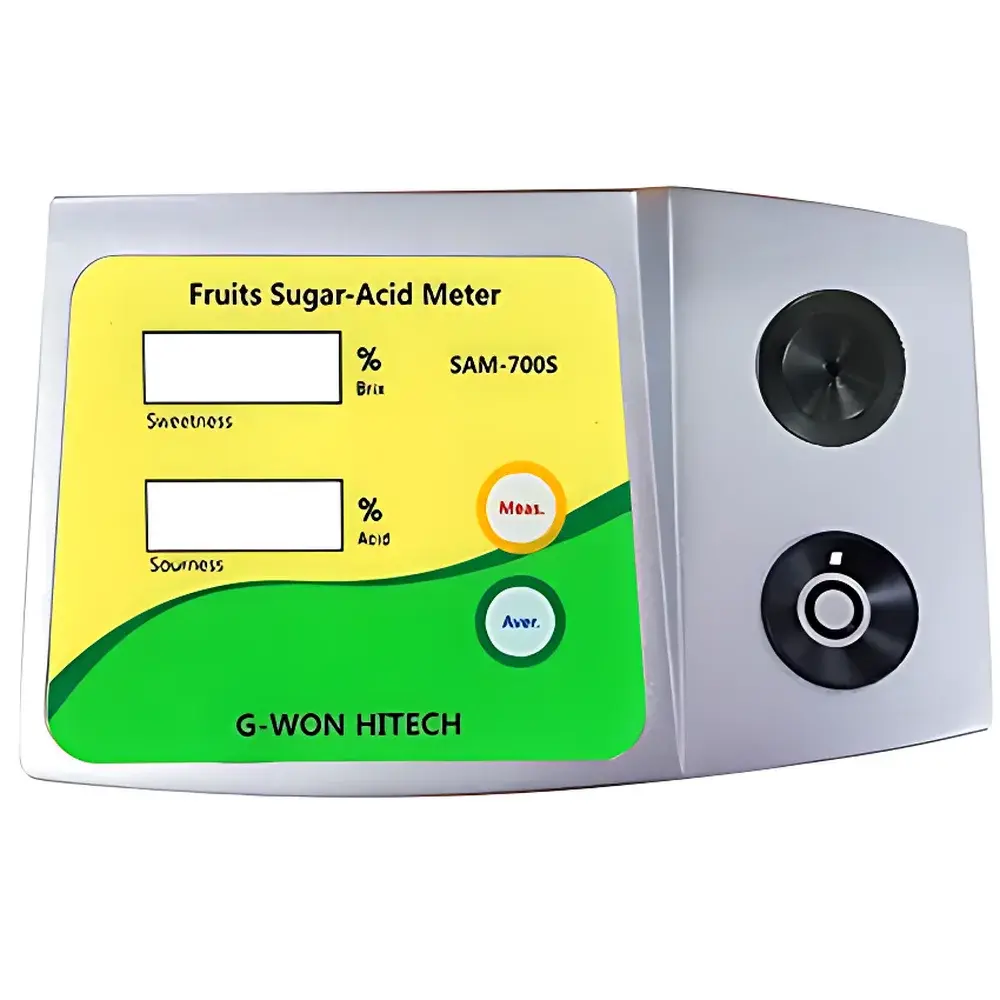
G-WON SAM-700S Portable Fruit Refractometric & Conductometric Brix and Acidity Meter
| Brand | G-WON |
|---|---|
| Origin | South Korea |
| Model | SAM-700S |
| Measurement Principle | Refractive Index (Brix) & Electrical Conductivity (Acidity) |
| Brix Range | 0–35.0% w/w |
| Acidity Range | 0–3.50% (as citric acid) |
| Brix Resolution | 0.1% |
| Acidity Resolution | 0.01% |
| Brix Accuracy | ±0.2% |
| Acidity Accuracy | ±0.05% |
| Temperature Compensation | Automatic (ATC, 10–40 °C) |
| Power Supply | 9 V alkaline battery (1×) |
| Dimensions | 200 × 132 × 62 mm |
| Weight | ~2.0 kg |
| Accessories | Pipette, pipette tips, fruit juice extractor tool, dilution cup, syringe, light-blocking cap, user manual |
Overview
The G-WON SAM-700S is a dual-parameter, handheld field instrument engineered for rapid, reagent-free assessment of soluble solids content (expressed as Brix %) and titratable acidity (reported as % citric acid equivalent) in fresh fruit juices and pulps. It integrates two independent physical measurement principles into a single compact platform: Abbe-type refractometry for Brix quantification and conductometric titration logic for acidity estimation—without requiring standard titrants, pH electrodes, or buffer solutions. Designed specifically for post-harvest quality control in orchards, packing houses, cold storage facilities, and agricultural extension labs, the SAM-700S delivers repeatable results under variable ambient conditions thanks to its built-in automatic temperature compensation (ATC) module calibrated across 10–40 °C. Its solid-state optical path and sealed conductivity sensor minimize drift and contamination risk, supporting consistent operation in high-humidity, dust-prone environments typical of harvest-side applications.
Key Features
- Refractometric Brix measurement via high-stability prism optics with digital analog-to-digital conversion at 16-bit resolution
- Conductivity-based acidity estimation using calibrated two-electrode cell geometry optimized for low-ionic-strength fruit juice matrices
- True auto-ranging detection: simultaneous acquisition and real-time cross-compensation between Brix and conductivity signals
- Integrated ATC algorithm compliant with ISO 2173:2003 (fruit juice determination) and AOAC Official Method 932.12 (Brix)
- No consumables required: eliminates dependency on calibration standards, titrant solutions, or electrode storage fluids
- Auto-hold function triggered by signal stabilization (±0.02% Brix / ±0.005% acidity over 2 s), followed by automatic power-down after 5 minutes of inactivity
- Low-battery indicator with voltage monitoring circuitry ensuring measurement integrity until shutdown threshold
- Ergonomic, IP54-rated housing with non-slip rubberized grip and protective light-blocking cap for outdoor daylight use
Sample Compatibility & Compliance
The SAM-700S is validated for direct analysis of clarified or lightly filtered juices from common horticultural species including Citrus sinensis (oranges), Vitis vinifera (grapes), Malus domestica (apples), Fragaria × ananassa (strawberries), Actinidia deliciosa (kiwifruit), and Prunus persica (peaches). Sample preparation requires only mechanical expression (via included stainless-steel juice extractor) and optional dilution for highly viscous or pulp-rich matrices—no centrifugation, filtration, or thermal treatment needed. The instrument’s measurement traceability aligns with national reference methods specified in KS M ISO 2173 (Korean Industrial Standard) and supports GLP-aligned documentation when paired with external data logging. While not FDA 21 CFR Part 11-certified as a standalone system, its immutable measurement logs (timestamped, non-editable readouts) satisfy basic audit requirements for internal QC records.
Software & Data Management
The SAM-700S operates as a self-contained embedded system with no onboard memory or USB/Bluetooth interface. All measurements are displayed in real time on a high-contrast LCD and retained only during active session viewing. For traceable recordkeeping, users are advised to pair the device with validated third-party mobile applications or laboratory information management systems (LIMS) via manual transcription or camera-based OCR capture. The unit’s stable output format (fixed decimal places, standardized units) ensures compatibility with spreadsheet-based statistical process control (SPC) workflows, including X-bar/R charting per ISO 7870-2. Firmware is factory-programmed and non-upgradable—a design choice prioritizing long-term calibration stability over feature expansion.
Applications
- Harvest timing decisions based on Brix:acid ratio thresholds for optimal flavor development
- Sorting and grading fruit lots prior to cold storage or processing
- Monitoring ripening progression during shelf-life studies
- Verifying compliance with export-grade specifications (e.g., EU Regulation (EC) No 1221/2008 for citrus)
- Field validation of irrigation or fertilization trial outcomes
- Training and extension services for smallholder cooperatives requiring low-infrastructure QA tools
FAQ
Does the SAM-700S require daily calibration?
No. It is factory-calibrated using NIST-traceable sucrose and citric acid reference standards; recalibration is only recommended annually or after physical impact.
Can it measure frozen or dried fruit samples?
No. It requires freshly expressed liquid juice; frozen-thawed or rehydrated samples introduce phase separation and viscosity artifacts that compromise both refractive index and conductivity readings.
Is the acidity result equivalent to titratable acidity (TA) by AOAC method?
It provides a rapid estimate correlated to TA (as % citric acid), but is not a replacement for volumetric titration in regulatory submissions; correlation coefficients ≥0.92 have been reported against AOAC 942.15 in apple and grape matrices.
What maintenance does the prism surface require?
Wipe gently with lens tissue and distilled water after each use; avoid alcohol or abrasive cleaners to preserve anti-reflective coating integrity.
How does temperature variation affect accuracy outside the 10–40 °C range?
Measurements below 10 °C or above 40 °C fall outside ATC compensation limits; observed Brix error increases by ~0.05%/°C deviation, acidity error by ~0.008%/°C.




