UltraSound Technologies LD 300 Ultrasonic Leak Detector
| Origin | UK |
|---|---|
| Manufacturer Type | Authorized Distributor |
| Origin Category | Imported |
| Model | LD 300 |
| Pricing | Upon Request |
Overview
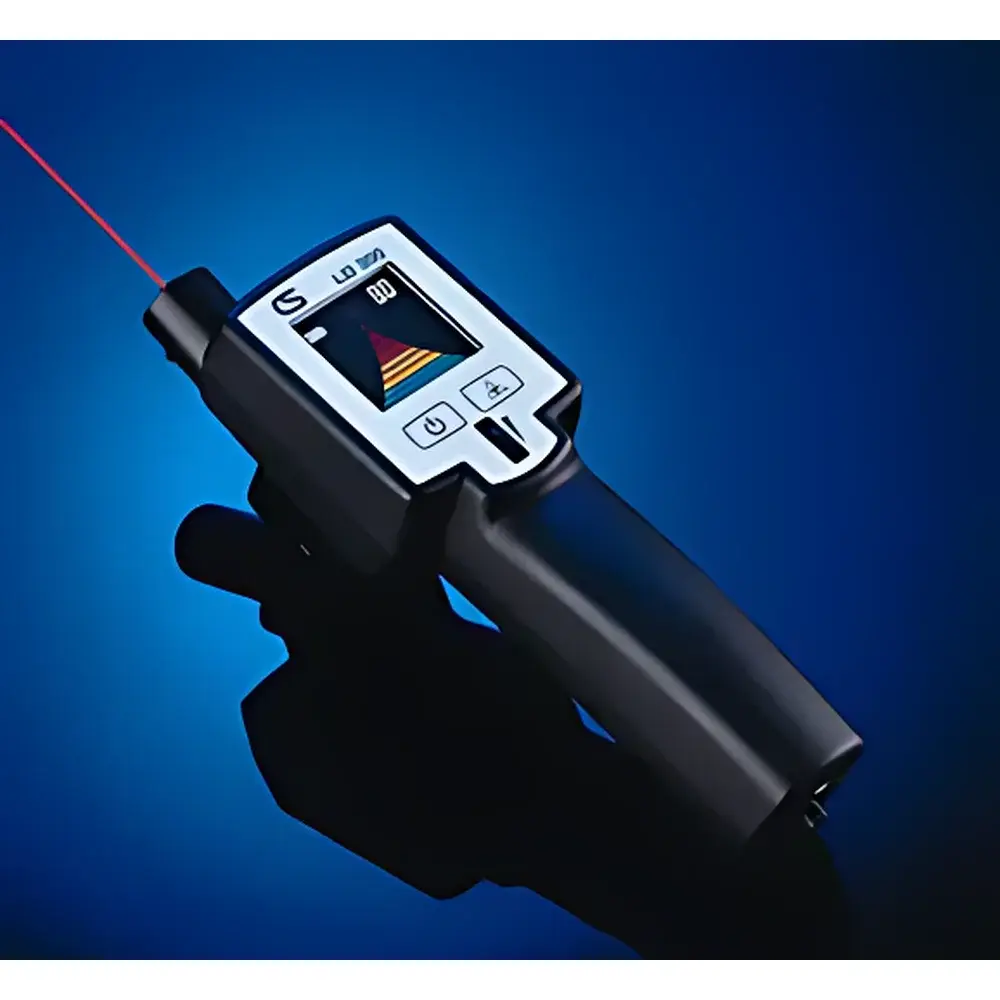
The UltraSound Technologies LD 300 Ultrasonic Leak Detector is an engineered precision instrument designed for non-invasive, real-time detection of high-frequency acoustic emissions generated by pressurized or vacuum system leaks. Operating on the principle of ultrasonic heterodyning—where turbulent gas flow across a restriction (e.g., a crack, pinhole, or seal failure) produces broadband ultrasound in the 38–42 kHz range—the LD 300 captures and down-converts these inaudible signals into the human-audible spectrum (typically 1–5 kHz) via real-time heterodyne processing. This enables rapid, contactless localization of sub-millimeter leaks at distances up to 10 meters—even in noisy industrial environments—without requiring system shutdown, pressure modification, or tracer gases. Its integrated Class II laser pointer (655–660 nm, ≤0.5 mW) provides precise visual targeting aligned with the acoustic axis, ensuring spatial correlation between auditory feedback and physical leak origin.
Key Features
- High-sensitivity piezoelectric ultrasonic sensor with optimized frequency response centered at 40 kHz ±2 kHz, delivering consistent signal-to-noise ratio across varying background noise levels.
- Three-color black-mask LCD display with 10-level intensity grading, enabling intuitive interpretation of ultrasonic amplitude without reliance on audio alone.
- Dual-input interface: 4-pole combo jack for simultaneous headphone output and charger connection; 3.5 mm stereo mini-jack for optional sensor extension cables or external transducers.
- Integrated Class II visible laser (IEC 60825-1 compliant), co-aligned with acoustic beam path, supporting accurate triangulation during long-range inspections.
- Rechargeable NiMH battery pack providing ≥6 hours of continuous operation with laser enabled, and ≥4 hours with laser disabled—optimized for full-shift field deployment.
- Rugged, ergonomic handheld architecture (2.5 kg total system weight) housed in impact-resistant polymer casing, rated for operation from 0°C to +40°C ambient temperature.
Sample Compatibility & Compliance
The LD 300 detects ultrasonic emission signatures irrespective of gas composition—including air, nitrogen, helium, SF₆, refrigerants (R-134a, R-410A), steam, and vacuum-induced ingress—making it universally applicable across HVAC/R, power generation, semiconductor fab utilities, pharmaceutical clean utilities, and compressed air distribution networks. It complies with IEC 61000-6-3 (EMC emission standards) and IEC 61000-6-2 (immunity requirements). While not a certified metrological standard per ISO/IEC 17025, its repeatable acoustic response supports documented leak screening protocols aligned with ASTM E2613 (Standard Practice for Ultrasonic Leak Detection) and ISO 17161 (Ultrasonic testing — Terminology). For regulated environments, data logging integration (via optional PC interface) supports GLP/GMP audit trails when paired with validated software workflows.
Software & Data Management
The LD 300 operates as a standalone field instrument with no embedded firmware-based data storage. However, its analog audio output (via headphone jack) and real-time amplitude display enable seamless integration with third-party sound analysis platforms (e.g., MATLAB, SoundCard-based FFT analyzers, or custom Python-acquired time-series acquisition). When used with the optional ultrasonic sound generator (Model 0554 0103), the system supports quantitative leak sensitivity verification per ISO 20486 Annex B methodologies. All accessories—including focusing tube (0554 0102), extension cable (0530 0101), and calibrated charging station (0553 0102)—are traceably serialized and supplied with EU Declaration of Conformity documentation.
Applications
- Preventive maintenance of compressed air systems: quantifying leakage rate trends across distribution headers, couplings, and pneumatic actuators.
- Vacuum integrity validation in lyophilizers, electron microscopes, and thin-film deposition chambers.
- Steam trap performance assessment and condensate line integrity verification in thermal utility networks.
- Building envelope diagnostics: identifying air infiltration paths around windows, doors, curtain walls, and HVAC duct penetrations.
- Partial discharge (PD) detection in medium-voltage switchgear and terminations—correlating ultrasonic bursts with insulation degradation events prior to electrical failure.
- Non-destructive verification of hermetic seals in medical device packaging, lithium battery enclosures, and MEMS sensor housings.
FAQ
Can the LD 300 detect leaks in vacuum systems?
Yes—the instrument detects ultrasonic energy generated by gas ingress into sub-atmospheric environments, including vacuum lines, chambers, and cryogenic systems.
Is calibration required before each use?
No routine field calibration is needed; however, annual verification against a certified ultrasonic source (e.g., Model 0554 0103) is recommended per ISO/IEC 17025 traceability guidelines.
Does the LD 300 require line-of-sight to detect a leak?
While optimal sensitivity requires direct acoustic path alignment, the instrument can detect reflections off adjacent surfaces—enabling indirect localization in confined or obstructed spaces.
Can it distinguish between different types of ultrasonic sources (e.g., bearing noise vs. gas leak)?
Yes—trained operators differentiate spectral character (broadband turbulence vs. tonal mechanical harmonics) using real-time audio cues and amplitude modulation patterns; advanced users may augment analysis with external FFT tools.
What is the minimum detectable leak size under typical industrial conditions?
Under controlled 3-bar pressure differential and ambient noise <65 dB(A), the LD 300 reliably identifies leaks equivalent to ≤0.01 sccm helium—subject to distance, background noise, and surface reflectivity.