
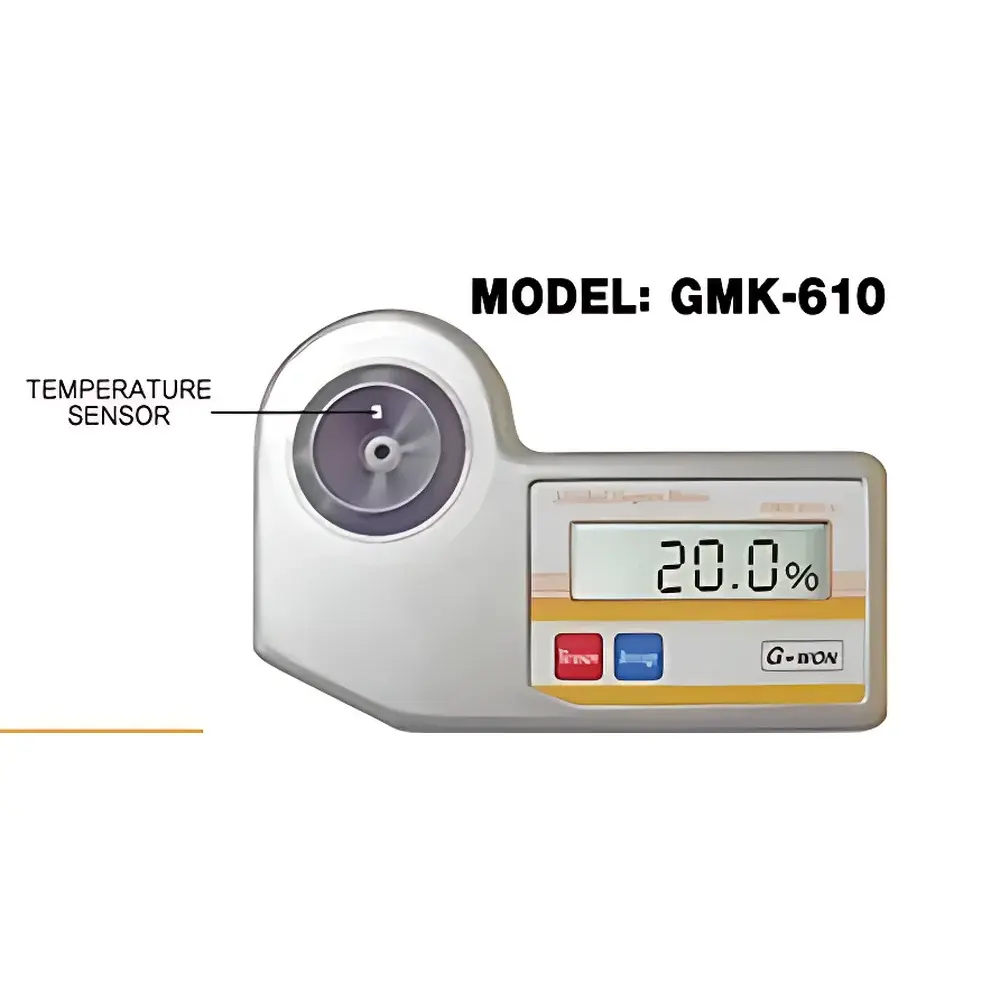
G-WON GMK-610 Desktop Alcohol Refractometer
| Brand | G-WON |
|---|---|
| Origin | South Korea |
| Model | GMK-610 |
| Product Type | Benchtop Refractometer |
| Temperature Control | Yes (10–30 °C auto-regulated) |
| Digital Display | Yes |
| Measurement Range | 0–60.0% v/v ethanol (dilutable to 0–99.8% v/v) |
| Accuracy | ±0.5% v/v |
| Resolution | 0.1% v/v |
| Power Supply | 9 V alkaline battery (1 pc) |
| Measurement Time | ~10 s |
| Dimensions | 154 × 108 × 43 mm |
| Weight | ~1.0 kg |
Overview
The G-WON GMK-610 Desktop Alcohol Refractometer is a precision optical instrument engineered for rapid, reliable quantification of ethanol concentration in liquid samples using the principle of critical-angle refractometry. Based on Snell’s law and calibrated against standardized ethanol–water reference solutions, the GMK-610 determines volume percent (v/v) ethanol by measuring the refractive index shift induced by ethanol content under controlled thermal conditions. Unlike handheld or analog refractometers, the GMK-610 integrates active temperature regulation (10–30 °C), embedded sample-stage thermometry, and factory-traceable calibration protocols—ensuring metrological consistency across laboratory, distillery QC, and regulatory compliance environments. Its optical path is optimized for aqueous ethanol systems, with compensation algorithms validated for common beverage matrices including undiluted spirits, diluted liqueurs, and fermentation intermediates.
Key Features
- Integrated Peltier-based temperature control system maintaining sample chamber stability within ±0.3 °C across the 10–30 °C operating range
- Embedded Pt100 temperature sensor mounted directly in the sample prism assembly—enabling real-time, contact-based measurement of actual sample temperature (not ambient air)
- Automated self-calibration sequence initiated at power-on and before each measurement cycle; verifies optical alignment, detector linearity, and baseline refractive index offset using internal reference optics
- Digital LCD display with backlighting showing simultaneous readouts of ethanol concentration (% v/v), sample temperature (°C), and battery status
- Auto-save functionality retaining up to 100 sequential measurements with timestamp and temperature metadata
- Intelligent power management: automatic shutdown after 5 minutes of inactivity; low-battery indicator activates when voltage drops below 7.2 V
- Benchtop form factor with anti-slip rubber feet and ergonomic prism cover for repeatable sample loading and contamination control
Sample Compatibility & Compliance
The GMK-610 is validated for use with clear, non-turbid ethanol–water solutions—including distilled spirits (e.g., vodka, gin, whiskey), fortified wines, neutral grain spirits, and laboratory-grade ethanol dilutions. It is not suitable for samples containing suspended solids, high-viscosity additives (e.g., glycerol, sugar syrups >15 Brix), or volatile organic co-solvents beyond ethanol/water binary systems. The instrument conforms to ISO 21743:2019 (Alcoholic beverages — Determination of ethanol concentration — Reference method using density measurement) as a rapid screening tool, and supports GLP-compliant workflows through traceable calibration logs and measurement audit trails. While not FDA 21 CFR Part 11–certified out-of-the-box, its data export capability (via optional RS-232 interface) enables integration into validated LIMS environments requiring electronic record integrity.
Software & Data Management
The GMK-610 operates as a standalone instrument with no onboard software stack. All calibration, measurement, and storage logic is implemented in embedded firmware compliant with IEC 61508 SIL-2 functional safety requirements for laboratory instrumentation. Measurement history is retained in non-volatile memory and can be retrieved manually via the front-panel interface. For extended data handling, an optional serial communication module (RS-232, TTL level) allows ASCII-formatted output (e.g., “ALC=42.3% TEMP=22.1°C TIME=2024-06-15T14:22:08”) compatible with standard spreadsheet applications or custom QA databases. Calibration certificates—traceable to NIST SRM 1821 (ethanol–water standards)—are provided with each unit and archived per ISO/IEC 17025 documentation requirements.
Applications
- Quality control in distilleries and craft spirit producers for batch release verification against ABV labeling requirements (e.g., TTB 27 CFR §5.37, EU Regulation (EU) No 1169/2011)
- Routine monitoring of fermentation progress in brewing and bioethanol facilities
- Raw material verification of industrial ethanol deliveries (pharmaceutical grade, fuel grade)
- Educational laboratories for teaching optical metrology principles and solution thermodynamics
- Regulatory inspection support where portable yet lab-grade ethanol quantification is required onsite
FAQ
Does the GMK-610 require manual calibration before each use?
No. The instrument performs an automated self-calibration cycle upon startup and prior to every measurement. Manual calibration is only necessary if the auto-calibration fails consecutively three times or after physical impact or extreme thermal shock.
Can the GMK-610 measure methanol or isopropanol?
No. It is optically and algorithmically calibrated exclusively for ethanol–water systems. Using it for other alcohols introduces systematic bias exceeding ±5% due to differing molar refraction coefficients.
What is the minimum sample volume required?
A single drop (~0.05 mL) fully covering the prism surface (12 mm × 12 mm) is sufficient. Excess liquid does not improve accuracy and may cause leakage into the optical housing.
Is temperature compensation applied automatically during measurement?
Yes. Real-time temperature data from the integrated prism-mounted sensor feeds into the refractive index–to–ethanol conversion algorithm, eliminating need for post-hoc correction tables.
How often should the prism surface be cleaned?
After every sample, using lint-free tissue and reagent-grade isopropyl alcohol. Residual sugars or oils degrade optical coupling and introduce drift exceeding ±0.3% v/v within 5 measurements.





