
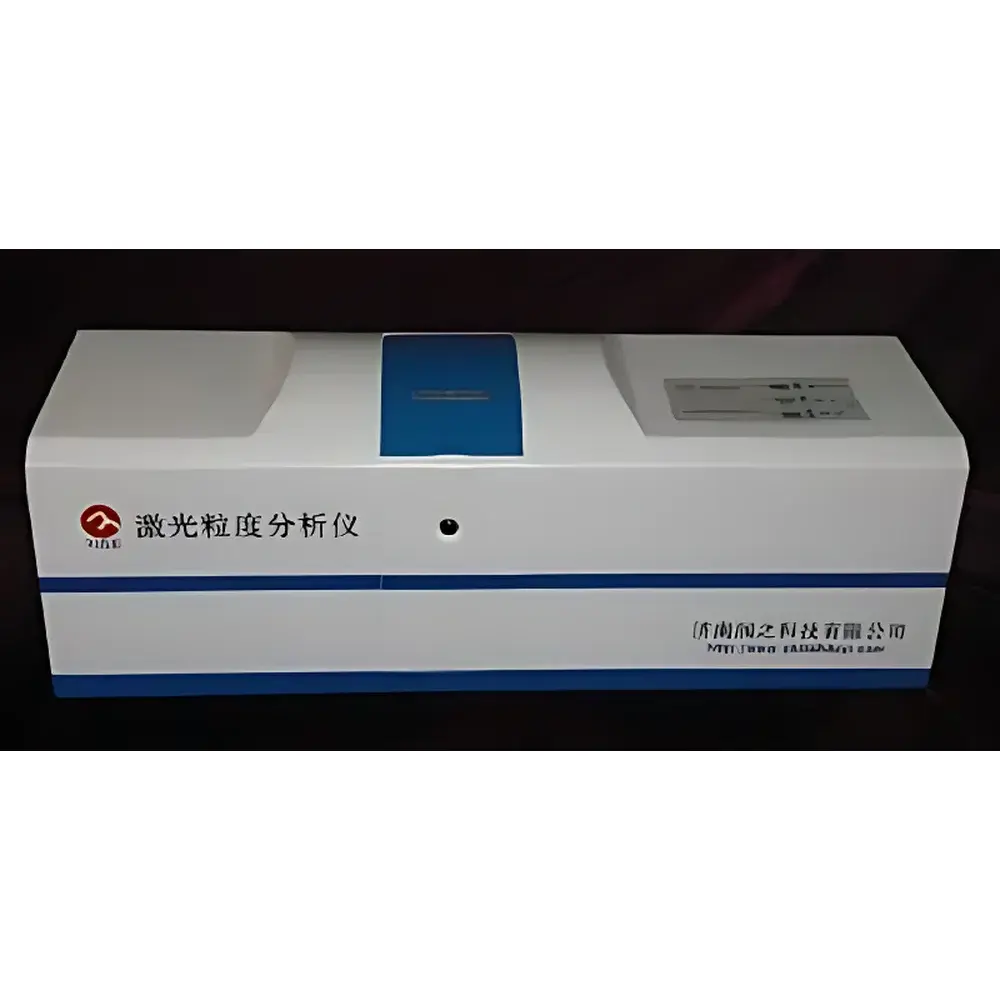
RISE 2202 Fully Automated Laser Particle Size Analyzer
| Origin | Shandong, China |
|---|---|
| Manufacturer Type | Authorized Distributor |
| Origin Category | Domestic (China) |
| Model | RISE 2202 |
| Pricing | Available Upon Request |
| Measurement Range | 0.1–600 µm |
| Accuracy Error | < ±1% (D50, NIST-traceable standard reference materials) |
| Repeatability | < ±1% (D50, same sample, consecutive runs) |
| Power Supply | AC 220 V ±10%, 50 Hz, 200 W |
| Dimensions (L×W×H) | 1000 × 330 × 320 mm |
| Weight | 39 kg |
| Laser Source | He-Ne gas laser, λ = 632.8 nm, linewidth < 0.002 nm, lifetime > 25,000 h |
| Detector Array | Non-uniform, cross-dimensional 3D扇-shaped matrix (patent-pending geometry), max detection angle: 90° |
| Dispersion System | Integrated 400 mL wet dispersion cell with 100 W ultrasonic probe, programmable sonication time, adjustable stirrer speed & circulation pump flow rate |
| Software | PADMAS v5.2 (Particle Diameter Measure & Analysis System), compliant with GLP audit trail requirements, supports FDA 21 CFR Part 11 optional electronic signature module |
Overview
The RISE 2202 Fully Automated Laser Particle Size Analyzer is a high-precision, wet-dispersion instrument engineered for robust and reproducible particle size distribution (PSD) measurement across industrial, academic, and regulatory laboratory environments. It operates on first-principles Mie scattering theory—fully accounting for the complex refractive index of both particles and dispersant—to invert angular light intensity profiles into volumetric PSD data. Unlike conventional fixed-assumption algorithms, the RISE 2202 implements true non-negative, unconstrained inverse scattering computation. This eliminates a priori distribution assumptions (e.g., log-normal or Rosin-Rammler), thereby delivering physically faithful representations of multimodal, skewed, or broad distributions without mathematical bias. Its optical architecture features a single-range convergent Fourier optical path—eliminating multi-lens alignment dependencies—and integrates a stabilized He-Ne laser (632.8 nm) with exceptional spectral purity and long-term power stability (>25,000 h MTBF), ensuring baseline signal integrity essential for trace-level repeatability.
Key Features
- Fully automated operational sequence: auto-filling, degassing (bubble elimination), dispersion, measurement, drainage, cleaning, data saving, and report generation—all initiated by a single software command.
- Advanced detector geometry: proprietary non-uniform 3D扇-shaped (fan-shaped) photodiode array with 90° maximum scattering angle coverage, enabling high-fidelity capture of forward- and side-scattered light critical for submicron resolution.
- Integrated dispersion module: 400 mL recirculating cell with 100 W ultrasonic transducer, variable-speed magnetic stirrer, and programmable peristaltic pump—optimized for deagglomeration of cohesive, fibrous, or high-density particulates.
- Self-calibrating optical train: factory-aligned convergent optics with no user-adjustable components; drift-compensated photodetector gain control ensures long-term measurement consistency.
- Intuitive workflow management: pre-configurable test protocols—including sonication duration, stir rate, and flow velocity—stored as method templates for rapid recall and inter-operator standardization.
Sample Compatibility & Compliance
The RISE 2202 supports aqueous and organic dispersions (e.g., water, ethanol, isopropanol) and accommodates powders, suspensions, emulsions, and slurries with densities ranging from 0.8 to 7.8 g/cm³. Its dispersion parameters are empirically validated against ISO 13320:2020 (Laser diffraction methods) and ASTM D4294–22 (Standard Test Method for Particle Size Distribution of Powders). Instrument performance verification adheres to NIST-traceable reference standards (e.g., NIST SRM 1963, SRM 2800), with accuracy and repeatability routinely verified at D50 per ISO 22412:2017. The system architecture supports GLP-compliant operation through full electronic audit trail logging in PADMAS software; optional 21 CFR Part 11 compliance packages include role-based access control, electronic signatures, and immutable raw data archiving.
Software & Data Management
PADMAS v5.2 provides comprehensive post-acquisition analysis including differential and cumulative volume/number distributions, R-R plots, custom binning (1–130 user-defined channels within 0.02–2000 µm), and derived metrics: D10, D50, D90, span, specific surface area (volume- and mass-based), and polydispersity index. Data export is native to .XLSX and .CSV formats; graphical outputs render as scalable vector graphics (SVG), PNG, or PDF—enabling direct embedding into technical reports and regulatory submissions. Batch processing allows statistical comparison across multiple samples with ANOVA-ready output. All raw scattering patterns, instrument logs, and metadata are stored in encrypted binary archives with SHA-256 checksum validation.
Applications
The RISE 2202 serves quality control and R&D workflows in pharmaceuticals (API crystallinity, excipient sizing), advanced ceramics (slurry homogeneity), battery materials (cathode/anode powder grading), catalyst development (pore structure proxies), pigment manufacturing (hue consistency), and environmental science (sediment grain analysis). Its automation fidelity makes it suitable for unattended overnight testing in high-throughput labs; its accuracy profile meets specification thresholds for USP , EP 2.9.31, and JP 6.07 methodologies when paired with validated dispersion protocols.
FAQ
What dispersion media are compatible with the RISE 2202?
Deionized water, ethanol, isopropanol, and other low-viscosity, optically transparent solvents with refractive indices between 1.33 and 1.45 are supported. Viscous or opaque media require method adaptation and are not recommended.
Does the system require periodic optical recalibration?
No. The convergent optical path and factory-aligned detector array are maintenance-free under normal operating conditions. Annual performance verification using NIST SRMs is recommended for ISO/IEC 17025 accreditation.
Can PADMAS generate reports compliant with FDA submission requirements?
Yes—when configured with the optional 21 CFR Part 11 module, PADMAS enforces electronic signature workflows, secure audit trails, and data integrity controls aligned with FDA guidance for electronic records.
Is the ultrasonic dispersion module adjustable for heat-sensitive samples?
Yes. Sonication power and duty cycle are fully programmable; pulse-mode operation minimizes thermal load while maintaining effective deagglomeration.
How does the RISE 2202 handle highly anisotropic or irregular particles?
While laser diffraction reports an equivalent spherical diameter (ESD), the instrument’s wide angular detection range and Mie-based inversion improve fidelity for moderately nonspherical particles—particularly when refractive index is accurately specified in the software model.
Related Products



