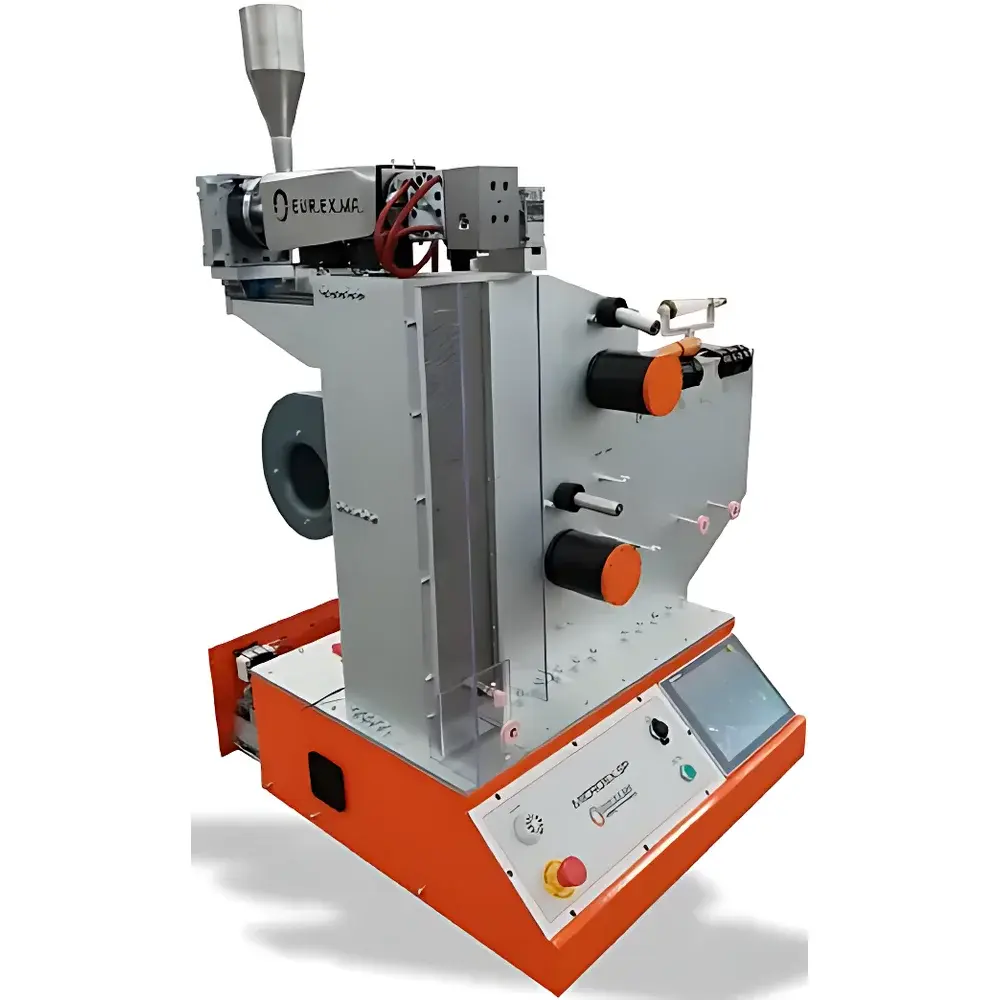
Microex SP Mini Desktop Spinning Line
| Brand | EUROTECH |
|---|---|
| Origin | Italy |
| Model | Microex SP |
| Type | Laboratory-Scale Melt Spinning System with Integrated Twin-Screw Microextruder |
| Application | Thermoplastic Polymer Fiber Development (PP, PA, PET) |
| Configuration | Benchtop, Modular, Vacuum-Ready, Air-Cooled Die Assembly |
| Compliance | CE Marked, ISO 9001–Certified Manufacturing |
Overview
The Microex SP Mini Desktop Spinning Line is a compact, fully integrated laboratory-scale melt spinning system engineered for rapid prototyping and process development of synthetic thermoplastic fibers. Built around EUROTECH’s proprietary Microex twin-screw microextruder platform, the system delivers precise melt homogenization, temperature-controlled extrusion, and controlled fiber drawing—enabling reproducible filament formation from polypropylene (PP), polyamide (PA), and polyethylene terephthalate (PET). Unlike conventional pilot-scale spinning lines requiring dedicated floor space and utility infrastructure, the Microex SP operates as a self-contained benchtop unit with integrated gear pump dosing, precision metering die, and adjustable air-gap quench zone. Its design follows fundamental polymer processing principles: melt conveying under controlled shear history, capillary die flow governed by Bagley and Rabinowitsch corrections, and solidification kinetics modulated via convective cooling and take-up velocity. This architecture supports both monofilament and multifilament configurations (up to 12 filaments) and serves as a scalable bridge between formulation screening and industrial spin-line commissioning.
Key Features
- Modular twin-screw microextruder (L/D = 25) with segmented barrel zones (±0.5 °C thermal stability) and torque-controlled drive (0.1–50 rpm range)
- Integrated positive-displacement gear pump for stable volumetric melt delivery (flow repeatability ±1.2% RSD)
- Stainless-steel spinneret assembly with interchangeable dies (0.2–1.0 mm orifice diameters; standard 0.3 mm for PP/PA/PET)
- Adjustable air-gap height (10–150 mm) with laminar-flow quench air supply (0–100 L/min, ±2 °C temperature control)
- Programmable winder with dual-speed servo motor (0.1–1000 m/min linear speed; tension feedback loop optional)
- Benchtop footprint (650 × 480 × 520 mm) with CE-compliant safety interlocks and emergency stop circuitry
- Optional vacuum venting port at second barrel zone for moisture/volatiles removal (critical for PET drying pre-spinning)
Sample Compatibility & Compliance
The Microex SP is validated for use with crystalline and semi-crystalline thermoplastics requiring melt processing above their glass transition (Tg) and below thermal degradation onset. Primary compatible polymers include isotactic PP (Tm ≈ 160–170 °C), PA6/PA66 (Tm ≈ 220–265 °C), and intrinsic-viscosity-adjusted PET (Tm ≈ 250–260 °C). All wetted components comply with FDA 21 CFR §177.1520 (indirect food contact) and EU Regulation (EC) No. 1935/2004. The system meets IEC 61000-6-2 (EMC immunity) and IEC 61000-6-4 (EMC emissions) standards. Full traceability documentation—including material certificates, calibration records for temperature sensors (Pt100 Class A), and CE Declaration of Conformity—is supplied with each unit.
Software & Data Management
Operation is managed via MICROSPIN v3.2 control software running on an embedded industrial PC. The interface provides real-time monitoring of 16 process variables (e.g., barrel zone temperatures, screw torque, gear pump RPM, winder speed, die pressure) with 100 ms logging resolution. Data export supports CSV, HDF5, and ASTM E1447-compliant .tdms formats. Audit trail functionality complies with ALCOA+ principles: all parameter changes are timestamped, user-ID tagged, and immutable. Optional 21 CFR Part 11 compliance package includes electronic signatures, role-based access control, and encrypted database backup—validated per GAMP 5 Annex 11 requirements for regulated environments (e.g., medical-grade fiber R&D under ISO 13485).
Applications
- Rapid screening of polymer formulations (e.g., additive masterbatches, nanocomposites, biodegradable blends) for spinnability and fiber morphology
- Correlation studies between melt rheology (measured separately via capillary or rotational rheometry) and as-spun fiber tensile properties
- Optimization of draw ratio, quench rate, and relaxation conditions to control crystallinity and orientation in PP/PA fibers
- Development of functionalized PET fibers for filtration media, geotextiles, or textile reinforcement applications
- Training platform for polymer engineering curricula—demonstrating structure–property–process relationships in fiber science
FAQ
What polymer feed forms are supported?
Granules or pellets only; powder feeding is not recommended due to inconsistent densification in the microextruder feed throat.
Can the system produce bicomponent fibers?
No—the current configuration supports single-component extrusion only. Bicomponent capability requires retrofitting with a co-extrusion module (Microex SP-Dual), available as a factory-installed option.
Is offline fiber characterization supported?
Yes. Standardized sample collection ports enable direct transfer to DSC, XRD, SEM, or tensile testers. Fiber diameter distribution can be quantified using laser diffraction (e.g., Malvern Morphologi G3) or optical microscopy with ISO 1888–2013-compliant protocols.
What maintenance intervals are recommended?
Gear pump oil replacement every 500 operating hours; die cleaning after each polymer change; full screw/barrel inspection every 2,000 hours or when torque deviation exceeds ±5% of baseline.
Does the system support nitrogen purging?
Yes—an optional N2 inlet port is available at the hopper and die zone to minimize thermal oxidation during high-temperature PET processing.