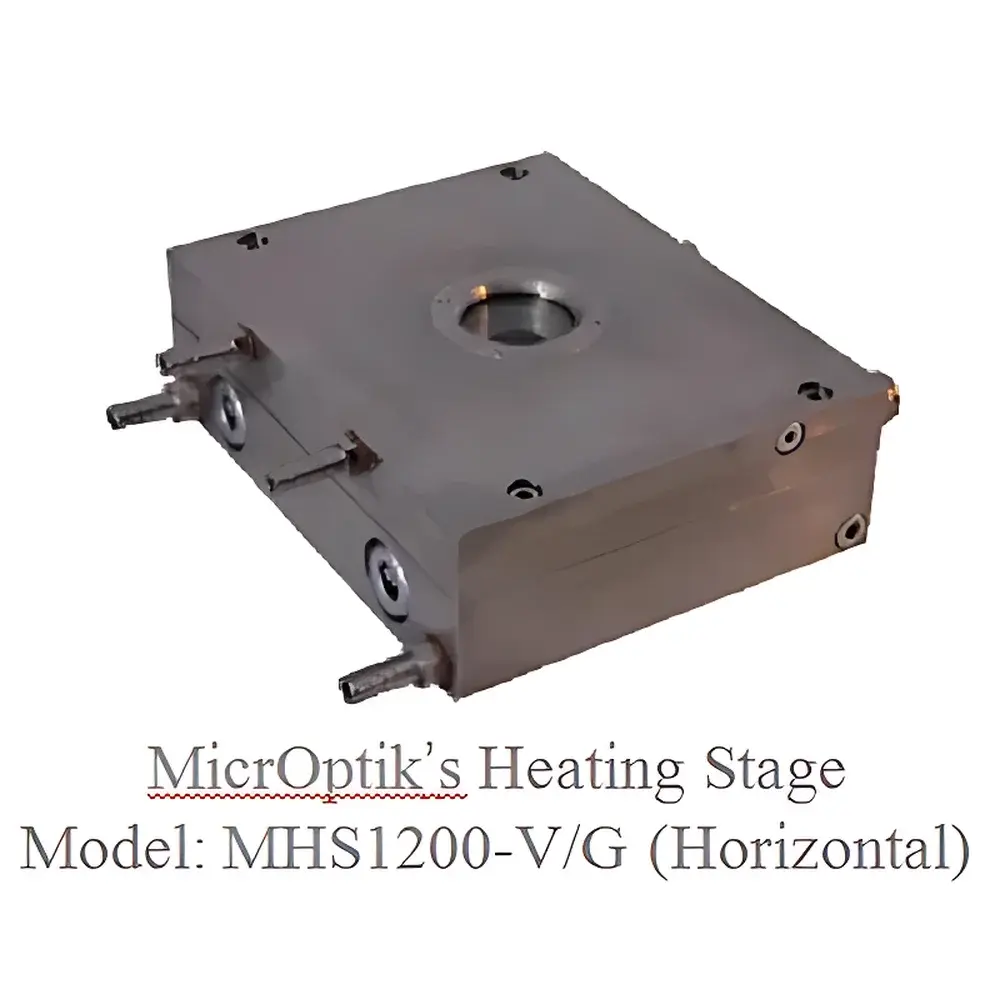
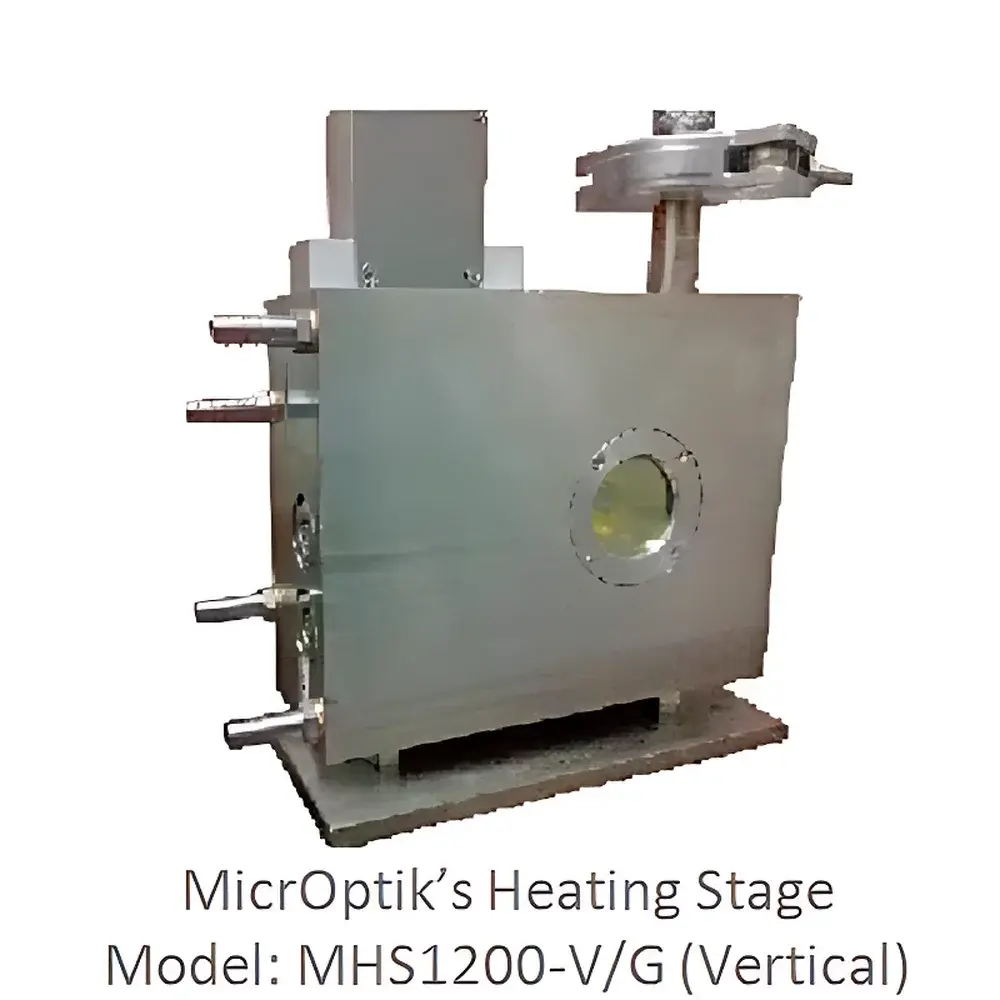
MicrOptik MHS1200-V/G High-Temperature Vacuum/Gas-Tight Optical Microscopy Stage
| Brand | MicrOptik |
|---|---|
| Origin | Netherlands |
| Model | MHS1200-V/G |
| Max Temperature | 1200 °C |
| Temp Resolution | 1 °C |
| Control Method | PID/PID-Switching |
| Sensor | Type S Pt-10%Rh/Pt Thermocouple |
| Sample Area Options | Ø25 mm / 48 mm / 75 mm |
| Chamber Height | Standard 4 mm (customizable) |
| Observation Port Diameter | 32 mm (customizable) |
| Objective Working Distance | 6 mm (customizable) |
| Electrical Feedthroughs | 4 channels |
| Cooling | Integrated Water-Cooled Mounting Bracket |
| Controller | MTDC600 Programmable Temperature Controller (USB 2.0, ±0.4% of reading accuracy) |
Overview
The MicrOptik MHS1200-V/G is a precision-engineered high-temperature stage designed for integration into optical microscopy and spectroscopic systems requiring controlled thermal environments under vacuum or inert/gas-purged conditions. Based on resistive heating and closed-loop thermocouple feedback, the stage operates on the principle of Joule heating within a refractory metal alloy heater element, coupled with real-time temperature monitoring via a calibrated Type S (Pt-10%Rh/Pt) thermocouple embedded in the sample platform. Its architecture supports both transmission and reflection-mode optical configurations, enabling in situ observation of phase transitions, grain boundary dynamics, solid-state reactions, and melt behavior across materials science, geosciences, semiconductor processing, and photovoltaic R&D. The stage’s mechanical design maintains optical axis alignment and thermal stability during ramp-hold-cool cycles up to 1200 °C, with minimal thermal drift (<±0.5 °C over 1 hour at 1000 °C), ensuring repeatability essential for quantitative microstructural analysis.
Key Features
- Vacuum- and gas-tight chamber compatible with pressures down to 10−6 mbar and inert gas purging (N2, Ar, forming gas)
- Programmable temperature control from ambient to 1200 °C with ±0.4% of reading accuracy and 1 °C resolution
- PID/PID-switching algorithm optimized for rapid ramp rates (up to 50 °C/min) and stable isothermal holds
- Modular sample aperture system: standard 32 mm observation port, configurable for wide-field or high-NA objectives
- Interchangeable sample holders supporting Ø25 mm, 48 mm, or 75 mm specimens; chamber height adjustable (standard 4 mm, optional 2–12 mm)
- Integrated water-cooled mounting bracket to isolate microscope optics from conductive/convective heat leakage
- Four independent electrical feedthroughs (vacuum-rated ceramic seals) for simultaneous resistivity, impedance, or voltage bias measurements
- Horizontal and vertical mounting configurations supported without recalibration
Sample Compatibility & Compliance
The MHS1200-V/G accommodates diverse sample geometries—including polished wafers, thin films, mineral chips, fluid inclusion mounts, and sintered ceramics—while maintaining compatibility with ISO 17025-accredited laboratory workflows. Its construction adheres to CE electromagnetic compatibility (EMC) Directive 2014/30/EU and Low Voltage Directive 2014/35/EU. For regulated environments, the MTDC600 controller supports audit-trail-enabled operation compliant with FDA 21 CFR Part 11 when paired with validated software configuration (user-defined electronic signatures, change logs, and data integrity safeguards). The stage meets ASTM E1113 (Standard Guide for Use of High-Temperature Microscopy) and ISO 11357-3 (Plastics — Differential Scanning Calorimetry — Part 3: Determination of Melting and Crystallization Temperatures) methodology requirements for in situ thermal characterization.
Software & Data Management
The MTDC600 controller operates via intuitive Windows-based software (MTDC Studio v3.2+) supporting multi-segment temperature profiling with fully programmable ramp rates, dwell times, and slope constraints. All experimental profiles are named, timestamped, and stored locally in UTF-8 encoded .txt format (columns: Time [s], Temperature [°C], Setpoint [°C], Heater Power [%]). Export modules support direct conversion to CSV, Excel (.xlsx), SQL database ingestion, and MATLAB-compatible .mat files. Real-time plotting includes dual-Y-axis visualization of temperature vs. external sensor inputs (e.g., resistance, emission intensity). Software logging complies with GLP/GMP documentation standards, including user authentication, session locking, and immutable record generation. USB 2.0 interface ensures deterministic latency (<10 ms round-trip) for synchronized acquisition with high-speed cameras or spectrometers.
Applications
- Geoscience: In situ observation of fluid inclusion homogenization, mineral phase equilibria, and silicate melt textures at crustal/mantle-relevant temperatures
- Semiconductor R&D: Real-time monitoring of dopant diffusion, metal silicide formation, and interfacial reaction kinetics in thin-film stacks
- Photovoltaics: Thermal stability assessment of perovskite absorbers, electrode interdiffusion barriers, and encapsulant degradation mechanisms
- Materials Science: Solidification mapping, grain growth kinetics, oxidation layer evolution, and creep deformation in refractory alloys and ceramics
- Pharmaceutical Solid-State Chemistry: Polymorphic transition tracking, amorphous-to-crystalline conversion, and hydrate/dehydrate behavior under controlled atmospheres
FAQ
What vacuum level is the MHS1200-V/G rated for?
The stage is certified for continuous operation at pressures ≤10−6 mbar using all-metal vacuum seals and bake-out compatible materials.
Can the stage be used with oil-immersion objectives?
Yes—when configured with extended working distance options (e.g., 12 mm), and combined with vacuum-compatible immersion oils (e.g., Cargille Type A), provided objective housing is also vacuum-rated.
Is the MTDC600 controller compatible with LabVIEW or Python APIs?
Yes—full SCPI command set and DLL libraries are provided for native integration with LabVIEW, Python (PyVISA), MATLAB, and EPICS IOC environments.
How is temperature uniformity across the sample area characterized?
Uniformity is specified as ±3 °C over Ø25 mm at 1000 °C, measured via calibrated micro-thermocouple array mapping; uniformity degrades predictably with larger apertures and is documented in the calibration certificate supplied with each unit.
Does the system support simultaneous heating and cooling cycles?
Yes—the water-cooled base enables active quenching; maximum cooling rate is ~15 °C/min from 1000 °C to 400 °C under forced convection, limited by thermal mass and safety interlocks.