
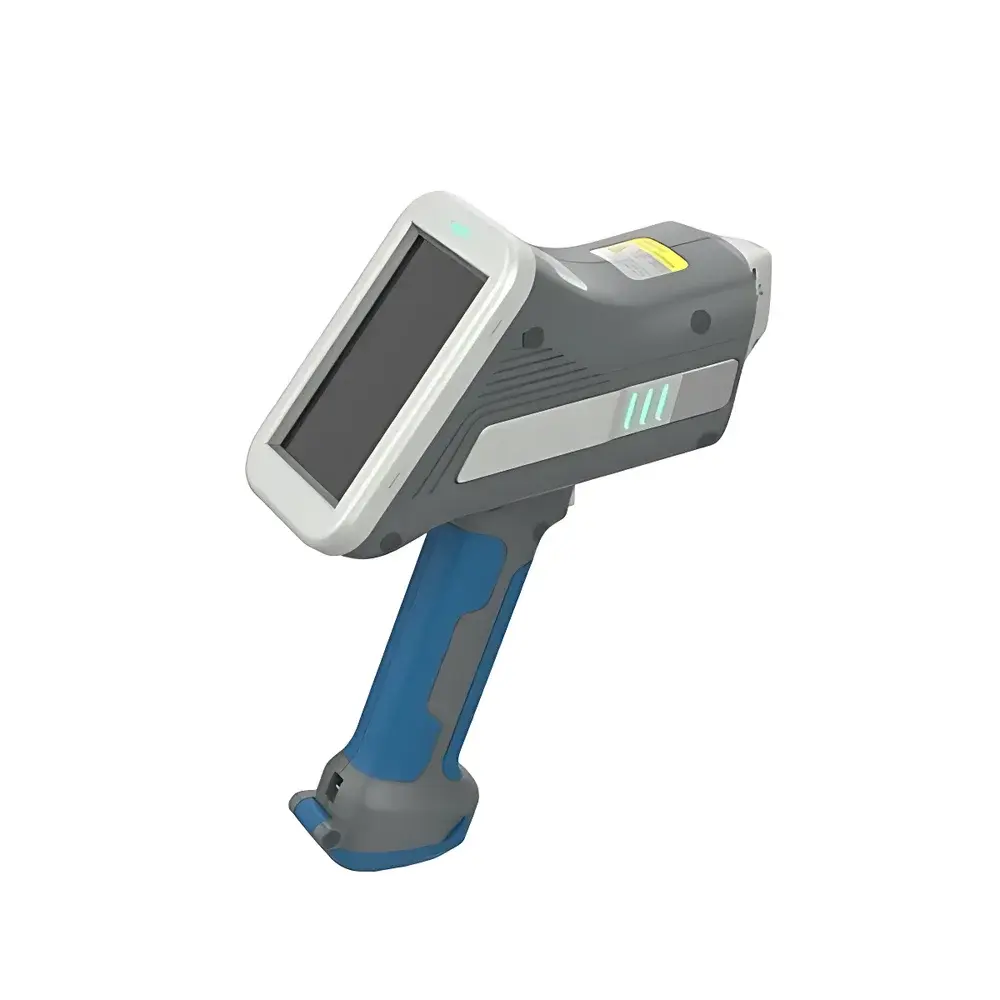
Portable350 Handheld Energy Dispersive X-Ray Fluorescence Spectrometer for Soil Heavy Metal Analysis
| Origin | Beijing, China |
|---|---|
| Manufacturer Type | Authorized Distributor |
| Regional Origin | Domestic (PRC) |
| Model | Portable350 |
| Price Range | USD 7,000–14,000 (FOB) |
| Form Factor | Handheld / Field-Deployable |
| Industry-Specific Use | Environmental & Industrial Compliance Monitoring |
| Elemental Range | Mg (Z=12) to U (Z=92) |
| Quantification Range | 1 ppm to 99.99 wt% |
| Energy Resolution | 149 ± 5 eV at Mn Kα |
| Repeatability | RSD ≤ 0.05% (for Fe in certified soil matrix, 60 s measurement) |
Overview
The Portable350 Handheld Energy Dispersive X-Ray Fluorescence (ED-XRF) Spectrometer is an ISO/IEC 17025-aligned field instrument engineered for rapid, non-destructive elemental quantification in heterogeneous soil matrices and environmental media. It operates on the fundamental principle of X-ray fluorescence: a high-brightness micro-focus Ag-anode X-ray tube (45 kV, 200 µA) irradiates the sample, inducing characteristic secondary X-ray emission from atoms with atomic numbers ranging from magnesium (Z=12) to uranium (Z=92). Emitted photons are resolved by a silicon PIN diode detector, enabling simultaneous multi-element detection without chemical digestion or sample preparation. Designed for regulatory-grade field deployment, the Portable350 delivers laboratory-comparable precision under real-world conditions—achieving sub-ppm detection limits for priority toxic metals (Pb, As, Cd, Cr, Hg, Ni) in <2 seconds per measurement. Its ruggedized architecture meets MIL-STD-810G for shock, vibration, and ingress protection (IP54), supporting continuous operation across ambient temperatures from –20 °C to +60 °C.
Key Features
- Field-optimized ED-XRF platform with integrated Si-PIN detector and Ag-target end-window X-ray tube delivering stable excitation at 45 kV / 200 µA
- True handheld form factor: weight ≤1.7 kg (including battery); ergonomic industrial-grade 5-inch semi-transflective touchscreen (1080 × 720 resolution)
- Intelligent sample interface: built-in 5 MP camera for geotagged imaging; proximity sensor-triggered auto-start; triple-state LED status indicator (red flashing = active analysis; green flashing = no sample; green steady = sample detected)
- Radiation safety compliance: automatic beam cutoff during idle or empty-beam conditions; lead-shielded collimator (2 mm / 3 mm aperture); measured dose rate <1 µSv/h at 10 cm — well below IEC 62495 and FDA 21 CFR Part 1020.40 limits
- Hot-swappable dual-battery system: two 6800 mAh Li-ion packs enabling >8 hours total runtime; battery-level display and seamless power transition without instrument shutdown
- Multi-modal connectivity: Wi-Fi 802.11ac, Bluetooth 5.0, and USB-C support secure data transfer between instrument, Windows PC, Android mobile devices, and cloud-based repositories
Sample Compatibility & Compliance
The Portable350 is validated for direct analysis of solid and powdered environmental samples—including topsoil, sediment, sludge, dust wipes, paint chips, and filter media—without homogenization or acid digestion. Its 9 mm × 5 mm elliptical test window ensures optimal signal-to-background ratio for low-Z elements (e.g., Mg, Al, Si) while maintaining sensitivity for heavy metals. Method performance aligns with EPA Method 6200 (Field Portable XRF for Elemental Analysis) and ASTM D7213–22 (Standard Practice for Determining Metals in Soils Using Portable XRF). Instrument firmware and software enforce GLP/GMP-compliant audit trails, including user authentication (multi-tier role-based access), timestamped spectral acquisition logs, and tamper-evident report generation. All calibration standards are traceable to NIST SRM 2710a (Montana Soil) and SRM 2711a (Montana Soil II).
Software & Data Management
TECSYNC™ software provides unified cross-platform control and data governance. The Windows desktop application and Android mobile client enable remote instrument configuration, real-time spectral visualization, FP (Fundamental Parameters) and empirical calibration management, and customizable report generation (PDF/CSV/XLSX). Cloud synchronization supports centralized data aggregation via secure TLS 1.3–encrypted endpoints. Reports include full spectral overlays, peak deconvolution metadata, uncertainty estimates per element (k=2), and digital signatures compliant with FDA 21 CFR Part 11 requirements. Email export functionality embeds raw spectra, geo-coordinates, operator ID, and QC pass/fail flags directly into PDF reports. Over-the-air (OTA) firmware updates ensure continuous alignment with evolving regulatory guidance (e.g., EU RoHS Annex II revisions, US RCRA Appendix IX updates).
Applications
- Rapid delineation of contamination plumes at brownfield sites, mining tailings, and industrial spill zones
- In-field verification of remediation endpoints per ASTM D7880 and ISO 18227
- RCRA hazardous waste characterization (metals listed in 40 CFR Part 261, Subpart D)
- Regulatory screening for EN 71-3 (Toy Safety), ASTM F963 (Toys), and CPSIA lead limits in consumer product soils
- Long-term environmental monitoring of landfill leachate impact zones and agricultural land adjacent to smelters
- Workplace exposure assessment per OSHA Z-Tables and ACGIH TLVs for airborne particulates collected on filters
- Forensic soil provenance studies leveraging rare-earth element (REE) fingerprinting capabilities
FAQ
Does the Portable350 require sample preparation prior to analysis?
No. It performs direct, non-destructive analysis of intact soil cores, loose powders, or composite grab samples. Minimal surface cleaning (e.g., removal of organic debris) is recommended for optimal accuracy.
How is measurement repeatability verified in the field?
Each unit ships with factory-certified check standards (e.g., NIST-traceable Fe/Cu/Zn doped clay pellets). Daily verification protocols embedded in TECSYNC™ generate RSD reports automatically and flag drift exceeding ±0.05% against reference values.
Is the instrument suitable for regulatory submission of data?
Yes—when operated per documented SOPs and calibrated against matrix-matched standards, data meet the data quality objectives (DQOs) specified in EPA QA/G-5 and ISO/IEC 17025 for field analytical methods.
What maintenance is required beyond routine calibration checks?
The X-ray tube and detector carry a 12-month warranty; no scheduled preventive maintenance is required. Firmware updates, spectral library expansions, and remote diagnostics are delivered via TECSYNC™ OTA infrastructure.
Can the Portable350 distinguish between different oxidation states (e.g., Cr(III) vs. Cr(VI))?
No. ED-XRF quantifies total elemental concentration only. Speciation requires complementary techniques such as XANES or HPLC-ICP-MS.






