
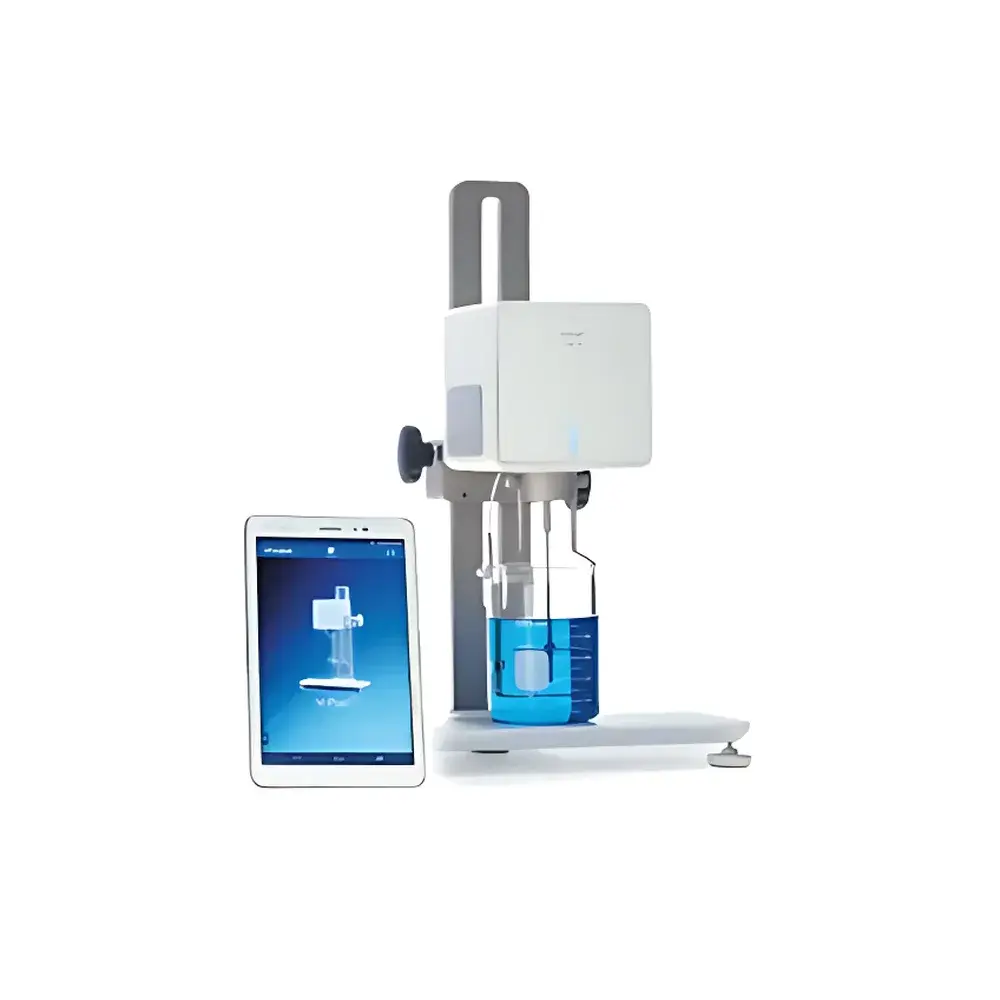
Fungilab V-PAD Advanced Rotational Viscometer
| Origin | Germany |
|---|---|
| Manufacturer Type | Authorized Distributor |
| Origin Category | Imported Instrument |
| Model | V-PAD |
| Price Range | USD 1,400 – 7,000 (FOB) |
| Instrument Type | Rotational Viscometer |
| Viscosity Range | 1–320,000 cP |
| Repeatability | ±0.2% |
| Accuracy | ±1% of full scale |
| Temperature Range | −40 °C to +300 °C |
| Temperature Resolution | 0.1 °C |
| Temperature Accuracy | ±0.3 °C |
| Temperature Sensor | PT100 Class A |
| Power Supply | 90–240 VAC, 50/60 Hz |
| Rotors | AISI 316 stainless steel |
| Included | 8″ Android tablet with preinstalled Fungilab ViscoApp, auto-lift base, temperature probe, calibration certificate, carrying case |
Overview
The Fungilab V-PAD Advanced Rotational Viscometer is a precision-engineered, screenless viscometry platform designed for laboratory and quality control environments requiring high reproducibility, traceable calibration, and seamless digital integration. Operating on the principle of rotational viscometry—measuring torque generated by a rotating spindle immersed in a fluid under controlled shear—the V-PAD delivers dynamic viscosity (mPa·s, cP), kinematic viscosity (mm²/s, cSt), shear rate (s⁻¹), and shear stress (Pa, N/m²) across a broad operational range. Its architecture conforms to ISO 2555, ASTM D2196, and ISO 3219 standards for rotational viscosity measurement. Unlike conventional benchtop viscometers, the V-PAD decouples hardware from interface: all configuration, real-time monitoring, and data analysis occur via a dedicated Android application running on an included 8-inch tablet—enabling intuitive parameter setup, graphical visualization, and audit-ready reporting without embedded firmware UI constraints.
Key Features
- Screenless viscometer head with integrated auto-lift mechanism for precise, repeatable sample immersion and withdrawal
- Fully programmable multi-step measurement protocols—including TTT (Torque Termination Threshold) and TTS (Time Termination Schedule) modes
- Real-time graphical display of viscosity vs. time, shear rate, or shear stress with customizable axis scaling and overlay capability
- User-definable QCL (Quality Control Line) alarms with configurable thresholds for out-of-specification results
- On-device calibration management: viscosity zero-point and temperature offset adjustments with factory-reset capability
- High-resolution torque sensing enabling viscosity resolution down to 0.01 cP (at ≤100 cP range) and 100.0 cP (at ≥100,000 cP range)
- Comprehensive data logging: timestamped measurements stored locally with metadata (operator ID, program name, rotor ID, temperature, ambient conditions)
- Export-ready output: PDF reports with header, method summary, raw data table, and graph; CSV files compatible with LIMS and statistical process control (SPC) software
- Modular rotor compatibility: L-, R-, and H-series spindles (AISI 316 SS) supporting low-, medium-, and high-viscosity regimes
- Optional accessories: Small Sample Adapter (APM), Low-Viscosity Adapter (LCP), and PPR (Push-Pull-Rotate) quick-connect spindle mount
Sample Compatibility & Compliance
The V-PAD accommodates Newtonian and non-Newtonian fluids—including suspensions, emulsions, polymer melts, coatings, pharmaceutical gels, and food matrices—across temperatures from −40 °C to +300 °C using optional heated/cooled baths. When paired with the L2C/L3C coaxial cylinder geometry, it enables true shear rate and shear stress quantification per ISO 6721-10 and ASTM D4402. All measurement configurations support GLP/GMP-aligned workflows: electronic signatures, operator authentication, audit trail activation, and 21 CFR Part 11–compliant data integrity controls (via optional ViscoApp Enterprise license). Calibration certificates are NIST-traceable and include uncertainty budgets per ISO/IEC 17025 requirements.
Software & Data Management
The Fungilab ViscoApp provides a validated, version-controlled Android environment for instrument control and data governance. It supports user role-based access (Administrator, Technician, Reviewer), encrypted local database storage, and scheduled automatic backup to network drives or cloud repositories. Measurement programs—including speed ramps, dwell times, and conditional logic—are saved as reusable templates with version history. The app logs all parameter changes, measurement starts/stops, and alarm events with timestamps and user IDs. Exported PDF reports embed digital signatures and comply with ISO 17025 documentation requirements for accredited testing laboratories.
Applications
- QC release testing of adhesives, paints, inks, and sealants per ASTM D1084 and ISO 2555
- Rheological profiling of thermoplastic melts during extrusion process development
- Stability assessment of topical pharmaceutical formulations under accelerated aging conditions
- Yield stress estimation of drilling muds and cement slurries using ramp-and-hold protocols
- Batch-to-batch consistency verification in food processing (e.g., ketchup, yogurt, plant-based dairy alternatives)
- Educational labs requiring modular, mobile-first instrumentation for rheology fundamentals instruction
FAQ
Does the V-PAD meet regulatory requirements for pharmaceutical manufacturing?
Yes—when configured with ViscoApp Enterprise and used within a validated SOP framework, the system supports 21 CFR Part 11 compliance through electronic signatures, audit trails, and secure data archiving.
Can I perform yield stress measurements with standard L-type spindles?
Yield stress determination requires controlled shear ramping and stress recovery analysis; this is best achieved using coaxial cylinder geometries (L2C/L3C) and specialized protocols—not standard L-spindles.
Is temperature calibration performed independently of viscosity calibration?
Yes—temperature sensor (PT100 Class A) calibration is separate and adjustable via ViscoApp; it does not affect torque transducer calibration, ensuring orthogonal uncertainty contributions.
What is the minimum sample volume required with the APM adapter?
The Small Sample Adapter (APM) reduces minimum volume to 0.5 mL for L-series measurements, maintaining accuracy within ±1.5% of full-scale reading.
How is measurement repeatability verified during routine operation?
Built-in self-test diagnostics perform motor torque linearity checks and thermal drift compensation at startup; daily verification uses standard silicone oil reference fluids certified per ISO 8503-2.



